 Conduit Bending
Updated 2026-09-29
The triangle behind every bend
Picture an offset from the side. The conduit between the two bends is the long side (hypotenuse) of a right triangle. The short vertical side is the offset depth, the angle at the first bend is the bend angle θ, and the horizontal side is how far along the run the offset travels.
Offsets
csc θ (cosecant, 1 ÷ sin θ) is the "multiplier". Rounded to one decimal it gives the numbers stamped on benders: 10° = 5.76 (used as 6), 22.5° = 2.61 (2.6), 30° = 2.00, 45° = 1.41 (1.4), 60° = 1.15 (1.2). The bending chart lists both.
Shrink
Shrink is how much shorter the run gets because the conduit travels diagonally for part of it: the hypotenuse minus the horizontal side. The identity csc θ − cot θ = tan(θ/2) gives the per-inch values: 10° = 0.087 (sticker 1/16"), 22.5° = 0.199 (3/16"), 30° = 0.268 (1/4"), 45° = 0.414 (3/8"), 60° = 0.577 (1/2").
The sticker values round down, which is why a deep 45° offset done by the rule of thumb lands short: 10" at 45° shrinks 4-1/8" by the math but 3-3/4" by the sticker.
3-point saddles
With a 45° center and 22.5° outer bends, csc 22.5° = 2.61, which the trade rounds to 2.5 so the marks are easy to measure, and tan 11.25° = 0.199 becomes the 3/16" per inch center shift. For 60°/30°: 2.0 and 1/4". For 90°/45°: 1.4 and 3/8". See the 3-point saddle calculator.
4-point saddles
Two offsets of the saddle depth, joined by a flat top as long as the obstruction plus the clearance on each side. Each side uses the offset formulas; total shrink is twice the offset shrink.
90° stubs: take-up
The take-up is a property of the shoe: the distance from the arrow to the back of the finished 90. For EMT hand benders it is 5", 6", 8" and 11" for 1/2" to 1-1/4". It depends on the shoe's radius and where the arrow is cast on it, which is why every size has its own number. Chart: bender deduct chart.
Gain and developed length
Gain is the conduit a bend saves compared with legs that meet at a sharp corner. If you measure the legs to the outside of a 90 (as stub heights and back-to-back distances are), the gain is one conduit diameter larger.
Kicks
A kick is half an offset: one bend, the same triangle. When you know where the end has to land, solve the angle from the rise and the run.
Rolling offsets
Then treat the true offset as a normal offset depth. See the rolling offset calculator.
Parallel offsets
In a rack of conduits bent at the same angle, each conduit's marks move this much farther along than the one inside it, so the bends nest and the spacing stays even through the offset.
Segmented bends
The shots form a polygon tangent to the arc. See the segmented 90 calculator.
When the shoe radius matters
All of the offset formulas above assume sharp corners. A real bend is an arc on the shoe's radius, which saves a little conduit at each bend (the gain for that angle). For shallow offsets with a 1/2" shoe the difference is under 1/16". For deep offsets, 45° and 60° bends, and larger shoes it grows to 1/8"–3/8", and on tight saddles the arcs can even overlap. The mark spacing corrected for the shoe is:
The same correction applies to shrink, twice (once per bend). The Conduit Bending Calculator app does this for the shoe you pick; the web calculators on this site use the sticker values, which is what most crews mark from.
Questions electricians ask
What is the formula for a conduit offset?
Distance between bends = depth × csc θ (1 ÷ sin θ). Shrink = depth × tan(θ ÷ 2). At 30°, csc = 2 and tan 15° = 0.268, so a 6" offset has marks 12" apart and shrinks about 1-5/8" (1-1/2" by the 1/4"-per-inch rule).
Why is the 30 degree multiplier 2?
Because sin 30° = 0.5, and the multiplier is 1 ÷ sin θ. The conduit between the bends is the hypotenuse of a right triangle whose opposite side is the offset depth.
What is the formula for gain?
For a 90° bend on centerline radius R, gain = 2R − πR/2 ≈ 0.429 × R. For any angle θ, gain = 2R·tan(θ/2) − R·θ (θ in radians). For legs measured to the outside of the bend, add one conduit diameter for a 90.
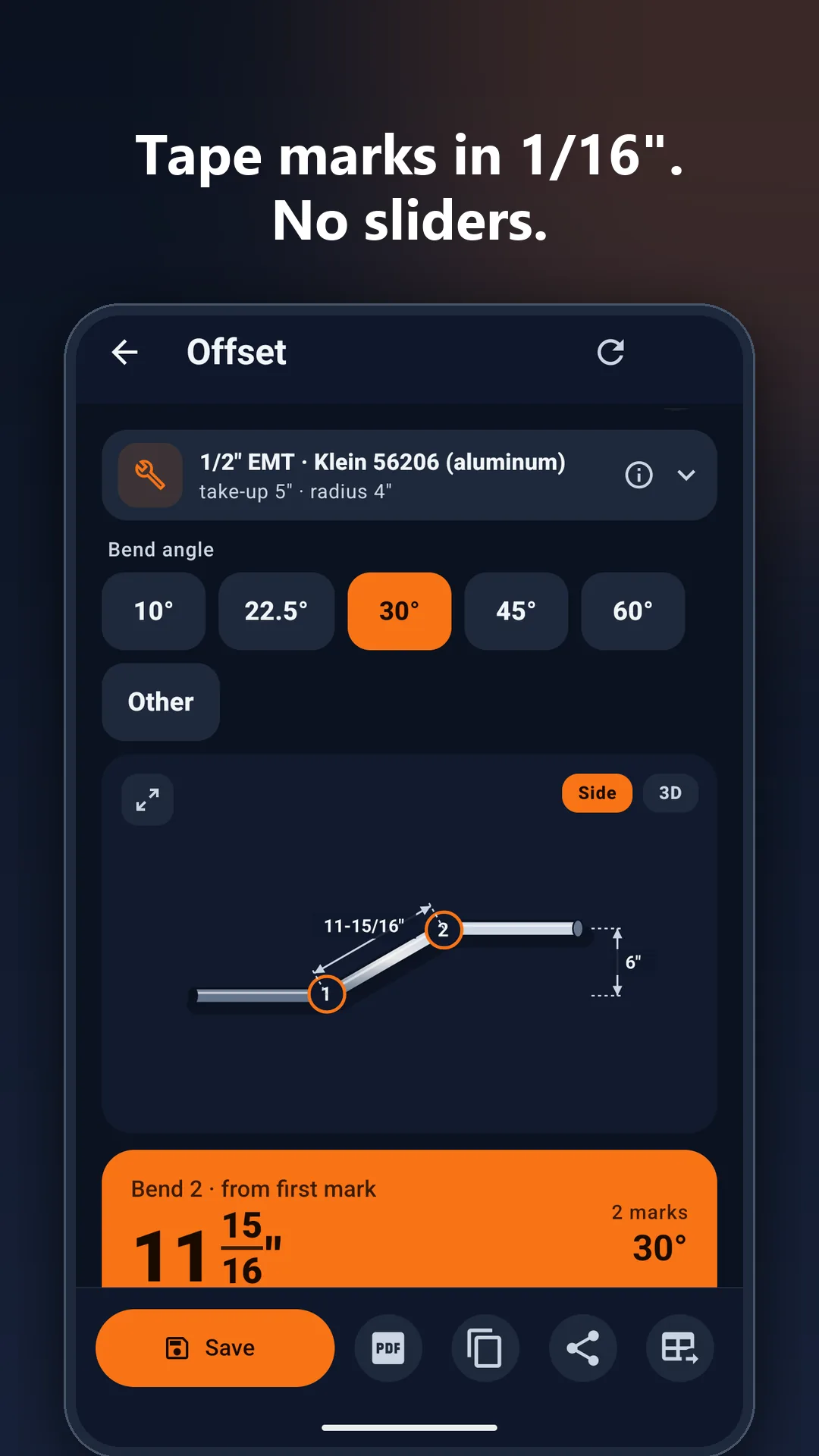
Exact math without doing the math
- Exact trigonometry, corrected for the radius of your shoe
- Or the sticker numbers your crew uses, one switch
- Any angle, including odd ones solved from what you measured
- Every step shown with the numbers filled in
$7.99 one time · no subscription · no ads · works offline
Keep going
Distance between bends and shrink for any offset depth and angle.
Open →Bending Multiplier ChartMultipliers, shrink per inch and a ready-made offset table from 1" to 24".
Open →3-Point SaddleCenter mark shift and outer marks to hop over a pipe.
Open →Bender Take-Up ChartTake-up (deduct), gain and radius for EMT and rigid hand benders.
Open →How to Bend ConduitA complete hand-bender guide from the first 90 to saddles, with the marks for each.
Open →