 Conduit Bending
Updated 2026-09-29
Short answer: measure to the center of the obstruction and add the shrink (45° saddle: 3/16" per inch of depth) to get the center mark. Put the outer marks depth × 2.5 on either side. Bend 45° on the center, then 22.5° on each outer mark back toward level.
What a 3-point saddle is
A 3-point saddle lifts the conduit over a small round obstruction, usually another pipe crossing the run, and brings it back down to the same line. It is three bends: one center bend over the obstruction and one on each side at half the angle.
How to bend a 3-point saddle
- Measure the depth: the outside diameter of the obstruction plus the clearance you want over it.
- Measure to the center of the obstruction from the end of the conduit, and add the shrink to get the center mark.
- Mark the outer bends depth × multiplier on each side of the center mark.
- Bend the center with the notch (teardrop) on the center mark to the center angle.
- Flip the bender, arrow on the first outer mark, and bend half the angle back toward level. Repeat on the other outer mark, keeping all bends in one plane.
3-point saddle multiplier and shrink chart
| Center / outer | Multiplier (center to outer mark) | Shrink per inch of depth |
|---|---|---|
| 45° / 22.5° | 2.5 | 3/16" |
| 60° / 30° | 2.0 | 1/4" |
| 90° / 45° | 1.4 | 3/8" |
Outer mark distance and center shift by depth
| Depth | 45° saddle | 60° saddle | 90° saddle |
|---|---|---|---|
| 1" | ± 2-1/2" / +3/16" | ± 2" / +1/4" | ± 1-3/8" / +3/8" |
| 1-1/2" | ± 3-3/4" / +5/16" | ± 3" / +3/8" | ± 2-1/8" / +9/16" |
| 2" | ± 5" / +3/8" | ± 4" / +1/2" | ± 2-13/16" / +3/4" |
| 2-1/2" | ± 6-1/4" / +1/2" | ± 5" / +5/8" | ± 3-1/2" / +15/16" |
| 3" | ± 7-1/2" / +9/16" | ± 6" / +3/4" | ± 4-3/16" / +1-1/8" |
| 4" | ± 10" / +3/4" | ± 8" / +1" | ± 5-5/8" / +1-1/2" |
| 5" | ± 12-1/2" / +15/16" | ± 10" / +1-1/4" | ± 7" / +1-7/8" |
| 6" | ± 15" / +1-1/8" | ± 12" / +1-1/2" | ± 8-3/8" / +2-1/4" |
First number: distance from the center mark to each outer mark. Second: how far the center mark moves out for shrink.
Worked example: 2" pipe, 36" from the end
A 2" pipe (2-3/8" outside diameter) crosses your run 36" from the end of the stick, and you want about 5/8" clearance: saddle depth 3".
- Shrink: 3 × 3/16" = 9/16". Center mark: 36" + 9/16" = 36-9/16".
- Outer spacing: 3 × 2.5 = 7-1/2". Outer marks: 29-1/16" and 44-1/16".
- Bend 45° on 36-9/16", then 22.5° on 29-1/16" and 44-1/16".
Measuring saddle depth
Depth is how far the bottom of your conduit must rise: the obstruction's height above the surface your conduit runs on, plus clearance. For a pipe lying on the same surface, that is its outside diameter. Remember that nominal pipe size is not the outside diameter: 2" rigid is about 2-3/8" OD, 1" EMT about 1-3/16".
Mistakes
- Putting the center bend on the obstruction measurement without adding shrink: the hump lands short of the pipe.
- Using the arrow for the center bend. The center bend uses the notch or center mark so the middle of the bend lands on the mark.
- Letting the conduit roll between bends, which twists the saddle.
- Using a 3-point saddle over something wide like a duct. Use a 4-point saddle for flat-topped obstructions.
Questions electricians ask
What is the multiplier for a 3-point saddle?
For a 45° center bend with 22.5° outer bends the multiplier is 2.5: the outer marks go 2.5 × the saddle depth either side of the center mark. For a 60° center it is 2.0, and for a 90° center it is 1.4.
How much shrink does a 3-point saddle have?
With a 45° center bend, move the center mark 3/16" farther out for each inch of saddle depth. A 3" saddle moves the center mark 9/16". The total conduit shrink is twice that.
Which mark do I bend first on a 3-point saddle?
The center bend first, using the rim notch (teardrop) or the center-of-bend mark on the bender, then flip the bender and make the two outer bends with the arrow, each at half the center angle.
Why use 45° and 22.5° for a saddle?
It keeps the hump low and the wire pull easy, and the multiplier of 2.5 is simple. A 60°/30° saddle is shorter end to end but pulls harder; a 90°/45° saddle is for tight spots only.
Does a 3-point saddle count toward the 360° limit?
Yes, every degree counts. A 45° saddle adds 45 + 22.5 + 22.5 = 90° to the run, the same as one 90.
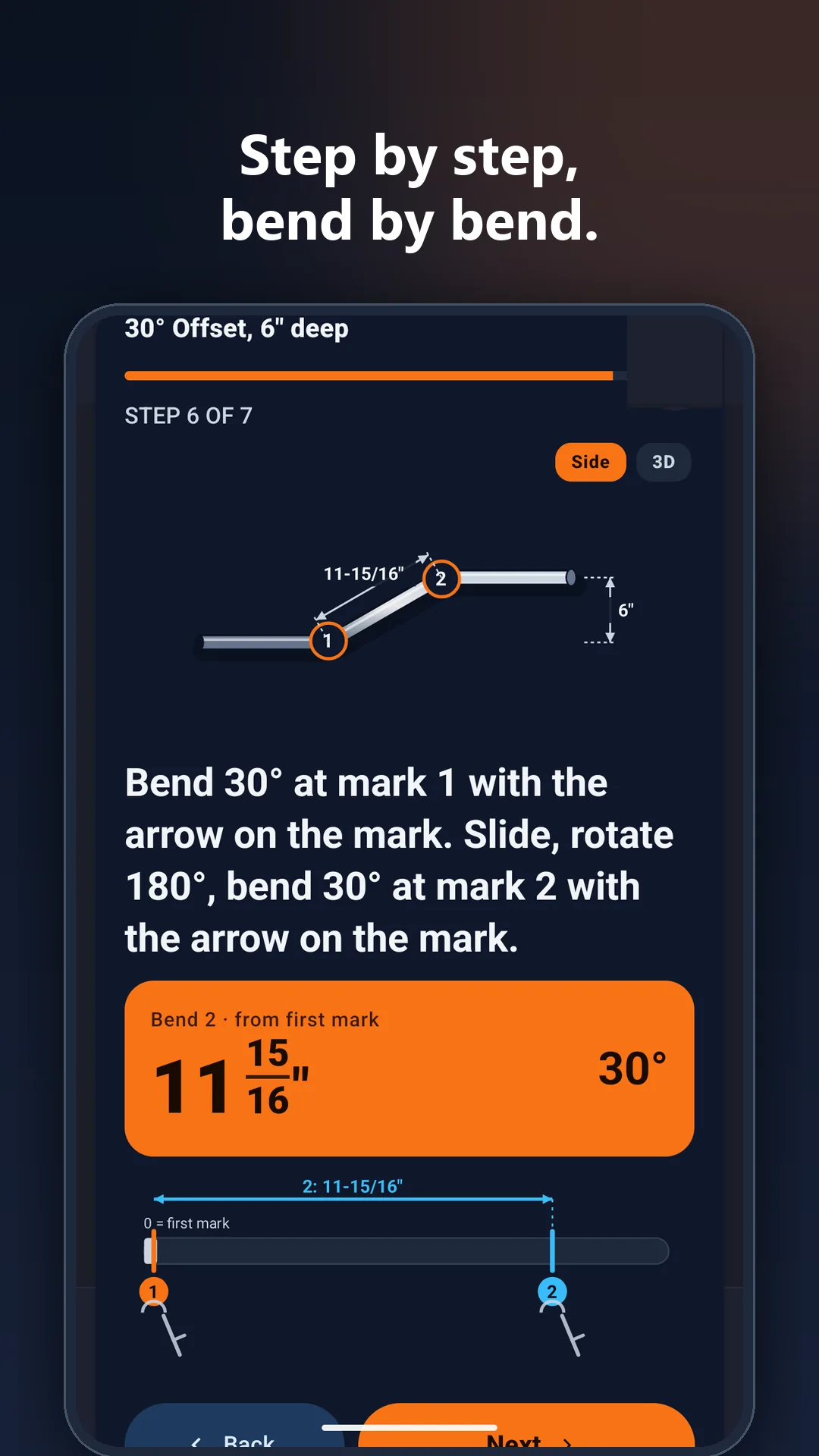
Saddles that fit your shoe
- Warns before you bend when a saddle is too tight for the bender radius
- Shows how much lower the hump really sits on a round shoe
- Guide mode: center bend first, then each outer bend, with the hook direction
- 4-point saddles with clearance, from the end of the pipe
$7.99 one time · no subscription · no ads · works offline
Related calculators and charts
Bend spacing and total shrink to clear a wide obstruction.
Open →OffsetDistance between bends and shrink for any offset depth and angle.
Open →Bending Multiplier ChartMultipliers, shrink per inch and a ready-made offset table from 1" to 24".
Open →How to Bend ConduitA complete hand-bender guide from the first 90 to saddles, with the marks for each.
Open →Conduit Bending FormulasEvery formula behind offsets, saddles, 90s and kicks, with where each number comes from.
Open →