By Blissom · Updated 2026-10-23

EMT (electrical metallic tubing) dimensions
| Trade size | OD in | OD mm | ID in | ID mm | Nominal wall in | Total area (100%) in² |
|---|---|---|---|---|---|---|
| 1/2" | 0.706 | 17.9 | 0.622 | 15.8 | 0.042 | 0.304 |
| 3/4" | 0.922 | 23.4 | 0.824 | 20.9 | 0.049 | 0.533 |
| 1" | 1.163 | 29.5 | 1.049 | 26.6 | 0.057 | 0.864 |
| 1-1/4" | 1.510 | 38.4 | 1.380 | 35.1 | 0.065 | 1.496 |
| 1-1/2" | 1.740 | 44.2 | 1.610 | 40.9 | 0.065 | 2.036 |
| 2" | 2.197 | 55.8 | 2.067 | 52.5 | 0.065 | 3.356 |
| 2-1/2" | 2.875 | 73.0 | 2.731 | 69.4 | 0.072 | 5.858 |
| 3" | 3.500 | 88.9 | 3.356 | 85.2 | 0.072 | 8.846 |
| 3-1/2" | 4.000 | 101.6 | 3.834 | 97.4 | 0.083 | 11.545 |
| 4" | 4.500 | 114.3 | 4.334 | 110.1 | 0.083 | 14.753 |
Rigid metal conduit (RMC) dimensions
| Trade size | OD in | OD mm | ID in | ID mm | Nominal wall in | Total area (100%) in² |
|---|---|---|---|---|---|---|
| 1/2" | 0.840 | 21.3 | 0.632 | 16.1 | 0.104 | 0.314 |
| 3/4" | 1.050 | 26.7 | 0.836 | 21.2 | 0.107 | 0.549 |
| 1" | 1.315 | 33.4 | 1.063 | 27.0 | 0.126 | 0.887 |
| 1-1/4" | 1.660 | 42.2 | 1.394 | 35.4 | 0.133 | 1.526 |
| 1-1/2" | 1.900 | 48.3 | 1.624 | 41.2 | 0.138 | 2.071 |
| 2" | 2.375 | 60.3 | 2.083 | 52.9 | 0.146 | 3.408 |
| 2-1/2" | 2.875 | 73.0 | 2.489 | 63.2 | 0.193 | 4.866 |
| 3" | 3.500 | 88.9 | 3.090 | 78.5 | 0.205 | 7.499 |
| 3-1/2" | 4.000 | 101.6 | 3.570 | 90.7 | 0.215 | 10.010 |
| 4" | 4.500 | 114.3 | 4.050 | 102.9 | 0.225 | 12.882 |
PVC conduit, Schedule 40 and 80
PVC conduit has the same outside diameter as rigid of the same trade size; Schedule 80 has a thicker wall and a smaller inside diameter.
| Trade size | OD in | OD mm | ID in | ID mm | Nominal wall in | Total area (100%) in² |
|---|---|---|---|---|---|---|
| 1/2" | 0.840 | 21.3 | 0.602 | 15.3 | 0.119 | 0.285 |
| 3/4" | 1.050 | 26.7 | 0.804 | 20.4 | 0.123 | 0.508 |
| 1" | 1.315 | 33.4 | 1.029 | 26.1 | 0.143 | 0.832 |
| 1-1/4" | 1.660 | 42.2 | 1.360 | 34.5 | 0.150 | 1.453 |
| 1-1/2" | 1.900 | 48.3 | 1.590 | 40.4 | 0.155 | 1.986 |
| 2" | 2.375 | 60.3 | 2.047 | 52.0 | 0.164 | 3.291 |
| 2-1/2" | 2.875 | 73.0 | 2.445 | 62.1 | 0.215 | 4.695 |
| 3" | 3.500 | 88.9 | 3.042 | 77.3 | 0.229 | 7.268 |
| 3-1/2" | 4.000 | 101.6 | 3.521 | 89.4 | 0.239 | 9.737 |
| 4" | 4.500 | 114.3 | 3.998 | 101.5 | 0.251 | 12.554 |
| Trade size | OD in | OD mm | ID in | ID mm | Nominal wall in | Total area (100%) in² |
|---|---|---|---|---|---|---|
| 1/2" | 0.840 | 21.3 | 0.526 | 13.4 | 0.157 | 0.217 |
| 3/4" | 1.050 | 26.7 | 0.722 | 18.3 | 0.164 | 0.409 |
| 1" | 1.315 | 33.4 | 0.936 | 23.8 | 0.190 | 0.688 |
| 1-1/4" | 1.660 | 42.2 | 1.255 | 31.9 | 0.203 | 1.237 |
| 1-1/2" | 1.900 | 48.3 | 1.476 | 37.5 | 0.212 | 1.711 |
| 2" | 2.375 | 60.3 | 1.913 | 48.6 | 0.231 | 2.874 |
| 2-1/2" | 2.875 | 73.0 | 2.290 | 58.2 | 0.292 | 4.119 |
| 3" | 3.500 | 88.9 | 2.864 | 72.7 | 0.318 | 6.442 |
| 3-1/2" | 4.000 | 101.6 | 3.326 | 84.5 | 0.337 | 8.688 |
| 4" | 4.500 | 114.3 | 3.786 | 96.2 | 0.357 | 11.258 |
Outside diameters are the standard manufactured sizes; inside diameters are derived from the NEC Chapter 9 Table 4 internal areas (d = √(4A ÷ π)), the values used for conduit fill. Wall values are nominal, half the difference between OD and ID, not guaranteed minimum wall thicknesses (check the maker's specification when that matters), and total area is the whole inside, not the area conductors may fill (40% for three or more).
Identifying conduit on site
- Measure the outside diameter with calipers or a tape and match it to the tables: 0.706" is 1/2" EMT, 0.840" is 1/2" rigid or PVC. The outside diameter identifies the trade size but not always the type, since EMT, rigid and PVC share diameters at some sizes, so check the material, markings, wall and fittings too.
- EMT has no threads and joins with set-screw or compression fittings; rigid and IMC are threaded; PVC is usually gray and solvent-welded (glued).
- At trade sizes 1/2" through 2", rigid has a larger outside diameter than EMT of the same trade size; at 2-1/2" through 4" their nominal outside diameters are the same. 1/2" rigid (0.840") sits between 1/2" and 3/4" EMT (0.706" and 0.922"), which is why a 3/4" EMT shoe can bend 1/2" rigid when its maker rates it for that.
Worked example: why 1/2" rigid needs a 3/4" EMT bender
1/2" EMT measures 0.706" outside, 1/2" rigid 0.840". The rigid is 0.134" larger and will not seat in the 1/2" EMT shoe, but it fits the 3/4" EMT shoe, made for 0.922" tube. That is why rigid bends on the next EMT size up when the shoe is rated for rigid, with that shoe's take-up: 6" for 1/2" rigid on a Klein 3/4" shoe.
Why the outside diameter matters for bending
For a pipe resting on the same surface as your conduit, saddle depth is its outside diameter plus clearance, not its trade size: a 2" rigid conduit needs about 2-3/8" of depth before clearance. And when you measure the legs of a 90 to its outside, the gain grows by one conduit diameter, which is why the back-to-back calculator and the deduct chart list both.
Sources: NEC 2023: Chapter 9, Table 4 (internal areas); ANSI C80.3 (EMT) and C80.1 (rigid) nominal outside diameters; UL 651 / NEMA TC 2 (PVC conduit). Method.
Questions electricians ask
What is the outside diameter of 3/4 EMT?
3/4" EMT is 0.922" (23.4 mm) outside and about 0.824" (20.9 mm) inside.
Is 1/2 inch conduit actually 1/2 inch?
No. Trade sizes are nominal. 1/2" EMT measures 0.706" outside and 0.622" inside; 1/2" rigid and PVC measure 0.840" outside.
Do EMT and rigid use the same fittings?
No. EMT uses set-screw or compression fittings and rigid is threaded. Their outside diameters differ at the smaller trade sizes but match at 2-1/2" through 4", so a matching diameter does not make a fitting compatible: use fittings listed for the conduit type. A 3/4" EMT hand bender rated for it bends 1/2" rigid because their sizes are close.
The right size, already in every bend
- Conduit OD is built into saddle depth and back-to-back gain
- EMT and rigid on the correct shoe
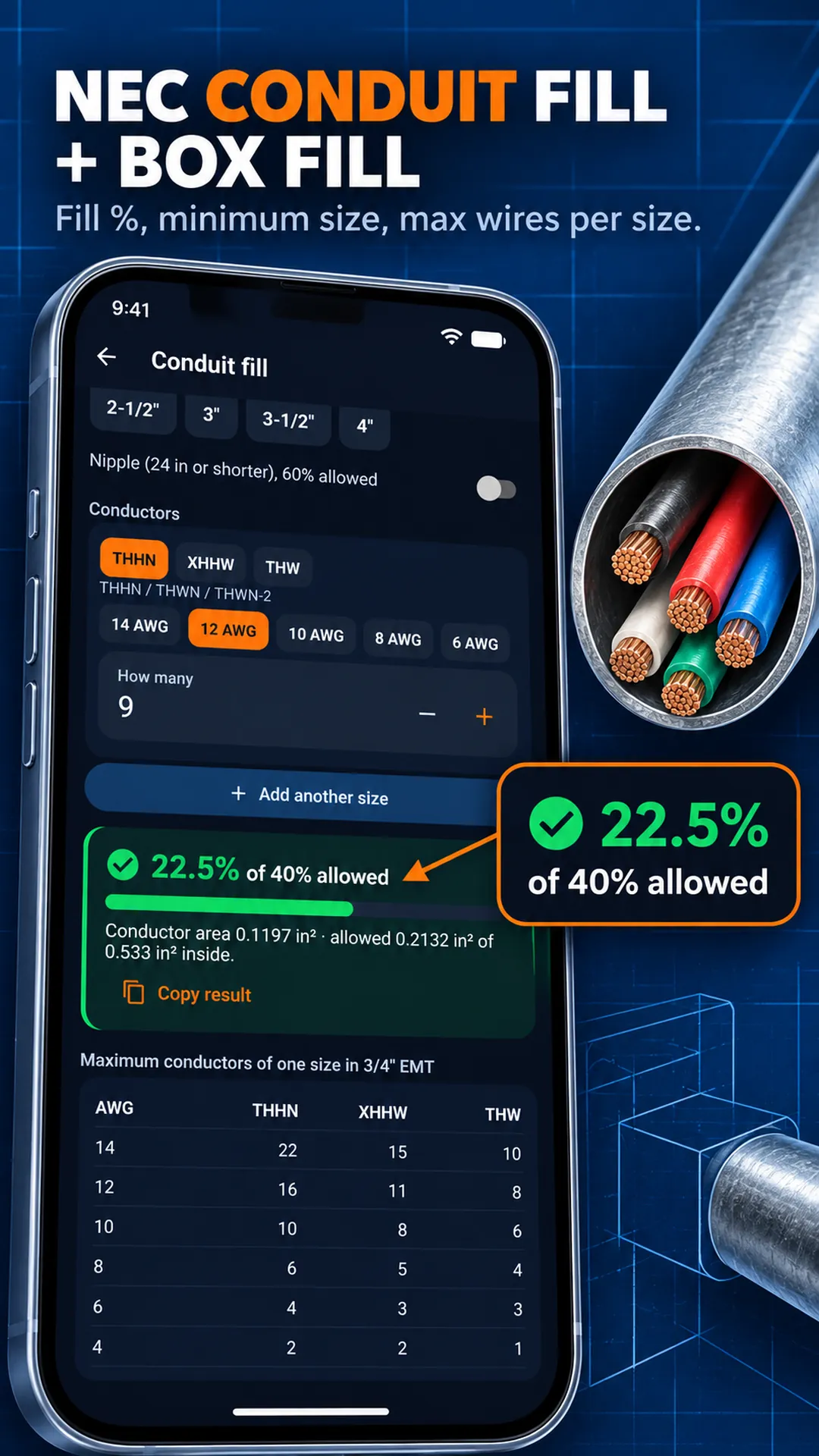
- Conduit fill for every trade size and raceway
- Offline, in inches or millimeters
Android only. There is no iPhone version yet; the free calculators on this site work on any phone.
$7.99 one time · no subscription · no ads · works offline