 Conduit Bending
Updated 2026-09-29
Measurements and numbers
- Take-up (deduct)
- The amount subtracted from a stub height to find where the bender arrow goes for a 90°. It is cast into the shoe: 5" for 1/2" EMT, 6" for 3/4", 8" for 1", 11" for 1-1/4". More →
- Gain
- The conduit a bend saves compared with two straight legs meeting at a sharp corner. For a 90° on centerline radius R it is 2R − πR/2, about 0.43 × R; measured to the back of the 90, add one conduit diameter. Used when cutting a piece with 90s to length. More →
- Shrink
- How much shorter a run becomes because of an offset or saddle, since part of the conduit travels diagonally. At 30° it is about 1/4" per inch of offset depth; exactly depth × tan(θ ÷ 2). Added to the measurement when bending toward an obstruction. More →
- Multiplier
- The number that turns offset depth into the distance between bends: 10° = 6, 22.5° = 2.6, 30° = 2, 45° = 1.4, 60° = 1.2. It is the cosecant (1 ÷ sine) of the bend angle. More →
- Depth (offset depth)
- How far an offset or saddle moves the conduit, measured square to the run.
- Rise
- The height a kick or stub must reach, measured square to the surface the conduit runs on. More →
- Travel
- The length of conduit between bend centers, or from a bend to where the rise is reached, measured along the pipe.
- Run
- The horizontal distance a bend covers, measured along the floor or wall rather than along the pipe.
- Developed length
- The length of conduit inside a bend (the arc). For a 90° on radius R it is π × R ÷ 2.
- Centerline radius
- The radius of a bend measured to the middle of the conduit. Hand-bender shoes are built to the NEC Chapter 9 Table 2 minimums: 4" for 1/2" EMT, 4-1/2" for 3/4", 5-3/4" for 1".
- True offset
- The actual depth of a rolling offset: √(horizontal² + vertical²). More →
Marks on the bender
- Arrow
- The main reference mark on a hand bender, used for stubs, offsets and kicks. For a stub-up the arrow goes on the mark with the hook facing the end.
- Star point
- A mark cast into the shoe that shows the back of a 90° when the bender is reversed. Used for back-to-back 90s without subtracting the take-up. More →
- Rim notch (teardrop)
- The mark for the center of a bend, used for the center bend of a 3-point saddle. More →
- Degree marks
- Sight lines on the shoe at 10°, 22.5°, 30°, 45° and 60°. The bend has reached the angle when the conduit lines up with the mark.
- Hook
- The end of the shoe that grips the conduit. Its direction relative to the mark decides where the bend lands.
Bends
- Stub-up (90° stub)
- A 90° bend that turns the conduit up out of a floor or wall to an exact height. More →
- Offset
- Two equal bends in opposite directions that move the run over an obstruction or off a surface and bring it back parallel. More →
- Box offset
- A shallow offset, about 1/2", that lets conduit enter a box or fitting flush with the surface. Usually two 10° bends, marks about 3" apart.
- Kick
- A single bend that angles the conduit away from a surface. More →
- Kicked 90
- A 90° stub with a small kick bent first so the stub stands off the wall.
- 3-point saddle
- Three bends (a center bend and two at half its angle) that lift the conduit over a round obstruction such as a pipe. More →
- 4-point saddle
- Two offsets, one up and one back down, with a flat top, used to clear a wide obstruction such as a duct. More →
- Back-to-back 90s
- Two 90s in one piece making a U, with an exact distance between the outsides (backs) of the two bends. More →
- Rolling offset
- An offset that moves the run over and up at the same time, bent in a plane rolled between horizontal and vertical. More →
- Parallel offsets
- The same offset bent in several conduits on a rack, with each conduit's marks moved spacing × tan(θ ÷ 2) so the runs stay evenly spaced.
- Segmented bend (shots)
- A large-radius bend made from several small bends called shots. More →
- Concentric bends
- Nested 90s on a rack, each conduit on a radius larger than the one inside it by the center-to-center spacing.
Problems and technique
- Dog-leg
- An offset or kicked 90 whose bends are not in the same plane, so the conduit twists sideways. Caused by not rotating exactly 180° between bends.
- Spring-back
- The few degrees a bend relaxes when the handle is released. EMT springs back about 2°, so bend slightly past the angle.
- Kink
- A flattened or buckled bend. Kinked conduit reduces the internal diameter, which the NEC does not allow (for EMT, 358.24), and must be cut out.
- Hickey
- A tool for bending rigid conduit in place, and also a fitting used to hang fixtures.
Code and conduit
- 360° rule
- The NEC limit of 360° of bends in total between pull points (for EMT, 358.26).
- Conduit fill
- The share of a raceway's internal area the conductors take up. NEC Chapter 9 allows 53% for one conductor, 31% for two and 40% for three or more. More →
- Nipple
- A raceway 24" or shorter between boxes or enclosures; it may be filled to 60%.
- Box fill
- The volume a box needs for its conductors, devices, clamps and grounds, per NEC 314.16. More →
- EMT
- Electrical metallic tubing: thin-wall steel conduit joined with set-screw or compression fittings, bent with hand benders.
- RMC and IMC
- Rigid metal conduit and intermediate metal conduit: threaded, thicker-walled steel conduit. On hand benders, the next EMT size up bends it (a 3/4" EMT shoe bends 1/2" rigid).
- PVC
- Rigid PVC conduit, Schedule 40 or 80. It is bent with heat (a hot box or heat blanket), not with a hand bender.
The terms, doing the work
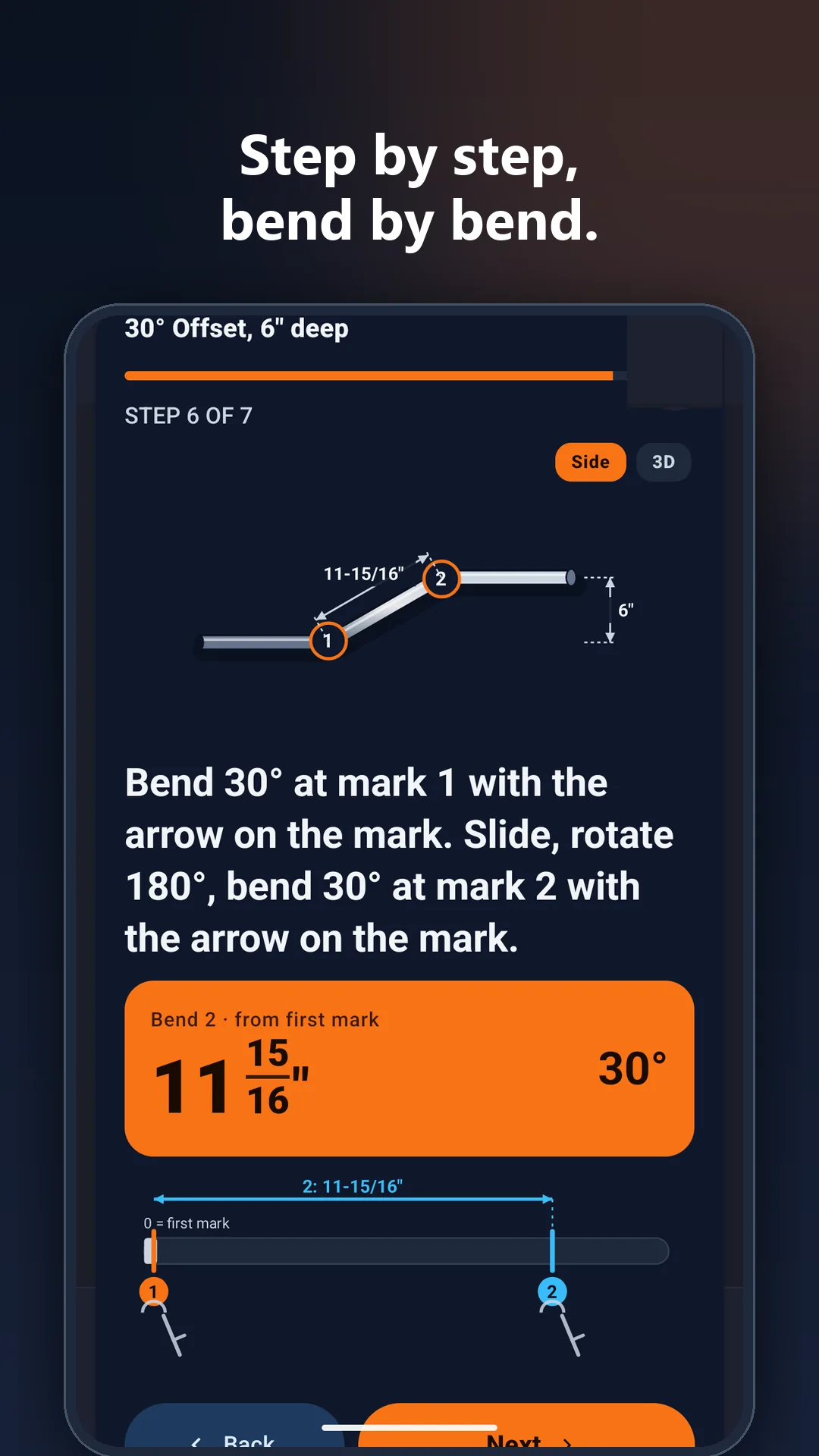
- Take-up, gain and radius for your exact shoe
- Shrink and multipliers applied for you, at any angle
- Guide mode explains each step as you bend
- Offline, in five languages
Android appGet it on Google Play
Scan with your phone camera to open it on Google Play.
$7.99 one time · no subscription · no ads · works offline
Keep going
How to Bend Conduit
A complete hand-bender guide from the first 90 to saddles, with the marks for each.
Open →Conduit Bending FormulasEvery formula behind offsets, saddles, 90s and kicks, with where each number comes from.
Open →Bending Multiplier ChartMultipliers, shrink per inch and a ready-made offset table from 1" to 24".
Open →Bender Take-Up ChartTake-up (deduct), gain and radius for EMT and rigid hand benders.
Open →OffsetDistance between bends and shrink for any offset depth and angle.
Open →