 Conduit Bending
Updated 2026-09-29
Short answer: travel = rise × multiplier (22.5° = 2.6, 30° = 2, 45° = 1.4). Run = rise ÷ tan(angle). Shrink = rise × tan(angle ÷ 2). To find the angle from a rise and run: atan(rise ÷ run).
What a kick is
A kick is a single bend, usually 10° to 45°, that angles the conduit away from the surface it runs on: out of a floor, off a wall, or into a box set at a different depth.
Kick table per inch of rise
| Angle | Travel per inch (sticker) | Exact | Run per inch | Shrink per inch |
|---|---|---|---|---|
| 10° | 6.00 | 5.759 | 5.671 | 1/16" |
| 15° | 3.86 | 3.864 | 3.732 | 1/8" |
| 22.5° | 2.60 | 2.613 | 2.414 | 3/16" |
| 30° | 2.00 | 2.000 | 1.732 | 1/4" |
| 45° | 1.40 | 1.414 | 1.000 | 3/8" |
Finding the kick angle from rise and run
When the kick has to hit a point (a box, a hole), you know the rise and the run, not the angle. The angle is the arctangent of rise over run.
- 3" rise over 17" run: atan(0.176) ≈ 10°.
- 3" rise over 7-1/4" run: atan(0.414) ≈ 22.5°.
- 3" rise over 3" run: 45°.
Odd angles are fine: bend to the calculated angle with a protractor or level. See the formulas for the full derivation.
Kicked 90s
For a kicked 90, bend the kick first, then lay the conduit on the floor with the kick pointing up at its angle and bend the 90 so the stub comes off the same side. Measure the stub from the kick with the conduit held at the kick angle, or the stub comes out long.
Mistakes
- Measuring the rise along the conduit instead of square to the surface.
- Bending a kicked 90 in two different planes, which throws the stub sideways ("dog-leg").
- Forgetting that a kick moves the end of the run: allow for the shrink when cutting to length.
Questions electricians ask
How do you calculate a kick in conduit?
Multiply the rise by the multiplier for the angle to get the travel along the conduit (22.5° = 2.6, 30° = 2). The horizontal run is rise ÷ tan(angle), and the kick shrinks the conduit by rise × tan(angle ÷ 2).
What is the difference between a kick and an offset?
A kick is one bend that changes the direction of the run; an offset is two equal bends that move the run over and bring it back parallel. A kick is often the first bend of a kicked 90, lifting the conduit off a wall before it turns up.
How do I find the angle of a kick?
Divide the rise by the horizontal run and take the arctangent: angle = atan(rise ÷ run). A 3" rise over a 5-3/16" run is 30°. The app solves this for you.
What is a kicked 90?
A 90° stub with a small kick bent first so the stub stands off the wall, for example to clear a baseplate or line up with a box. Bend the kick, then measure and bend the 90 with the conduit held at the kick angle.
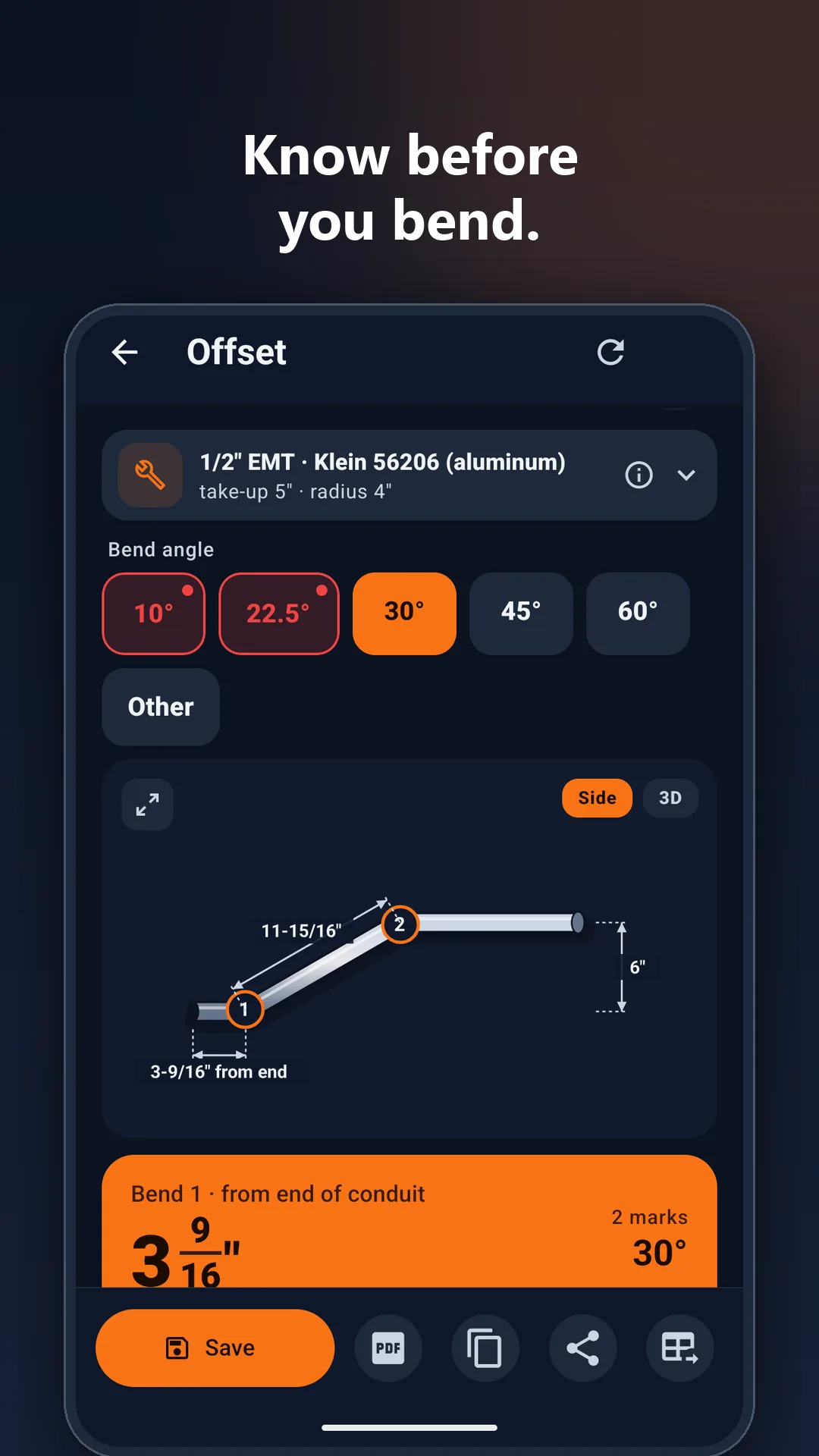
Kicks, solved both ways
- Enter rise and run and get the exact kick angle
- Parallel kicks with the adjustment for each conduit in a rack
- Level screen that buzzes when you hit the angle
- Every bend type, offline, saved as jobs
$7.99 one time · no subscription · no ads · works offline
Related calculators and charts
Distance between bends and shrink for any offset depth and angle.
Open →90° Stub-UpWhere to put the arrow for a stub of exact height, by bender size.
Open →Rolling OffsetTrue offset and roll angle when the run moves over and up at once.
Open →Bending Multiplier ChartMultipliers, shrink per inch and a ready-made offset table from 1" to 24".
Open →Conduit Bending FormulasEvery formula behind offsets, saddles, 90s and kicks, with where each number comes from.
Open →