 Conduit Bending
Updated 2026-09-29
The test
What is the take-up (deduct) on a standard 1/2" EMT hand bender?
You need a 12" stub-up on 3/4" EMT. Where does the arrow go?
What is the multiplier for a 30° offset?
How much does a 30° offset shrink per inch of depth?
A 4" offset with 30° bends: how far apart are the marks, and what is the shrink?
A 6" offset with 45° bends, using the bender multiplier. Distance between the marks?
What is the multiplier for 22.5°?
When you bend an offset toward an obstruction, what do you do with the shrink?
Between the two bends of an offset, how far do you rotate the conduit?
In a standard 3-point saddle with a 45° center bend, what are the two outer bends?
For a 45° 3-point saddle 2" deep, how far is each outer mark from the center mark?
Which mark on the bender is used for the center bend of a 3-point saddle?
What is the star point on a hand bender used for?
A rolling offset moves 6" horizontally and 8" vertically. What is the true offset?
A kick must rise 3" using a 30° bend. How far along the conduit does it travel?
What is the maximum total of bends allowed between pull points?
A 3/4" EMT hand bender can also bend which size of rigid conduit?
What is the maximum conduit fill for three or more conductors?
How many #12 THHN conductors fit in 1/2" EMT?
In box fill, how many allowances does a receptacle (one device yoke) count as?
Answer key
Show all 20 answers with explanations
- What is the take-up (deduct) on a standard 1/2" EMT hand bender? 5". 1/2" EMT is 5". 3/4" is 6", 1" is 8" and 1-1/4" is 11".
- You need a 12" stub-up on 3/4" EMT. Where does the arrow go? 6" from the end. Stub height minus take-up: 12" − 6" = 6".
- What is the multiplier for a 30° offset? 2. 1 ÷ sin 30° = 2. The distance between bends is twice the offset depth.
- How much does a 30° offset shrink per inch of depth? 1/4". About 1/4" per inch (exactly tan 15° = 0.268).
- A 4" offset with 30° bends: how far apart are the marks, and what is the shrink? 8" apart, 1" shrink. 4 × 2 = 8" between bends; 4 × 1/4" = 1" of shrink.
- A 6" offset with 45° bends, using the bender multiplier. Distance between the marks? 8-3/8". 6 × 1.4 = 8.4", about 8-3/8".
- What is the multiplier for 22.5°? 2.6. 1 ÷ sin 22.5° = 2.613, used as 2.6.
- When you bend an offset toward an obstruction, what do you do with the shrink? Add it to the measurement. The offset uses up conduit, so the marks move out by the shrink: add it to your measurement to the obstruction.
- Between the two bends of an offset, how far do you rotate the conduit? 180°. Exactly 180°, so both bends lie in one plane. Anything else causes a dog-leg.
- In a standard 3-point saddle with a 45° center bend, what are the two outer bends? 22.5° each. Each outer bend is half the center bend: 22.5°.
- For a 45° 3-point saddle 2" deep, how far is each outer mark from the center mark? 5". Depth × 2.5 = 2 × 2.5 = 5" on each side.
- Which mark on the bender is used for the center bend of a 3-point saddle? The rim notch (teardrop). The notch or teardrop marks the middle of the bend, so the center of the saddle lands on the mark.
- What is the star point on a hand bender used for? The back of a 90, for back-to-back bends. The star shows the back of a 90 with the bender reversed, so back-to-back bends can be marked without subtracting the take-up.
- A rolling offset moves 6" horizontally and 8" vertically. What is the true offset? 10". √(6² + 8²) = √100 = 10".
- A kick must rise 3" using a 30° bend. How far along the conduit does it travel? 6". Travel = rise × multiplier = 3 × 2 = 6".
- What is the maximum total of bends allowed between pull points? 360°. The NEC limits bends between pull points to 360° in total (358.26 for EMT).
- A 3/4" EMT hand bender can also bend which size of rigid conduit? 1/2". 1/2" rigid, with the same take-up. A 1" EMT shoe bends 3/4" rigid.
- What is the maximum conduit fill for three or more conductors? 40%. 40% (NEC Chapter 9, Table 1). One conductor 53%, two 31%, nipples 60%.
- How many #12 THHN conductors fit in 1/2" EMT? 9. Nine. 3/4" EMT holds 16.
- In box fill, how many allowances does a receptacle (one device yoke) count as? Two. Two allowances, based on the largest conductor connected to the device (314.16(B)(4)).
How to study conduit bending
- Memorize four numbers per angle: the multiplier (30° = 2, 45° = 1.4, 22.5° = 2.6, 10° = 6) and the shrink per inch (1/4", 3/8", 3/16", 1/16").
- Know your bender's take-up by heart: 5, 6, 8, 11 for 1/2" to 1-1/4" EMT.
- Bend scrap: a 90, an offset, a saddle. Measure the results and compare them with the calculators here.
- Learn why the numbers work (the formulas); test questions often change the angle to see if you can work it out.
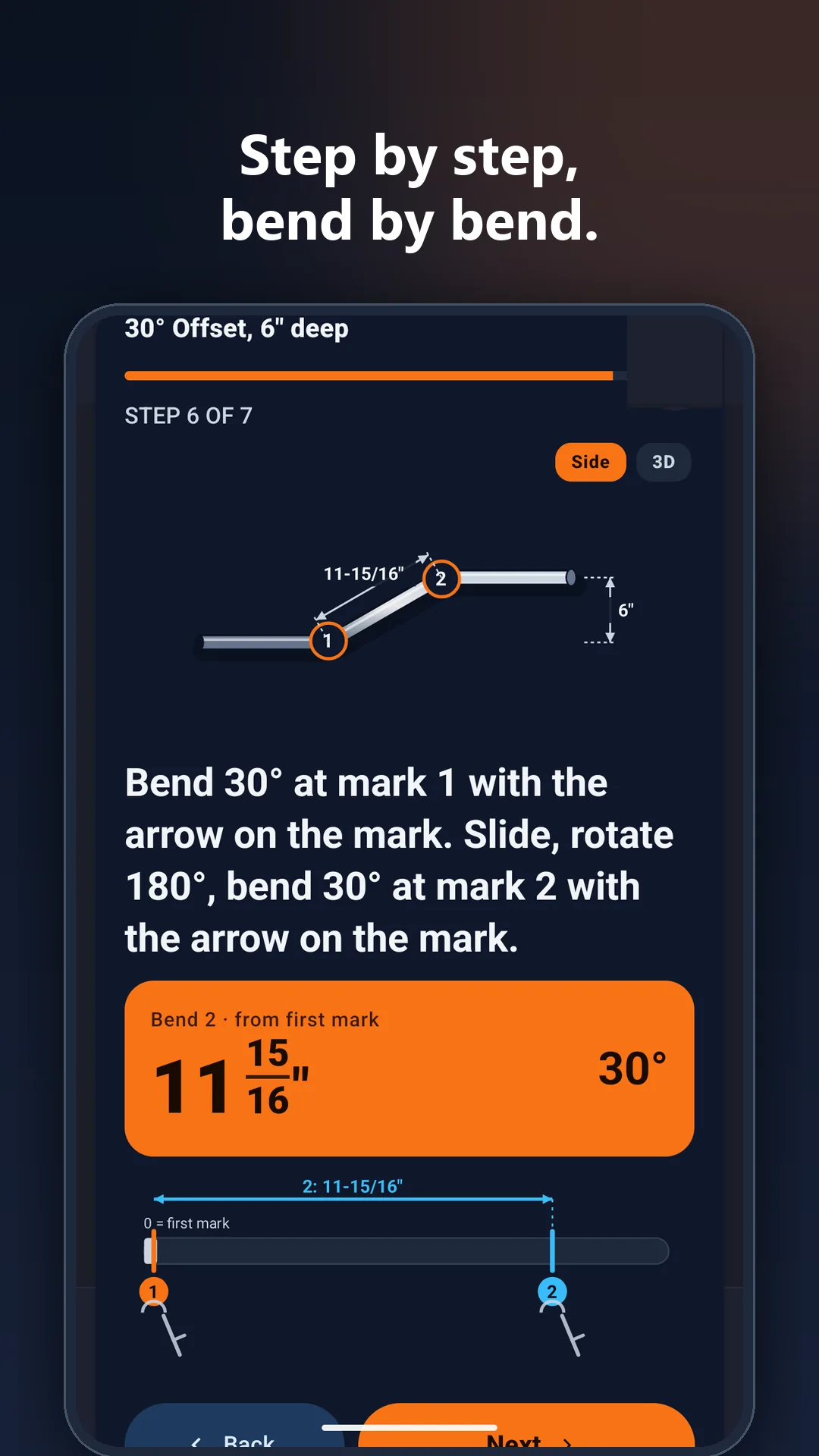
Practise on real pipe with guide mode
- Every bend walked through one step per screen
- The drawing and the tape marks for each step
- Check your hand math against the exact answer
- Offline in the shop and on site
$7.99 one time · no subscription · no ads · works offline
Keep going
A complete hand-bender guide from the first 90 to saddles, with the marks for each.
Open →Conduit Bending FormulasEvery formula behind offsets, saddles, 90s and kicks, with where each number comes from.
Open →Conduit Bending TermsTake-up, gain, shrink, star point, dog-leg and 35 more terms, each with its numbers.
Open →Bending Multiplier ChartMultipliers, shrink per inch and a ready-made offset table from 1" to 24".
Open →OffsetDistance between bends and shrink for any offset depth and angle.
Open →