 Conduit Bending
Updated 2026-09-29
Short answer: subtract your bender's take-up from the stub height, mark that distance from the end, put the arrow on the mark with the hook facing the end, and bend to 90°. Take-up: 1/2" EMT 5", 3/4" EMT 6", 1" EMT 8", 1-1/4" EMT 11".
How to bend a 90° stub-up
- Measure the stub height from the floor (the back of the finished 90) to where the end of the pipe must be.
- Subtract the take-up for your bender and mark that distance from the end of the conduit.
- Set the bender with the hook toward the end and the arrow on the mark. Keep the conduit on a flat, hard floor.
- Bend with foot pressure on the heel of the bender, keeping the conduit on the floor, until the stub is plumb, then check it with a level.
Take-up chart for hand benders
| EMT size | Take-up | Also bends rigid | Typical radius |
|---|---|---|---|
| 1/2" | 5" | — | 4" |
| 3/4" | 6" | 1/2" | 4-1/2" |
| 1" | 8" | 3/4" | 5-3/4" |
| 1-1/4" | 11" | 1" | 7-1/4" |
These are the values cast into the common hand benders from the major makers. A 3/4" EMT shoe also bends 1/2" rigid with the same take-up, a 1" EMT shoe bends 3/4" rigid and a 1-1/4" EMT shoe bends 1" rigid. The bender deduct chart adds gain and setback.
Worked examples
- 1/2" EMT, 12" stub: 12 − 5 = 7". Arrow on 7".
- 3/4" EMT, 18" stub into a panel: 18 − 6 = 12".
- 1" EMT, 24" stub: 24 − 8 = 16".
- 1-1/4" EMT, 30" stub: 30 − 11 = 19".
The shortest stub you can bend
The bender needs a few inches of straight pipe past the mark to grip, so the shortest practical stub is roughly the take-up plus 2": about 7" on 1/2" EMT. For a shorter stub, bend a longer one and cut it to length.
Spring-back and checking for 90°
EMT springs back a degree or two when you release the handle, so bend slightly past 90° (about 2°) and check the stub with a torpedo level on the vertical leg. Checking the horizontal leg too catches a stub that leans. Rigid springs back more than EMT.
Common mistakes
- Using the star or the notch instead of the arrow. Stubs use the arrow.
- Hook facing the wrong way: the stub comes out the take-up too long (or short).
- Measuring stub height to the top of the horizontal pipe instead of the floor.
- Lifting the conduit off the floor while bending, which "kinks" the bend or changes the stub length.
Questions electricians ask
What is the take-up for 3/4 EMT?
The take-up (deduct) on a 3/4" EMT hand bender is 6". For a 14" stub, mark 8" from the end. 1/2" EMT is 5", 1" EMT is 8" and 1-1/4" EMT is 11". Always check the number cast into your shoe; some models differ.
Is take-up the same as deduct?
Yes. Take-up and deduct are two names for the same number: how much shorter than the stub height the mark goes, because the bend itself uses up conduit before the pipe turns vertical.
Which way does the hook face for a stub-up?
The hook faces the end you measured from, the end that will become the stub. The arrow goes on the mark, then you pull the handle to 90°.
What is the difference between take-up and gain?
Take-up is used for marking: stub height minus take-up is the mark. Gain is the conduit a 90 saves compared with two legs meeting at a sharp corner; you subtract it when working out how long a piece with 90s needs to be.
How short a stub can I bend?
Roughly the take-up plus a couple of inches for the shoe to grip: about 7" on 1/2" EMT, 8" on 3/4" and 10" on 1". Shorter stubs need an offset-and-cut trick, or bend long and cut the stub to length.
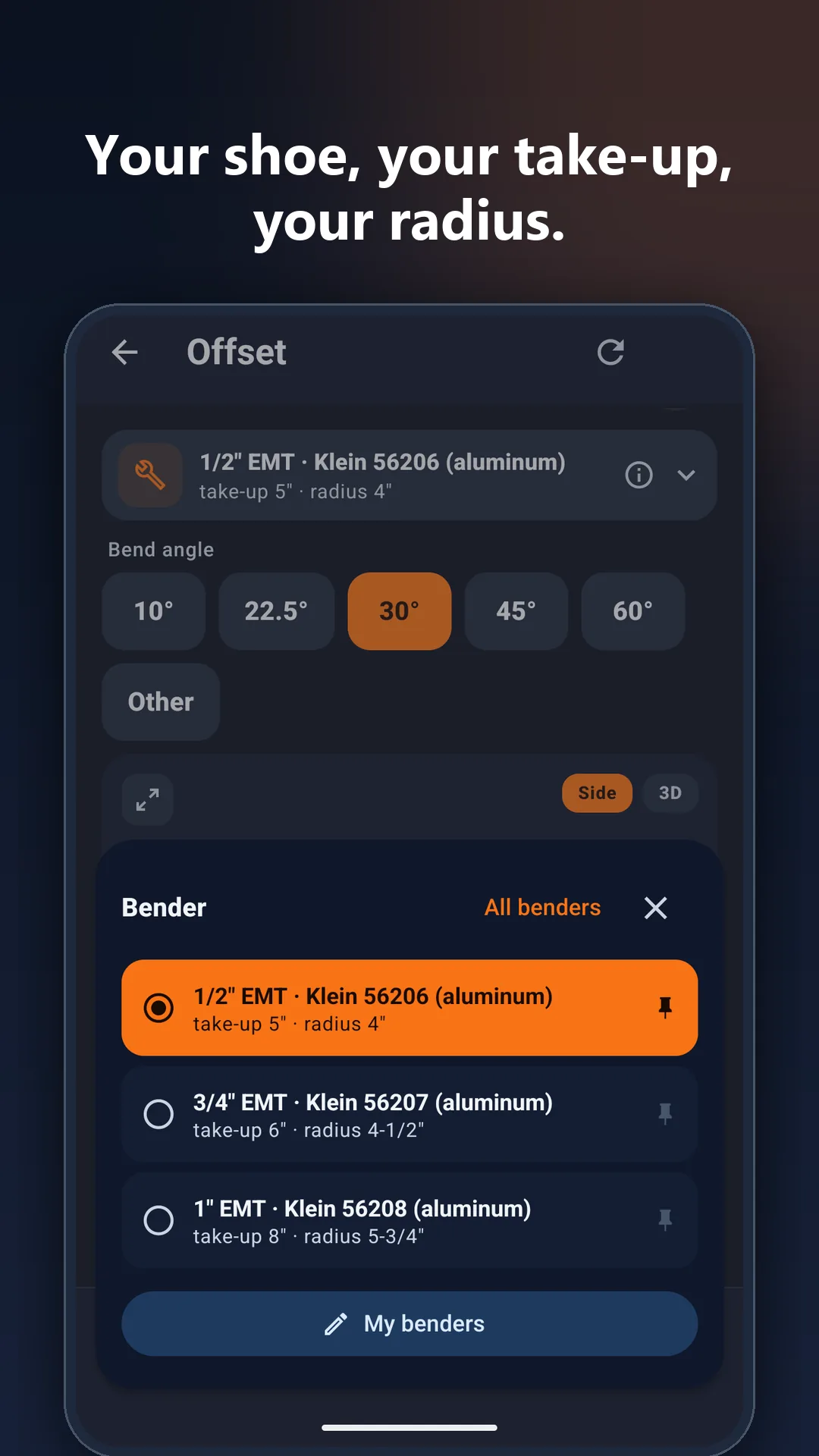
Every shoe you own, already set up
- Klein, Greenlee, IDEAL, Milwaukee, Southwire and Gardner Bender shoes, EMT and rigid
- Your own take-up and radius, pinned so the right shoe is always selected
- Back-to-back 90s and the conduit length a U needs
- Level screen that buzzes at 90°
$7.99 one time · no subscription · no ads · works offline
Related calculators and charts
Star-point and arrow marks for a U with an exact width.
Open →Bender Take-Up ChartTake-up (deduct), gain and radius for EMT and rigid hand benders.
Open →KickTravel and shrink for a single bend, or the angle from rise and run.
Open →OffsetDistance between bends and shrink for any offset depth and angle.
Open →How to Bend ConduitA complete hand-bender guide from the first 90 to saddles, with the marks for each.
Open →