 Conduit Bending
Updated 2026-09-29
Short answer: bends 1–2 and 3–4 are offsets of the saddle depth (30°: marks 2 × depth apart). Bends 2 and 3 are the width of the obstruction plus clearance apart. Bend 1 and 2 as an offset up, then 3 and 4 as the same offset back down. Total shrink at 30° is 1/2" per inch of depth.
How to lay out a 4-point saddle
- Measure the depth (height of the obstruction plus clearance) and the width along the run, plus the clearance you want on each side.
- Find the offset spacing: depth × multiplier (30° = 2, 22.5° = 2.6, 45° = 1.4).
- Mark bend 2 where the conduit must be up to full height, just before the obstruction (measure to the near edge minus clearance, plus the offset shrink).
- Mark bend 1 one offset spacing before bend 2, bend 3 the width plus both clearances after bend 2, and bend 4 one offset spacing after bend 3.
- Bend 1 and 2 as a normal offset. Then bend 3 and 4 as the mirror offset coming back down, all in the same plane.
Worked example: 3" deep, 8" wide duct at 30°
- Offset spacing: 3 × 2 = 6". Shrink per side: 3 × 1/4" = 3/4".
- The near edge of the duct is 30" from the end and you want 1" clearance: bend 2 at 30 − 1 + 3/4 = 29-3/4".
- Bend 1: 29-3/4 − 6 = 23-3/4".
- Bend 3: 29-3/4 + 8 + 2 = 39-3/4". Bend 4: 39-3/4 + 6 = 45-3/4".
- Total shrink: 1-1/2".
Handling shrink
Only the shrink of the first offset moves the marks toward the obstruction. The second offset shrinks the conduit after the saddle, which matters when the far end has to land on something (a box, a coupling), so take the total shrink into account when you cut the stick.
3-point or 4-point?
A 3-point saddle is faster (three bends) and fine over a round pipe. Anything with a flat top or wider than a few inches needs a 4-point saddle, or the hump will sit on the obstruction.
Mistakes
- Forgetting the clearance on the far side, so bend 3 lands on the obstruction.
- Bending 3 and 4 in the wrong direction: the second offset must come back down to the original line.
- Unequal angles, which leave the far end higher or lower than the start.
Questions electricians ask
How do you calculate a 4-point saddle?
Treat it as two offsets of the same depth. The distance between bends 1 and 2 (and between 3 and 4) is depth × the offset multiplier; bends 2 and 3 are the obstruction width plus clearance apart. Each side shrinks like an offset, so the total shrink is twice the offset shrink.
What angle should I use for a 4-point saddle?
30° is most common. 22.5° works for shallow saddles and pulls easier; 45° keeps the saddle short when space is tight. All four bends must be the same angle.
How much does a 4-point saddle shrink?
At 30°, 1/4" per inch of depth for each side, so 1/2" per inch in total. A 3" saddle at 30° shrinks 1-1/2" overall.
When should I use a 4-point saddle instead of a 3-point?
Use a 4-point saddle when the obstruction is wide or flat-topped, like a duct, a beam flange or a cable tray. A 3-point saddle only clears a narrow, round obstruction such as a pipe.
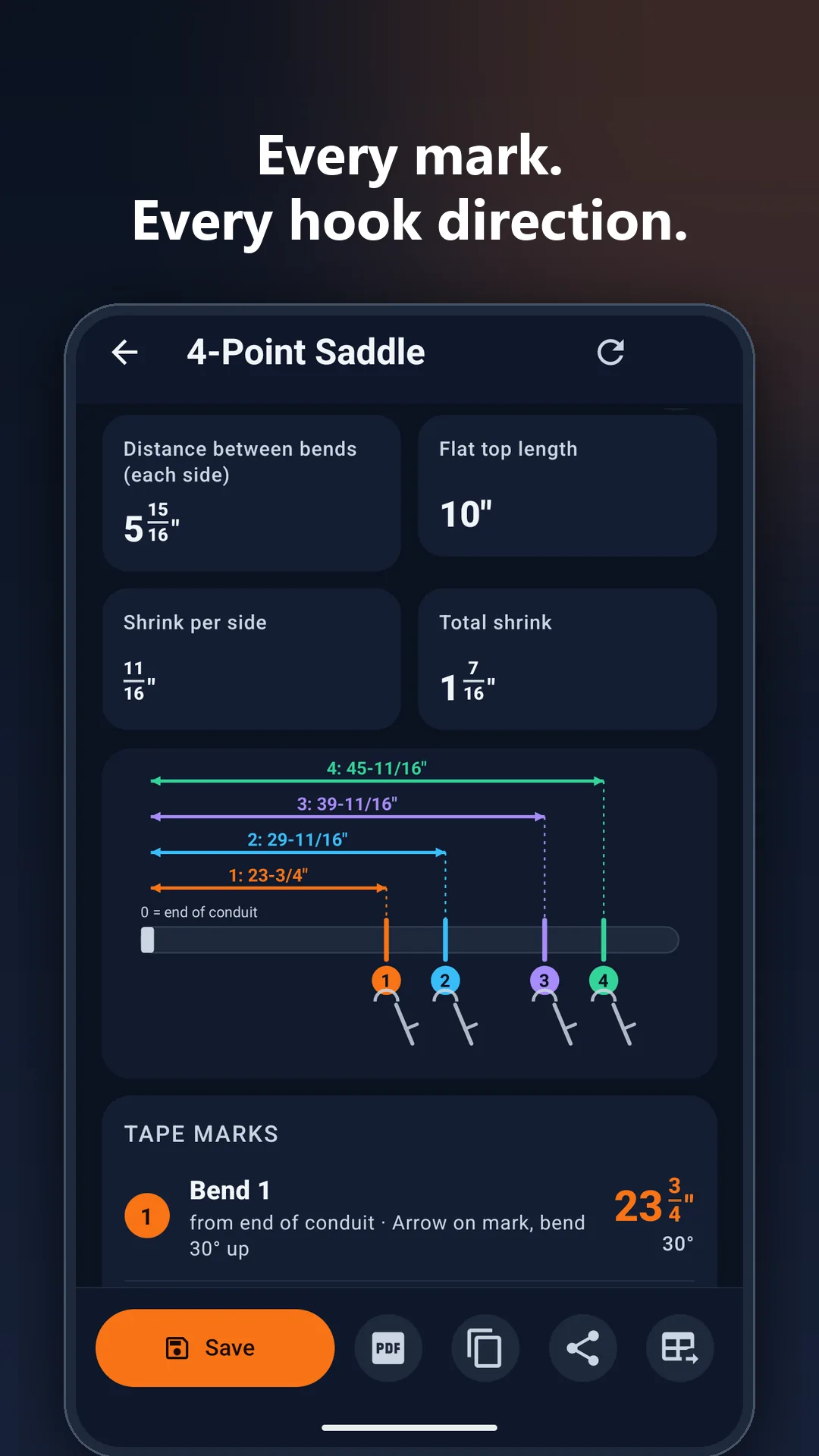
All four marks from the end of the pipe
- Enter the distance to the near edge and the clearance each side
- Marks from the end with the shrink already in, corrected for your shoe
- Every mark shows which way the hook faces
- Warns when the flat top is too short for your bender
$7.99 one time · no subscription · no ads · works offline
Related calculators and charts
Center mark shift and outer marks to hop over a pipe.
Open →OffsetDistance between bends and shrink for any offset depth and angle.
Open →Bending Multiplier ChartMultipliers, shrink per inch and a ready-made offset table from 1" to 24".
Open →How to Bend ConduitA complete hand-bender guide from the first 90 to saddles, with the marks for each.
Open →Rolling OffsetTrue offset and roll angle when the run moves over and up at once.
Open →