 Conduit Bending
Updated 2026-09-29
Short answer: add up an allowance for every conductor entering the box (#14 = 2.00 in³, #12 = 2.25 in³, #10 = 2.50 in³), two allowances per device yoke, one for internal clamps, one per fixture stud, and one for all the grounds (plus a quarter for each ground over four). The total must not exceed the box volume.
What counts, and how much (314.16(B))
| Item | Counts as |
|---|---|
| Each conductor that enters and ends or is spliced | 1 allowance of its size |
| Conductor passing through unbroken | 1 allowance |
| Pigtails and jumpers that do not leave the box | 0 |
| Internal cable clamps (any number) | 1 allowance, largest conductor |
| Each fixture stud or hickey | 1 allowance, largest conductor |
| Each device yoke | 2 allowances, largest conductor on that device |
| Equipment grounding conductors, up to 4 | 1 allowance, largest ground |
| Each ground beyond 4 (2020 NEC and later) | 1/4 allowance |
Volume per conductor (Table 314.16(B))
| Size | in³ each |
|---|---|
| #6 AWG | 5.00 |
| #8 AWG | 3.00 |
| #10 AWG | 2.50 |
| #12 AWG | 2.25 |
| #14 AWG | 2.00 |
| #16 AWG | 1.75 |
| #18 AWG | 1.50 |
Metal box volumes (Table 314.16(A))
| Box | Volume in³ | Max #14 | Max #12 |
|---|---|---|---|
| 4 × 1-1/4 round / octagon | 12.5 | 6 | 5 |
| 4 × 1-1/2 round / octagon | 15.5 | 7 | 6 |
| 4 × 2-1/8 round / octagon | 21.5 | 10 | 9 |
| 4 × 1-1/4 square | 18.0 | 9 | 8 |
| 4 × 1-1/2 square | 21.0 | 10 | 9 |
| 4 × 2-1/8 square | 30.3 | 15 | 13 |
| 4-11/16 × 1-1/4 square | 25.5 | 12 | 11 |
| 4-11/16 × 1-1/2 square | 29.5 | 14 | 13 |
| 4-11/16 × 2-1/8 square | 42.0 | 21 | 18 |
| 3 × 2 × 1-1/2 device | 7.5 | 3 | 3 |
| 3 × 2 × 2 device | 10.0 | 5 | 4 |
| 3 × 2 × 2-1/4 device | 10.5 | 5 | 4 |
| 3 × 2 × 2-1/2 device | 12.5 | 6 | 5 |
| 3 × 2 × 2-3/4 device | 14.0 | 7 | 6 |
| 3 × 2 × 3-1/2 device | 18.0 | 9 | 8 |
| 4 × 2-1/8 × 1-1/2 device | 10.3 | 5 | 4 |
| 4 × 2-1/8 × 1-7/8 device | 13.0 | 6 | 5 |
| 4 × 2-1/8 × 2-1/8 device | 14.5 | 7 | 6 |
"Max" is the number of allowances the box holds, before counting devices, clamps and grounds as allowances. Plastic and nonmetallic boxes use the volume marked on the box.
Worked example: receptacle in a 4" square box
A 4" square × 1-1/2" box (21.0 in³) with four #12 conductors, one receptacle, internal clamps and two grounds:
- 4 × #12 = 4 × 2.25 = 9.00 in³
- Receptacle yoke = 2 × 2.25 = 4.50 in³
- Clamps = 2.25 in³
- Grounds (two) = 2.25 in³
- Total 18.00 in³ ≤ 21.0 in³: the box is big enough.
The grounding rule since 2020
Before the 2020 NEC, all equipment grounding conductors in a box counted as a single allowance no matter how many there were. Since 2020, up to four count as one allowance and each one beyond four adds a quarter allowance. Boxes with many grounds that passed under older editions can now fail. Check which edition your jurisdiction enforces, and see the conduit fill calculator for the raceway side.
Questions electricians ask
How many 12 AWG wires can go in a 4x4 box?
A 4" square × 1-1/2" deep box (21 in³) holds nine #12 conductor allowances (9 × 2.25 = 20.25 in³). Remember that a device counts as two allowances, clamps as one and the grounds as one.
How do devices count in box fill?
Each yoke or strap holding a device (switch, receptacle) counts as two conductors of the largest size connected to it (314.16(B)(4)). A device wider than 2" counts two allowances for each gang it needs.
Do ground wires count in box fill?
Up to four equipment grounding conductors together count as one allowance of the largest ground. Since the 2020 NEC, each additional ground beyond four adds a quarter allowance.
Do pigtails count in box fill?
No. A conductor that starts and ends inside the box, such as a pigtail or a jumper, is not counted (314.16(B)(1) exception). Fixture wires coming from a canopy also do not count in some cases.
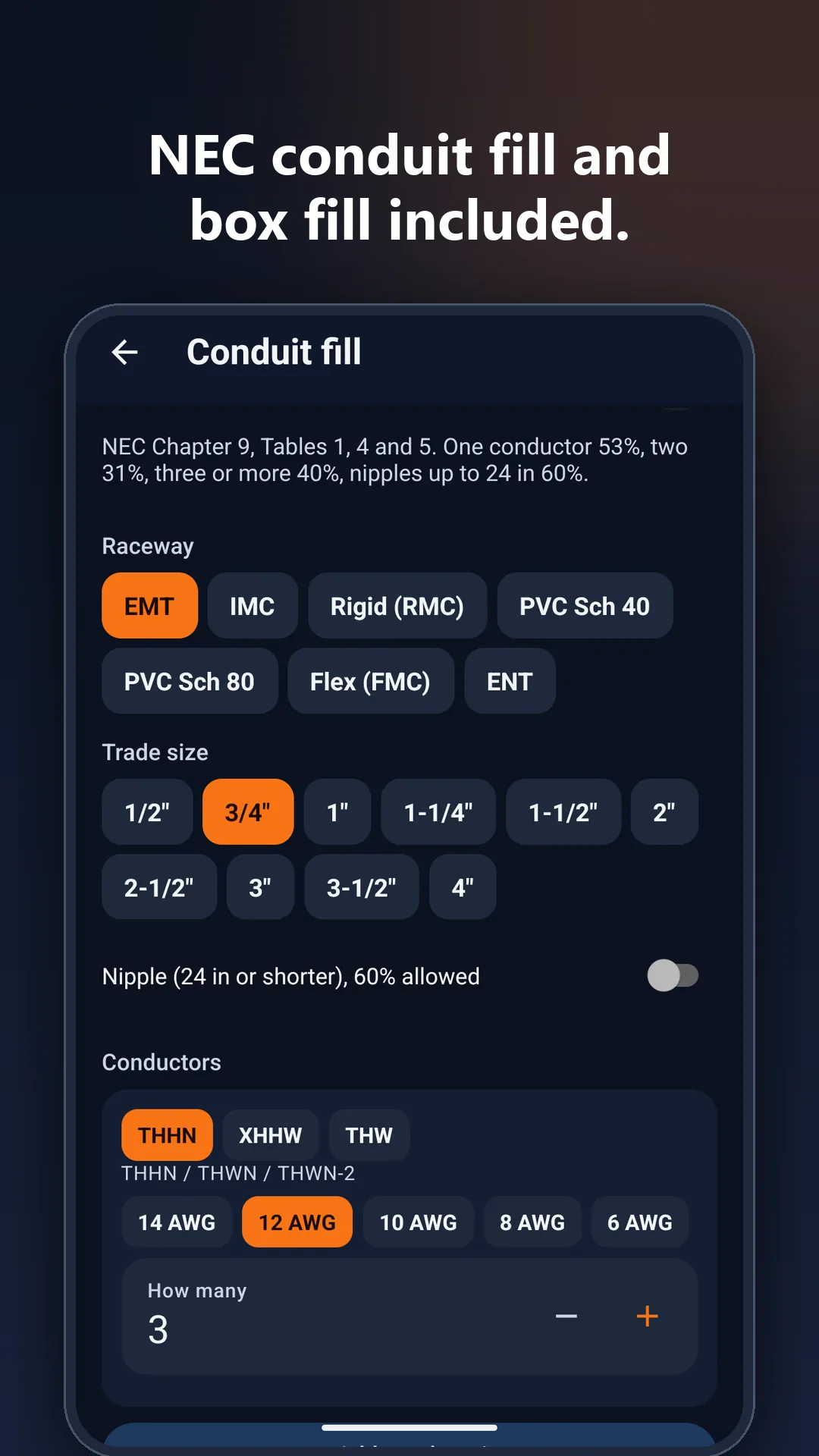
Box fill next to your bends
- Several conductor sizes, pass-throughs and fixture studs
- Smallest listed box that works
- Conduit fill with mixed wires
- Offline, in five languages
$7.99 one time · no subscription · no ads · works offline
Related calculators and charts
NEC Chapter 9 fill percentage for EMT, IMC, rigid, PVC and flex.
Open →Conduit Fill ChartMaximum THHN, XHHW and THW wires per trade size for EMT, PVC and rigid.
Open →90° Stub-UpWhere to put the arrow for a stub of exact height, by bender size.
Open →OffsetDistance between bends and shrink for any offset depth and angle.
Open →How to Bend ConduitA complete hand-bender guide from the first 90 to saddles, with the marks for each.
Open →