 Conduit Bending
Updated 2026-09-29
Short answer: bend the first 90 as a normal stub. Measure the back-to-back distance from the back of that 90 and mark it. Star-point method: star on the mark, bender reversed. Arrow method: mark the distance minus the take-up instead, arrow on it, hook toward the first 90.
How to bend back-to-back 90s
- Bend the first 90 as a stub-up: stub height minus take-up from the end.
- Measure from the back of the first 90 (the outside of the vertical leg) along the pipe, and mark the back-to-back distance.
- Place the bender using one of the two methods below and bend the second 90 in the same plane, so both legs point the same way.
- Check the U with a tape: outside to outside should read your back-to-back distance.
Star point or arrow
Both methods put the second 90 in the same place; use whichever your bender and habit favor, but never mix them on the same bend.
- Star point: mark the full back-to-back distance, reverse the bender so the hook faces away from the first 90, and put the star on the mark.
- Arrow: mark the back-to-back distance minus the take-up, and put the arrow on it with the hook facing the first 90. Take-ups: 1/2" 5", 3/4" 6", 1" 8", 1-1/4" 11".
How much conduit a U needs
Conduit needed ≈ first stub + back-to-back distance + second stub − 2 × the gain of a 90 measured to the back. On a typical 1/2" EMT shoe (4" radius, 0.706" OD) that gain is about 2-7/16" per 90.
Mistakes
- Measuring from the inside of the first 90 instead of the back.
- Using the arrow on the full distance: the U comes out a take-up too wide.
- Bending the second 90 out of plane, so the legs are not parallel. Stand the first stub against a wall or have someone sight it.
Questions electricians ask
What is a back-to-back bend?
Two 90° bends in the same piece of conduit, turned the same way to make a U, with an exact distance between the outside (back) of one 90 and the outside of the other. It is used for runs that drop down a wall, cross, and go back up.
What is the star point on a bender used for?
The star point marks the back of a 90 with the bender reversed. Put the star on your back-to-back mark and bend; the back of the new 90 lands on the mark. It saves subtracting the take-up.
Can I do back-to-back 90s with the arrow?
Yes. Subtract the take-up from the back-to-back distance, mark that distance from the back of the first 90, and put the arrow on it with the hook facing the first 90. It is the same as bending a stub measured from the first 90.
How long a piece of conduit do I need for a U?
Add the two stub heights and the back-to-back distance, then subtract the gain of both 90s. For 1/2" EMT on a typical shoe, the gain to the back of a 90 is about 2-7/16", so a 12" / 30" / 12" U needs about 49-1/8".
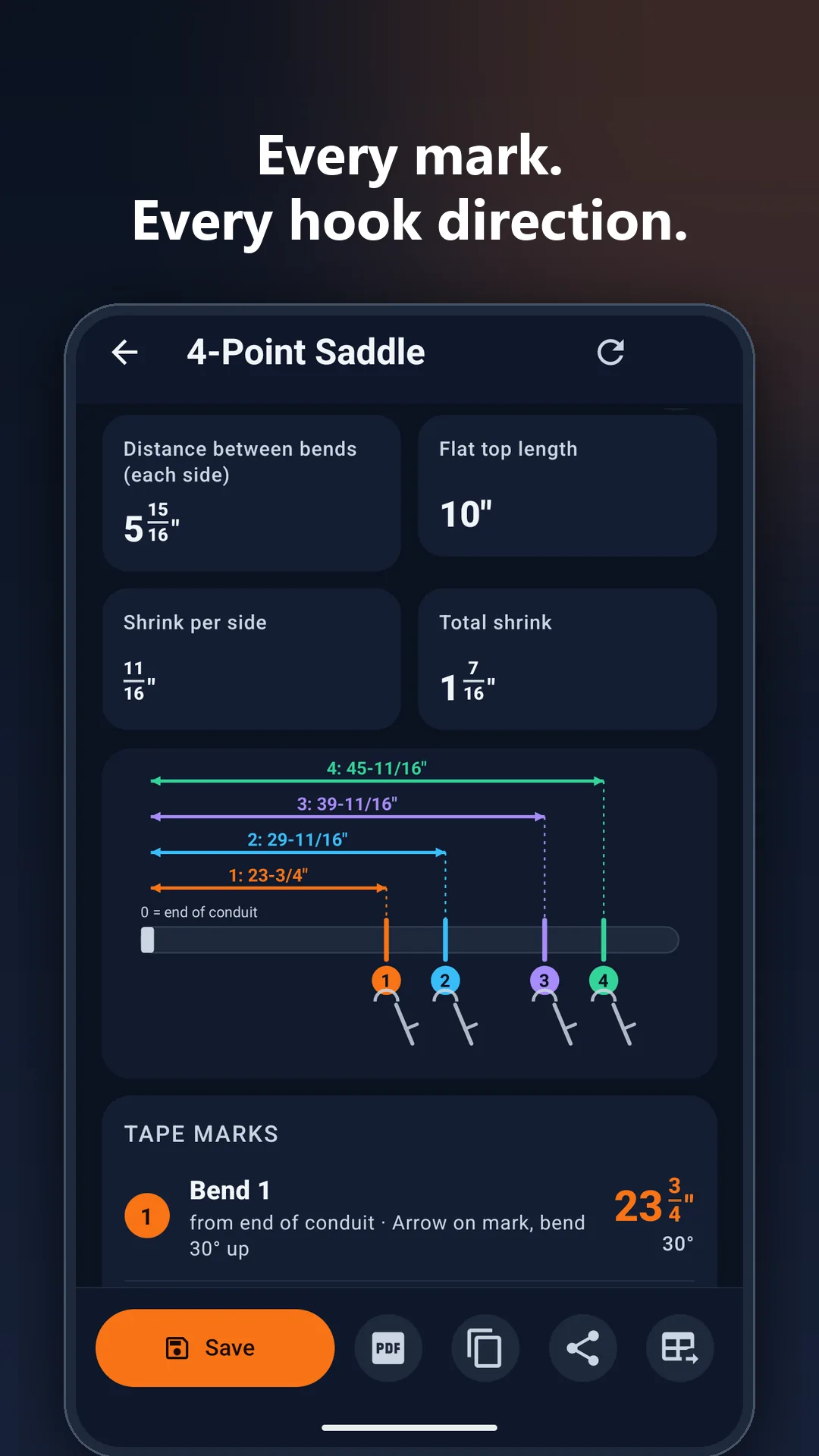
The whole U from one end of the stick
- First stub, second 90 and the conduit length in one screen
- Tape strip shows which way the hook faces for each mark
- Your shoe's take-up and radius, EMT or rigid
- Save it as a job and share a PDF with the crew
$7.99 one time · no subscription · no ads · works offline
Related calculators and charts
Where to put the arrow for a stub of exact height, by bender size.
Open →Bender Take-Up ChartTake-up (deduct), gain and radius for EMT and rigid hand benders.
Open →OffsetDistance between bends and shrink for any offset depth and angle.
Open →How to Bend ConduitA complete hand-bender guide from the first 90 to saddles, with the marks for each.
Open →Conduit Bending FormulasEvery formula behind offsets, saddles, 90s and kicks, with where each number comes from.
Open →