 Conduit Bending
Updated 2026-09-29
Tools you need
- A hand bender sized for the conduit (1/2", 3/4", 1" or 1-1/4" EMT). The size is cast in the shoe; a 3/4" EMT shoe also bends 1/2" rigid.
- A tape measure and a fine marker or pencil. Mark all the way around the pipe so you can see it from any side.
- A torpedo level to check 90s and angles, and optionally a protractor or angle finder.
- A hard, flat floor. Bending on soft ground or a rough slab lets the conduit wander.
Know the marks on your bender
- Arrow: used for stubs, offsets and kicks. For a stub, the arrow goes on the mark with the hook facing the end.
- Teardrop / rim notch: the middle of a bend; used for the center bend of a 3-point saddle.
- Star point: the back of a 90; used for back-to-back bends with the bender reversed.
- Degree marks: sight lines for 10°, 22.5°, 30°, 45° and 60°. The bend has reached that angle when the conduit lines up with the mark.
- Take-up (deduct): the number cast in the shoe, for example 5" on a 1/2" EMT bender. See the deduct chart.
Bending technique
- Lay the conduit on the floor and hook it in the bender with your mark lined up.
- Put one foot on the heel of the bender and keep steady pressure on it the whole time. This keeps the conduit in the groove.
- Pull the handle toward you smoothly, with the other hand low on the handle for leverage.
- Stop just past the angle you want (EMT springs back about 2°), release and check.
Bend a 90° stub
The first bend everyone learns. Stub height minus take-up is the mark; arrow on the mark; hook toward the end; bend to 90°.
Example: a 12" stub on 1/2" EMT is marked at 12 − 5 = 7". Use the stub-up calculator for other sizes.
Bend an offset
Two equal bends that move the run over an obstruction or off a surface. Distance between the marks is depth × multiplier (30° = 2); add the shrink (30° = 1/4" per inch) to your measurement when bending toward the obstruction. Bend the first mark, rotate the conduit exactly 180°, and bend the second.
Example: 4" deep at 30°: marks 8" apart, 1" shrink. Use the offset calculator for any depth and angle.
Bend a 3-point saddle
To hop over a pipe. Center mark = distance to the center of the pipe + 3/16" per inch of depth (45° saddle). Outer marks 2.5 × depth either side. Bend 45° on the center with the notch, then 22.5° on each outer mark with the arrow.
For a wide obstruction like a duct, use a 4-point saddle instead.
Bend back-to-back 90s
A U with an exact width. Bend the first 90 as a stub, measure the width from its back, and either put the star point on that mark (bender reversed) or subtract the take-up and use the arrow with the hook facing the first 90.
Bend a kick
A single bend to angle the conduit off a surface. Travel along the pipe = rise × multiplier. For a kicked 90, bend the kick first, then the 90 in the same plane. See the kick calculator.
Code rules to remember
- 360° maximum of bends between pull points (NEC 358.26 for EMT; the same rule applies to rigid, IMC and PVC).
- No damage: bends must not reduce the internal diameter (358.24), so no kinks or flattening.
- Minimum radius: Chapter 9, Table 2 sets the minimum bend radius for each trade size; hand benders are built to it.
Fixing a bad bend
- Over-bent 90: put the stub over the bender handle or into the hook and pull it back gently.
- Dog-leg offset (bends not in one plane): lay the conduit on the floor and twist gently at the second bend, or recut. Better: sight down the conduit before the second bend.
- Kinked or flattened: cut it out. A damaged bend is a code violation and can strip wire insulation during the pull.
Questions electricians ask
What is the easiest way to bend conduit?
Use a hand bender sized for the conduit, a tape measure and a marker. Measure, subtract the take-up (for a 90) or use the multiplier (for an offset), mark, put the arrow on the mark, and bend with steady foot pressure on the heel of the bender while the conduit stays on the floor.
How do you bend conduit without kinking it?
Use the correct size bender, keep heavy foot pressure on the heel so the conduit stays in the shoe, pull the handle smoothly rather than in jerks, and bend on a hard, flat floor. Kinks usually come from the conduit lifting out of the shoe.
Can you bend EMT by hand without a bender?
Not to code quality. Bending EMT over a knee or a post flattens it and reduces its inside area, which can damage the wire during the pull. NEC 358.24 requires bends to be made without damage to the tubing and without reducing its internal diameter.
How many bends can you have in a conduit run?
No more than 360° total between pull points (for EMT, NEC 358.26). Add a pull box or conduit body when a run needs more.
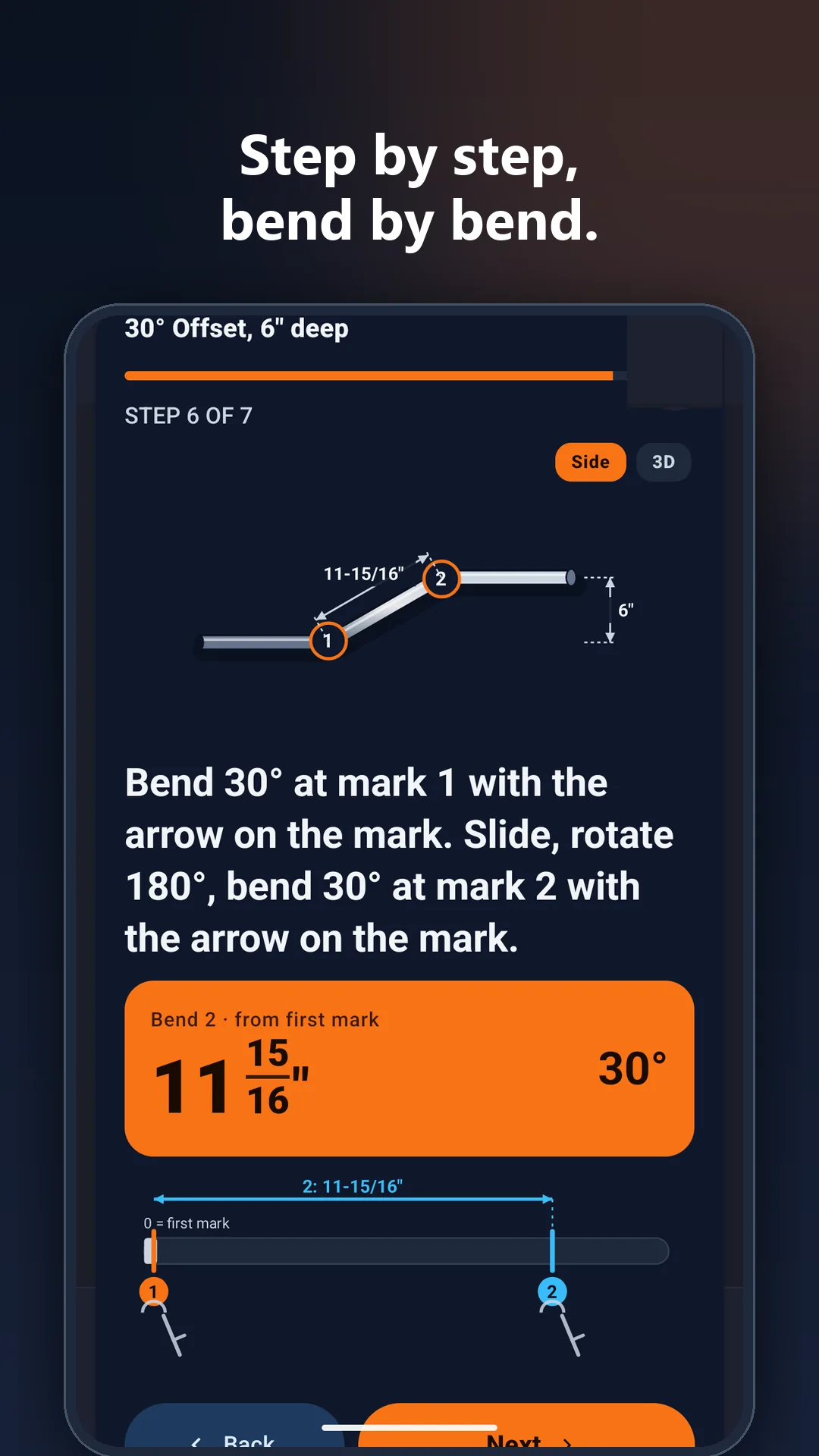
Guide mode: one bend at a time
- Each step on its own screen, with the mark and the angle in big type
- The bend animates into place as you go
- Tape strip with the hook direction under every mark
- Works offline, in five languages
$7.99 one time · no subscription · no ads · works offline
Keep going
Where to put the arrow for a stub of exact height, by bender size.
Open →OffsetDistance between bends and shrink for any offset depth and angle.
Open →3-Point SaddleCenter mark shift and outer marks to hop over a pipe.
Open →Back-to-Back 90sStar-point and arrow marks for a U with an exact width.
Open →Bending Multiplier ChartMultipliers, shrink per inch and a ready-made offset table from 1" to 24".
Open →