By Blissom · Updated 2026-10-23
Layout values: check them against your own bender, on scrap first.

Download the 1-1/4" EMT chart as a one-page PDF
1-1/4" EMT and its bender
1-1/4" EMT is used for feeders and larger branch groups; by fill area it takes forty-five #12 THHN, seven #4 or four #1. It is the largest EMT size commonly bent with a hand bender, and the 1-1/4" shoe is also the one for 1" rigid and IMC.
| Outside diameter | 1.510" |
| Inside diameter (from NEC internal area) | 1.380" |
| Internal area (NEC Chapter 9, Table 4) | 1.496 in² |
| Hand-bender take-up (deduct) | 11" |
| NEC minimum radius (Ch. 9, Table 2) | 7-1/4" |
| Example radius (read your shoe) | 9" |
| Gain of a 90 (centerline) | 3-7/8" |
| Gain, legs to the back | 5-3/8" |
| Developed length of a 90 | 14-1/8" |
| Rigid / IMC that bends on this shoe | 1", if the shoe is rated for it (same 11" take-up) |
11" is the 1-1/4" EMT take-up in Klein's guides, and 1" rigid uses the same figure if the shoe lists it. Check the finished 90 with a level, not by eye.
Stub-up marks for 1-1/4" EMT
1-1/4" stubs are long because the take-up is 11": anything under about 14" barely fits in the shoe. They usually rise into gear or pull boxes from a slab or trench.
| Stub height | Arrow mark from end |
|---|---|
| 14" | 3" |
| 16" | 5" |
| 18" | 7" |
| 20" | 9" |
| 24" | 13" |
| 30" | 19" |
| 36" | 25" |
| 42" | 31" |
| 48" | 37" |
| 60" | 49" |
With an 11" take-up, a stub shorter than about 14" leaves very little conduit in the shoe. For short stubs into gear, bend long and cut, or use a factory elbow.
Back-to-back 90s on 1-1/4" EMT
On the 1-1/4" shoe the arrow mark sits 11" inside the star mark. Long 1-1/4" U-bends are easier with two people, one holding the first 90 plumb while the second is bent.
| Back-to-back distance | Star mark | Arrow mark |
|---|---|---|
| 30" | 30" | 19" |
| 36" | 36" | 25" |
| 42" | 42" | 31" |
| 48" | 48" | 37" |
| 60" | 60" | 49" |
| 72" | 72" | 61" |
| 84" | 84" | 73" |
| 96" | 96" | 85" |
Star column: 1-1/4" back-to-back distance from the back of the first 90, hook away from it. Arrow column: 11" less, hook toward the first 90; that leg swings toward you, so stand clear. Same plane for both 90s.
Cut lengths for pieces with 90s
Cut-length savings depend on the actual centerline radius of your shoe. NEC Chapter 9, Table 2 lists 7-1/4" as the minimum one-shot radius for 1-1/4" EMT; the examples below assume a 9" radius, so measure your shoe or check its maker’s data before final cuts. With a 9" radius as an example, a 1-1/4" 90 saves 5.373" (about 5-3/8") against its two legs measured to the back, about 10-3/4" on a piece with two 90s. The table uses the unrounded gain.
| Piece | Legs added | Cut length |
|---|---|---|
| Stub 12" and a 36" leg | 48" | 42-5/8" |
| Stub 18" and a 48" leg | 66" | 60-5/8" |
| U: 12" + 30" + 12" | 54" | 43-1/4" |
| U: 24" + 48" + 24" | 96" | 85-1/4" |
Worked example on 1-1/4" EMT
1-1/4" piece: 24" stub, 72" leg (both to the back of the 90).
- Arrow mark: 24 − 11 = 13" from the stub end.
- Cut length: 96" of legs − 5.373" gain = 90-5/8".
Gain by shoe radius
Gain = 0.429 × your shoe's centerline radius, plus 1.510" to the back of the 90.
| Centerline radius | Gain (centerline) | Gain to back of 90 | Developed 90 |
|---|---|---|---|
| 7-1/4" (NEC minimum) | 3-1/8" | 4-5/8" | 11-3/8" |
| 9" | 3-7/8" | 5-3/8" | 14-1/8" |
| 9-1/2" | 4-1/16" | 5-9/16" | 14-15/16" |
| 10" | 4-5/16" | 5-13/16" | 15-11/16" |
| 10-1/2" | 4-1/2" | 6" | 16-1/2" |
| 11" | 4-3/4" | 6-1/4" | 17-1/4" |
Gain at each angle on a 9" radius 1-1/4" shoe
With a 9" example radius, gain is about 3/8" per bend at 45° and close to 1" at 60°. For 1-1/4" offsets, work the exact marks out for your shoe rather than trusting the sticker multipliers.
| Bend angle | 10° | 22.5° | 30° | 45° | 60° | 90° |
|---|---|---|---|---|---|---|
| Gain (centerline) | 0.004" | 0.046" | 0.111" | 0.387" | 0.968" | 3.863" |
Offsets, saddles and kicks on a 9" 1-1/4" shoe
Theoretical minimum offset for two adjoining bends on this 9" 1-1/4" radius: 2 × radius × (1 − cos θ), rounded up. These are geometric lower bounds, not workable minimums: shoe length, hook clearance and the maker's instructions set the real limit, so check on your bender.
| Angle | Multiplier | Field shrink per inch | Theoretical minimum offset (9" radius) |
|---|---|---|---|
| 10° | 6.0 | 1/16" | 5/16" |
| 22.5° | 2.6 | 3/16" | 1-3/8" |
| 30° | 2.0 | 1/4" | 2-7/16" |
| 45° | 1.4 | 3/8" | 5-5/16" |
Marks for a 1-1/4" saddle, kick or offset; every bend counts toward the 360° maximum between pull points (NEC 2023 358.24(B); the 2026 NEC adds 300.24 for mixed raceway types).
How many wires fit in 1-1/4" EMT
1-1/4" EMT takes forty-five #12, twenty-eight #10 or seven #4 THHN at 40%. Mixed wire sizes: conduit fill calculator.
| Wire | THHN / THWN | XHHW | THW |
|---|---|---|---|
| #14 | 61 | 43 | 28 |
| #12 | 45 | 33 | 23 |
| #10 | 28 | 24 | 18 |
| #8 | 16 | 13 | 10 |
| #6 | 12 | 10 | 8 |
| #4 | 7 | 7 | 6 |
1-1/4" fill counts are not circuit capacity: grounds count toward fill, and over three current-carrying wires usually need ampacity adjustment (NEC 310.15(C)(1)).
Bending 1-1/4" EMT well
At 1-1/4" a hand bend takes real force. Use the full-length handle, bend on a solid floor and keep firm, controlled foot pressure on the bender’s foot pedal with stable footing, as the maker’s instructions describe, rather than relying on the handle alone; many crews switch to a mechanical (chain or ratchet) bender for anything they make more than a few times. The large radius of a 1-1/4" shoe makes stubs sweep well away from the wall, so plan stub positions in a panel with that radius in mind.
- Bending 1" rigid with the 1" EMT numbers: it goes on a 1-1/4" EMT shoe rated for it, with the 11" take-up.
- Not checking the finished angle: at this size a small amount of spring-back moves the stub end noticeably, so check every bend with a level and correct it as the bender’s instructions describe.
- Kinked second bends on short offsets: the shoe is long, so leave enough room between offset marks for your bender, or use smaller angles.
Sources: NEC 2023 358.24 and Chapter 9, Table 2; Klein Tools Conduit Bender Guide (stub take-up, offset multipliers and shrink, saddles). Method.
Questions electricians ask
What is the take-up for 1-1/4 inch EMT?
Klein gives 11 inches, and some 1-1/4" shoes from other makers use a different deduct. For a 24" stub the arrow goes 13" from the end.
Can you bend 1 inch rigid with a 1-1/4 EMT bender?
Yes. 1" rigid and IMC use the 1-1/4" EMT shoe and its 11" take-up.
How many #12 wires fit in 1-1/4 inch EMT?
Forty-five #12 THHN at 40% fill; twenty-eight #10.
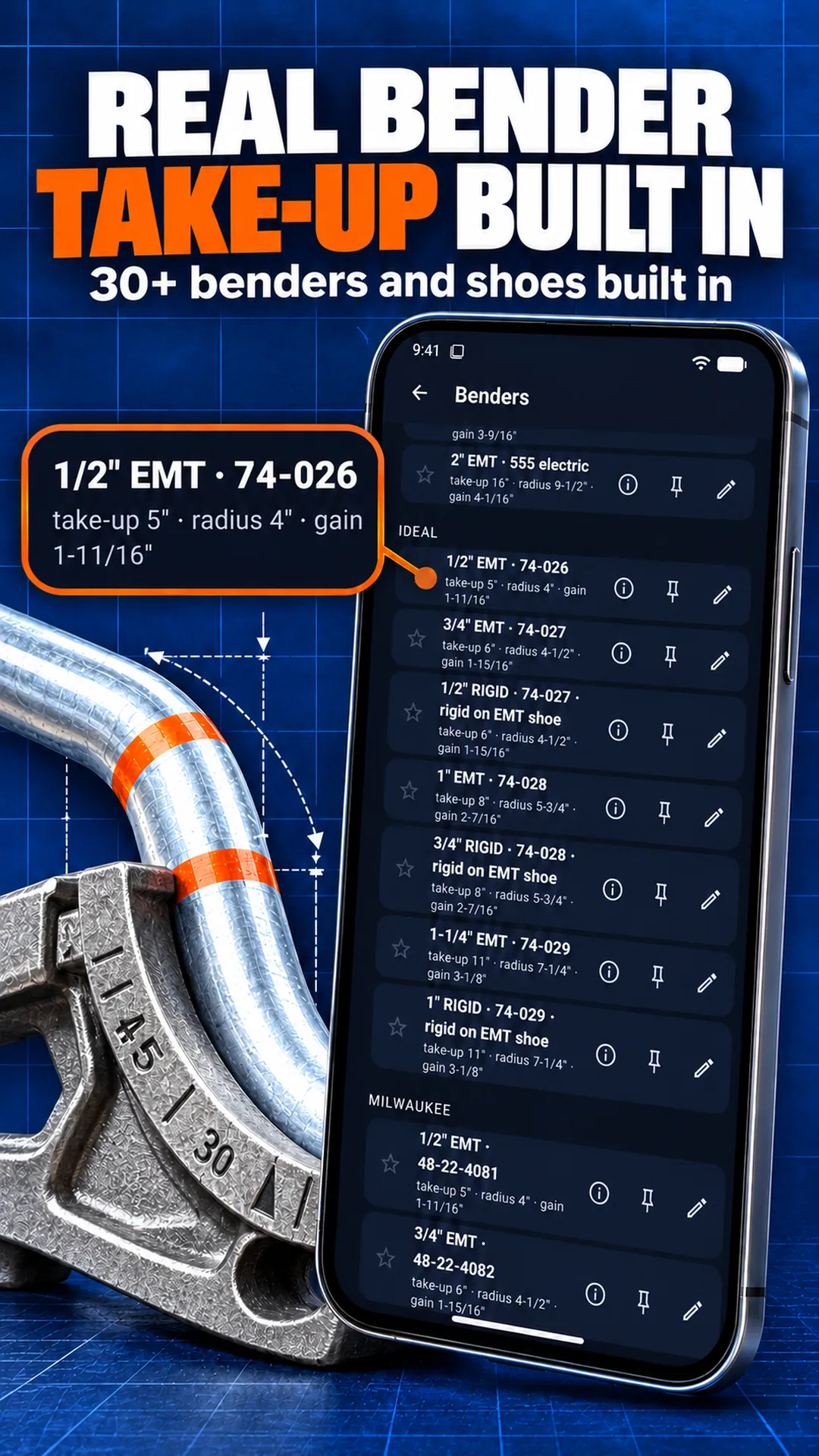
Your 1-1/4" shoe, already loaded
- 1-1/4" EMT and 1" rigid on the same shoe
- Mechanical and electric bender templates when hand bending gets too heavy
- Offsets corrected for the 7-1/4" radius
- Cut lengths and saved jobs, offline
Android only. There is no iPhone version yet; the free calculators on this site work on any phone.
$7.99 one time · no subscription · no ads · works offline