 Conduit Bending
Updated 2026-09-29
Which bender for which size
| Rigid / IMC size | Usual bender |
|---|---|
| 1/2" to 1" | Hand bender (an EMT shoe one size up, or a rigid-rated hand bender); a hickey for bends in place |
| 1-1/4" to 2" | Mechanical ratchet or segment bender |
| 2-1/2" and up | Hydraulic or electric bender with the matching shoe |
Take-up for rigid on EMT shoes
| Rigid size | Bent on | Take-up | 12" stub mark |
|---|---|---|---|
| 1/2" | 3/4" EMT shoe | 6" | 6" |
| 3/4" | 1" EMT shoe | 8" | 4" |
| 1" | 1-1/4" EMT shoe | 11" | 1" |
Mechanical and electric benders publish their own take-up and gain per shoe in the manual; use those. Stub marks work the same way as EMT: stub height − take-up. See the stub-up calculator and the deduct chart.
Technique and spring-back
- Rigid takes much more force. Use a long, sturdy handle and keep heavy foot pressure on the heel so the pipe stays in the groove.
- Spring-back is larger than with EMT: bend a few degrees past the target and check with a level before releasing on the last bends.
- Offsets and saddles use the same multipliers and shrink as EMT; the shoe radius is larger, so the exact correction matters more on deep offsets.
Bending with a hickey
A hickey is a short bending head on a handle for rigid up to about 1". It bends in many small bites rather than one sweep: move the hickey a little along the pipe between each bite so the bend forms a smooth radius instead of a kink. It is useful for bends in place and short pieces where a full bender will not fit.
Threads and bends
Keep bends away from threaded ends; a fitting needs straight thread to seat. Plan the layout so each end has enough straight pipe for threading and the coupling, and cut and thread after bending when the exact length matters.
RMC vs IMC
IMC has the same outside diameter and threads as RMC with a thinner wall, so it is lighter and bends with a little less effort on the same benders. The conduit sizes chart has outside and inside diameters.
NEC rules for rigid and IMC bends
- Bends must not damage the conduit or reduce its internal diameter (344.24 for RMC, 342.24 for IMC).
- No more than 360° of bends between pull points (344.26, 342.26).
- Minimum radius per Chapter 9, Table 2.
Questions electricians ask
Can you bend rigid conduit with an EMT bender?
Yes, one size up: a 3/4" EMT hand bender bends 1/2" rigid, a 1" EMT bender bends 3/4" rigid, and a 1-1/4" EMT bender bends 1" rigid, with that shoe's take-up. Rigid is harder to pull, so use a long handle and steady foot pressure.
What is the take-up for 1/2 inch rigid conduit?
6", the take-up of the 3/4" EMT shoe it is bent on. 3/4" rigid on a 1" EMT shoe is 8", and 1" rigid on a 1-1/4" EMT shoe is 11". Check the number on your own bender.
Does rigid conduit spring back more than EMT?
Yes. The thicker wall springs back more, so over-bend a few degrees more than you would with EMT and check with a level.
What is the difference between RMC and IMC?
IMC (intermediate metal conduit) has a thinner wall than RMC and is lighter, with the same outside diameter and threads. It bends with the same benders and slightly less effort.
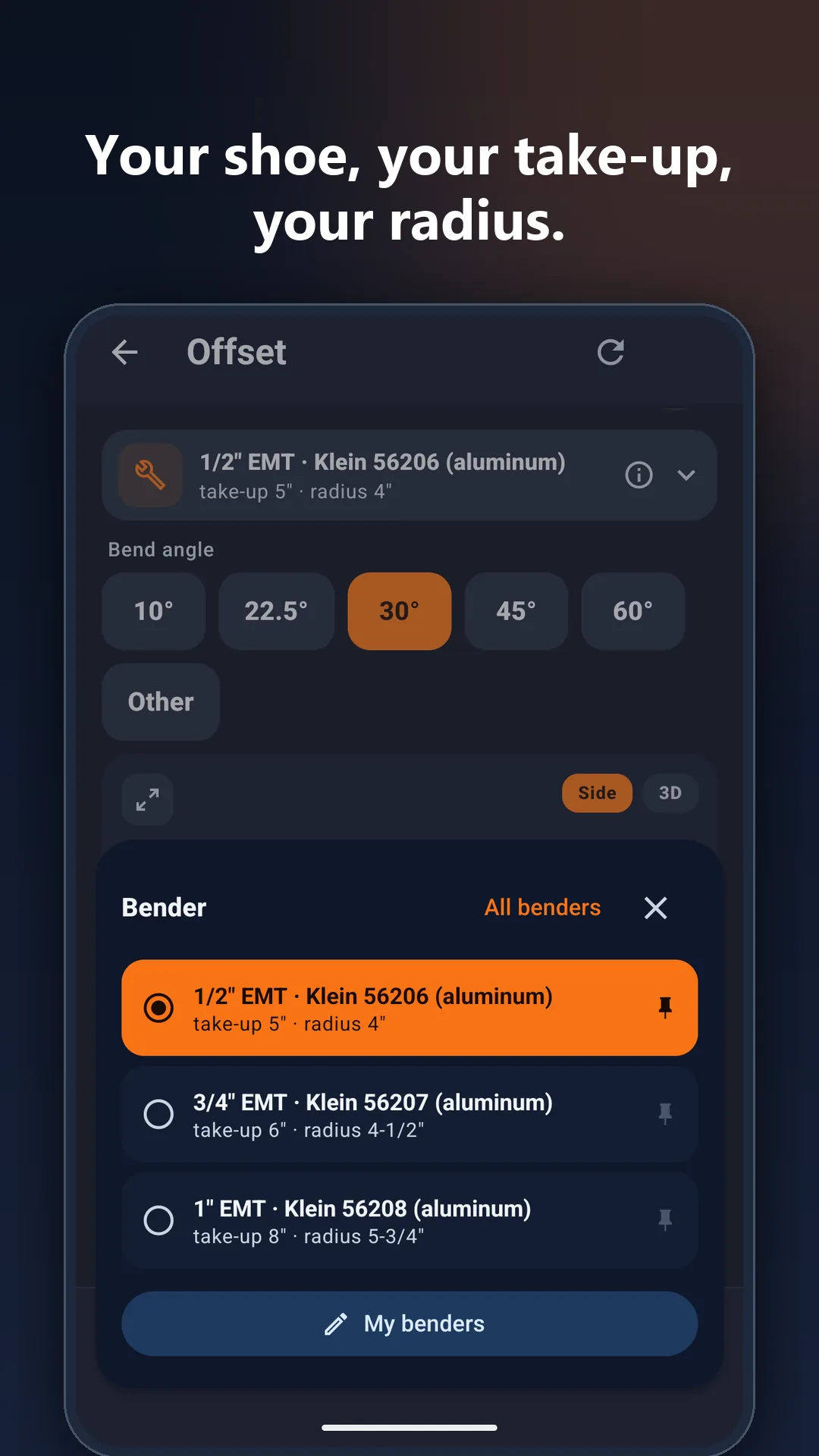
Rigid on the right shoe, already set
- Rigid on EMT shoes with the correct take-up
- Mechanical and electric bender templates for larger sizes
- Marks from the end of the pipe for every bend
- Your own take-up and radius, saved
$7.99 one time · no subscription · no ads · works offline
Keep going
Where to put the arrow for a stub of exact height, by bender size.
Open →Bender Take-Up ChartTake-up (deduct), gain and radius for EMT and rigid hand benders.
Open →OffsetDistance between bends and shrink for any offset depth and angle.
Open →How to Bend PVCHeat bending PVC conduit: heaters, heat length, 90s and offsets, minimum radius.
Open →Conduit Sizes ChartActual outside and inside diameters of EMT, rigid and PVC, 1/2" to 4".
Open →