By Blissom · Updated 2026-10-23
Layout values: check them against your own bender, on scrap first.

What a box offset is for
EMT run flat on a wall or strut sits lower than the knockout of a box mounted on the same surface, because the connector and the box back hold the knockout out from the wall. A box offset is the small double bend just before the box that lifts the conduit to that height, so it enters the connector straight instead of being sprung into it.
It is the same geometry as any offset: two equal bends in opposite directions, spaced depth × multiplier apart. Because the depth is so small, 10° bends are used, which keeps the spacing workable and the shrink close to zero.
Box offset table
Distance between the two bends and the shrink, for the depths you will meet on boxes, at 10° and 22.5°.
| Depth | 10°: between bends | 10°: shrink | 22.5°: between bends | 22.5°: shrink |
|---|---|---|---|---|
| 1/4" | 1-1/2" * | 0" | too shallow for a hand bender | |
| 3/8" | 2-1/4" | 0" | too shallow for a hand bender | |
| 1/2" | 3" | 1/16" | too shallow for a hand bender | |
| 5/8" | 3-3/4" | 1/16" | too shallow for a hand bender | |
| 3/4" | 4-1/2" | 1/16" | 1-15/16" | 1/8" |
| 1" | 6" | 1/16" | 2-5/8" | 3/16" |
| 1-1/4" | 7-1/2" | 1/16" | 3-1/4" | 1/4" |
| 1-1/2" | 9" | 1/8" | 3-7/8" | 5/16" |
* Marks this close are hard to make on a hand bender because the first bend is still in the shoe; use a box offset bender or bend the offset slightly deeper. Shrink shows as 0" where it rounds below 1/32". At 22.5°, two separate bends on a 1/2" EMT shoe with a 4-5/8" radius need about 3/4" of depth (2 × radius × (1 − cos 22.5°)), so shallower 22.5° box offsets are left out; shoes with a different radius differ.
Bending it with a hand bender
- Measure the depth: from the wall to the center of the knockout, minus the distance from the wall to the center of the conduit as it runs. On most surface boxes this comes out near 1/2".
- Mark the second bend so that a few inches of straight conduit remain between it and the box, enough for the connector to seat square.
- Mark the first bend one bend spacing back from the second (3" for a 1/2" depth at 10°).
- Bend 10° on the first mark, roll the conduit exactly 180°, and bend 10° on the second mark. Use the 10° sight line on the shoe.
- Check it against the box before cutting: lay the conduit on the wall and see that the end lines up with the knockout.
Worked example: a 1/2" box offset ending at a connector 48" from the end
- Spacing for 1/2" at 10°: 0.5 × 6 = 3". Shrink is under 1/16", so ignore it.
- Leave 4" of straight conduit before the connector: second bend at 44", first bend at 41".
- Bend 10° at 41", roll exactly 180°, bend 10° at 44". The pair adds 20° to the run's 360° budget.
Box offset benders
Electricians who make a lot of box offsets use a box offset bender: a tool that forms both bends in one operation. Some have a maximum depth matched to standard boxes and make shallower offsets with less handle travel; check the conduit sizes and depth range your tool supports. It is faster and the offsets come out consistent. For any other depth, or when the box is not on the same surface, bend it with the hand bender and the table above.
Mistakes
- Rolling the conduit less than 180° between bends: the offset kicks sideways and the conduit no longer lies flat on the wall.
- Putting the second bend right at the end of the conduit: the connector then sits on the bend and the conduit enters the box at an angle.
- Over-bending: with the marks 3" apart, two 15° bends give about 3/4" of depth instead of 1/2", and the conduit misses the knockout.
- Forgetting the box offset when counting bends: it still adds 20° toward the 360° limit.
Sources: NEC 2023 358.24 and Chapter 9, Table 2; Klein Tools Conduit Bender Guide (stub take-up, offset multipliers and shrink, saddles). Method.
Questions electricians ask
How deep is a box offset?
Usually about 1/2", enough to lift EMT running flat on a wall up to the knockout of a box mounted on the same surface. Measure your own box and connector: the depth is the distance the conduit has to move out from the wall.
What angle do you use for a box offset?
10° bends are standard: the multiplier is 6 and the shrink is almost nothing. 22.5° bends put the bends much closer together: on a 1/2" EMT hand bender they need roughly 3/4" or more of depth to make as two separate bends.
How far apart are the marks for a 1/2 inch box offset?
3" with 10° bends (0.5 × 6). At 22.5° the arithmetic gives about 1-5/16", but a 1/2" offset is too shallow for two separate 22.5° bends on a typical 1/2" EMT hand bender, so use 10° or a box offset bender.
Does a box offset count toward the 360 degrees?
Yes. Two 10° bends add 20° to the bends between pull points.
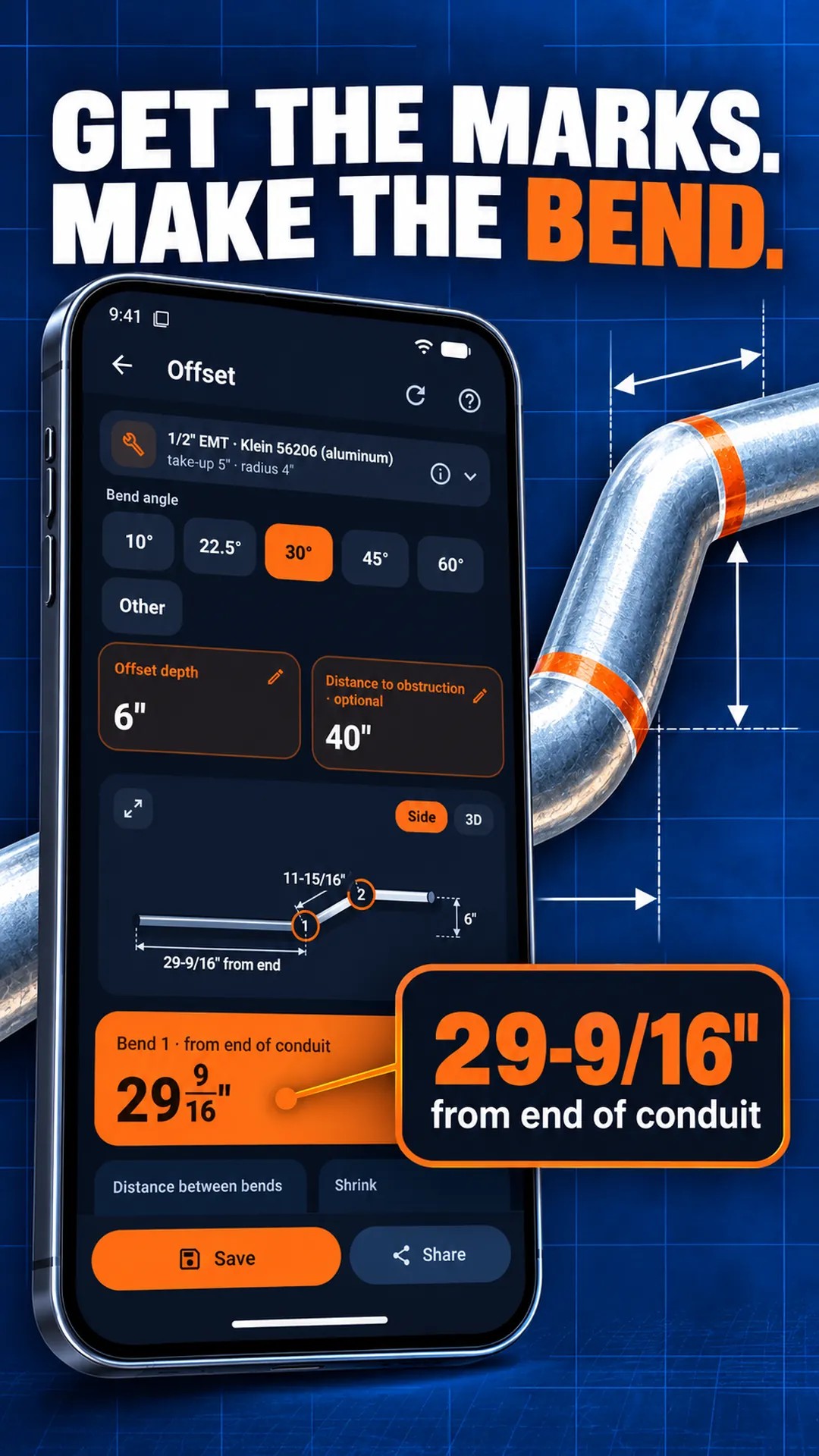
Box offsets and kicks for every drop
- Offsets at any angle, marks from the end of the pipe
- Warns when two marks are too close for the shoe
- Corrected for the radius of your bender
- Offline on the job
Android only. There is no iPhone version yet; the free calculators on this site work on any phone.
$7.99 one time · no subscription · no ads · works offline