By Blissom · Updated 2026-10-23
Layout values: check them against your own bender, on scrap first.

What a concentric bend is
When a rack of parallel conduits turns a corner with every conduit on the same radius, the start of each bend has to be staggered to keep the spacing right on both straight runs, and the spacing still widens through the turn. A concentric bend instead bends every conduit around one shared center on progressively larger radii, so the spacing stays close to the same before, through and after the turn.
The price is that each conduit needs its own radius, its own developed length and, if it is made in shots, its own mark spacing. That is what the charts below give you.
The formula
R₁ is the radius of the inside conduit, measured to its centerline. The center spacing is the center-to-center distance of the conduits in the rack, not the gap between them. The shot spacing is worked out the same way as a segmented 90, from each conduit's own developed length; the tangent method gives slightly longer spacings.
Charts for three rack setups
Before using these charts: they are geometric layouts, not approved radii for every size. Check that the radius meets the NEC minimum for your raceway type, trade size and bending method, and your bender maker's instructions: a 12" centerline radius, for example, is below the Table 2 minimum for 3" EMT. The examples suit the smaller trade sizes (the worked example uses 1" EMT).
12" inside radius, 2" centers, 9 shots per 90
| Conduit | Radius | Developed length | Gain | Shot spacing |
|---|---|---|---|---|
| 1 (inside) | 12" | 18-7/8" | 5-1/8" | 2-1/8" |
| 2 | 14" | 22" | 6" | 2-7/16" |
| 3 | 16" | 25-1/8" | 6-7/8" | 2-13/16" |
| 4 | 18" | 28-1/4" | 7-3/4" | 3-1/8" |
| 5 | 20" | 31-7/16" | 8-9/16" | 3-1/2" |
18" inside radius, 3" centers, 9 shots per 90
| Conduit | Radius | Developed length | Gain | Shot spacing |
|---|---|---|---|---|
| 1 (inside) | 18" | 28-1/4" | 7-3/4" | 3-1/8" |
| 2 | 21" | 33" | 9" | 3-11/16" |
| 3 | 24" | 37-11/16" | 10-5/16" | 4-3/16" |
| 4 | 27" | 42-7/16" | 11-9/16" | 4-11/16" |
| 5 | 30" | 47-1/8" | 12-7/8" | 5-1/4" |
24" inside radius, 4" centers, 10 shots per 90
| Conduit | Radius | Developed length | Gain | Shot spacing |
|---|---|---|---|---|
| 1 (inside) | 24" | 37-11/16" | 10-5/16" | 3-3/4" |
| 2 | 28" | 44" | 12" | 4-3/8" |
| 3 | 32" | 50-1/4" | 13-3/4" | 5" |
| 4 | 36" | 56-9/16" | 15-7/16" | 5-5/8" |
Gain is the centerline gain of each 90: the conduit it saves compared with two straight legs meeting at a sharp corner. First shot on each conduit sits half a shot spacing past the start of its curve.
Worked example: three 1" EMT on 2" centers
- Inside conduit on a 12" radius, the next two on 14" and 16".
- Conduit in each curve: 18-7/8", 22" and 25-1/8". Each conduit farther out needs about 3-1/8" more conduit in its 90 than its neighbor (1.571 × the 2" spacing).
- Start all three curves on the same line square to the rack; the outer two just end later.
Laying out the rack
- Fix the start line. Snap one line square across the rack where the turn begins. Every conduit starts its curve on this line.
- Bend the inside conduit first on the smallest radius, and set it in place as the template.
- Mark each outer conduit with its own shot spacing from the chart, starting half a spacing past the start line.
- Bend every shot the same number of degrees (10° for 9 shots, 9° for 10 shots), keeping the conduit from rolling between shots.
- Check against the inside conduit: the gap between neighbors should be the same at the start, the middle and the end of the turn.
Mistakes to avoid
- Measuring spacing as the gap between conduits instead of center to center. With 1" EMT on 2" centers the gap is only about 13/16".
- Starting the outer curves farther along the rack. They start on the same line; they are just longer.
- Using the same number of shots but eyeballing the spacing. Each conduit's spacing is different, and small errors add up across the rack.
- Forgetting the extra conduit in the outer bends when cutting: the fifth conduit in the first chart uses 12-9/16" more conduit in its curve than the inside one.
Sources: NEC 2023: 358.24(A) (EMT bends; minimum centerline radius from Chapter 9, Table 2, one-shot and full-shoe column) and 358.24(B) (360° between pull points); other raceways follow their own bending sections; Standard trigonometry for developed length and shot spacing (see the formulas page). Method.
Questions electricians ask
What is a concentric bend?
A set of 90° bends in parallel conduits that share one center point, so the conduits keep close to the same spacing all the way around the turn. Each conduit farther out has a larger radius.
How do you calculate concentric bend radius?
Radius of conduit n = radius of the inside conduit + (n − 1) × the center-to-center spacing. With a 12" inside radius and 2" centers: 12", 14", 16", 18", 20".
Can you make concentric bends with a hand bender?
Yes, on suitable smaller conduit, by bending each conduit as a segmented bend in several small shots where the shoe and the mark spacing allow. A single full bend in a fixed shoe follows that shoe’s radius, so larger radii need shots or a mechanical or electric bender with matching shoes. Follow the bender maker’s instructions and check the finished radius.
Do all conduits in a concentric bend start on the same line?
Yes. In the ideal concentric 90, every conduit starts its curve on one line square to the incoming rack. Each conduit has its own tangent point on that line, and the outer curves are longer.
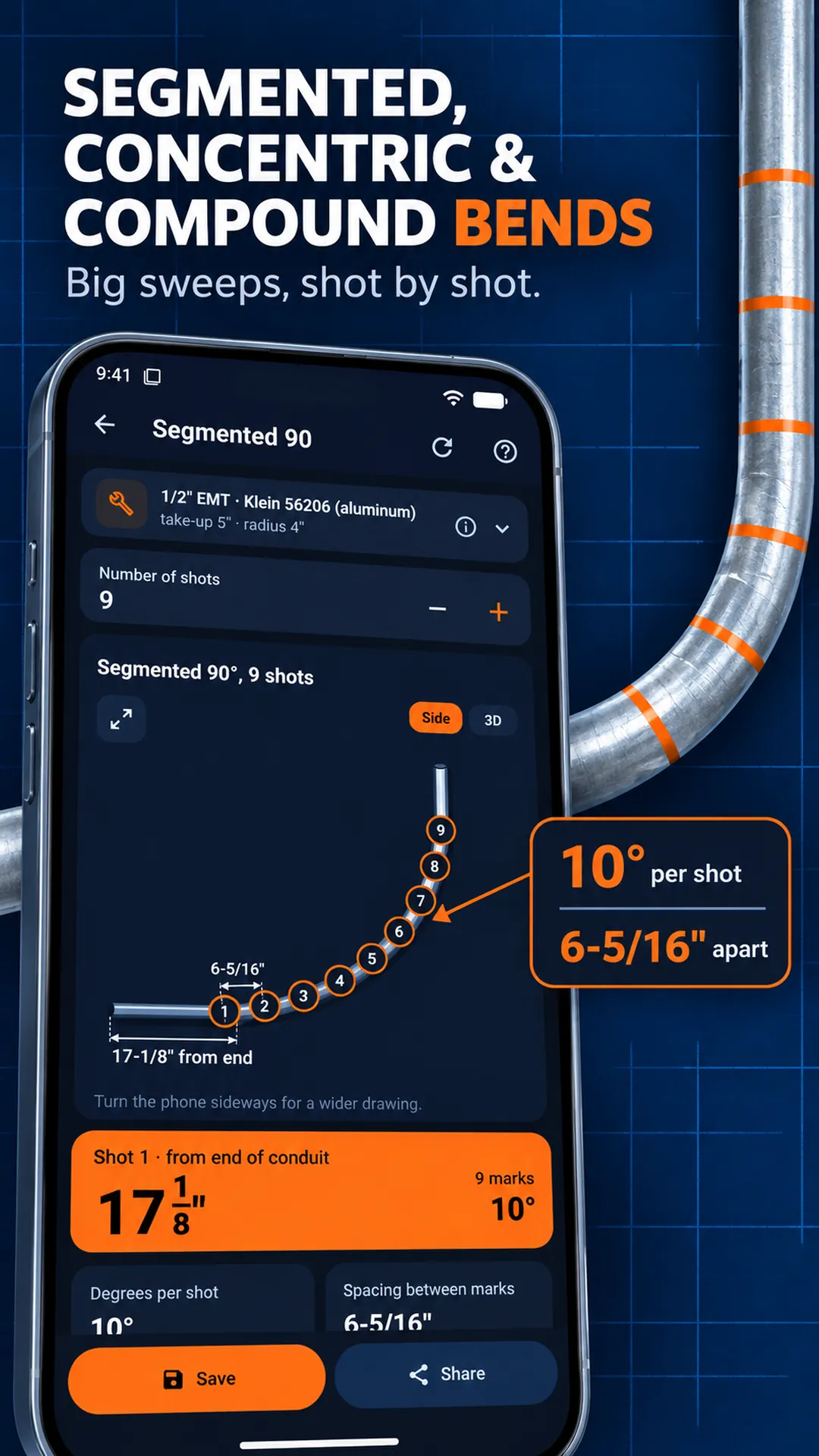
Every conduit on the rack, worked out
- Concentric 90s for any inner radius, spacing and number of conduits
- Shot spacing and the first mark for each conduit
- Developed length and gain per conduit
- Saved with the job, offline
Android only. There is no iPhone version yet; the free calculators on this site work on any phone.
$7.99 one time · no subscription · no ads · works offline