 Conduit Bending
Updated 2026-09-29
Short answer: shift = center-to-center spacing × tan(bend angle ÷ 2). At 10° the factor is 0.087, at 22.5° 0.199, at 30° 0.268, at 45° 0.414 and at 60° 0.577. Move both marks of every following conduit by one more shift than the one before it.
Why parallel offsets need a shift
If every conduit in a rack is marked in the same place, the bends start side by side. The conduit on the outside of the bend then crowds its neighbor inside the offset and the spacing pinches. Starting each outer conduit's bends a little later keeps the centers the same distance apart all the way through.
How to bend a rack of offsets
- Lay out conduit 1 (the one on the inside of the offset) as a normal offset.
- Work out the shift for your center spacing and angle.
- Mark conduit 2 with both marks moved one shift farther along; conduit 3 two shifts; and so on.
- Bend every conduit to the same angle with the same bender orientation, and check the rack with a straightedge.
Shift per conduit by spacing and angle
| Center spacing | 10° | 22.5° | 30° | 45° | 60° |
|---|---|---|---|---|---|
| 1" | 1/16" | 3/16" | 1/4" | 7/16" | 9/16" |
| 1-1/2" | 1/8" | 5/16" | 3/8" | 5/8" | 7/8" |
| 2" | 3/16" | 3/8" | 9/16" | 13/16" | 1-1/8" |
| 2-1/2" | 3/16" | 1/2" | 11/16" | 1-1/16" | 1-7/16" |
| 3" | 1/4" | 5/8" | 13/16" | 1-1/4" | 1-3/4" |
| 4" | 3/8" | 13/16" | 1-1/16" | 1-11/16" | 2-5/16" |
| 6" | 1/2" | 1-3/16" | 1-5/8" | 2-1/2" | 3-7/16" |
The formula
At each bend the outer conduit follows an arc around the same corner as the inner one, offset by the center spacing. The point where it has to start bending moves along the run by the spacing times the tangent of half the angle, the same geometry that gives offset shrink. See the formulas.
Mistakes
- Shifting in the wrong direction, which makes the spacing pinch instead of stay even.
- Shifting only the first mark: both marks of each conduit move by the same amount.
- Mixing angles or benders in one rack. Every conduit must be bent the same way.
Questions electricians ask
How do you calculate parallel offsets?
Lay out the first conduit as a normal offset. Then shift both marks of each following conduit by center-to-center spacing × tan(half the bend angle). At 30° that factor is 0.268, so 2" centers give a 9/16" shift per conduit.
Which way do the marks move for parallel offsets?
Toward the outside of the offset: each conduit farther from the inside of the bend gets its marks moved farther along the run, so its bends start later and the conduits stay evenly spaced through the offset.
Do parallel kicks use the same formula?
Yes. A rack of kicks uses the same shift, center spacing × tan(θ ÷ 2), applied to the single kick mark of each conduit.
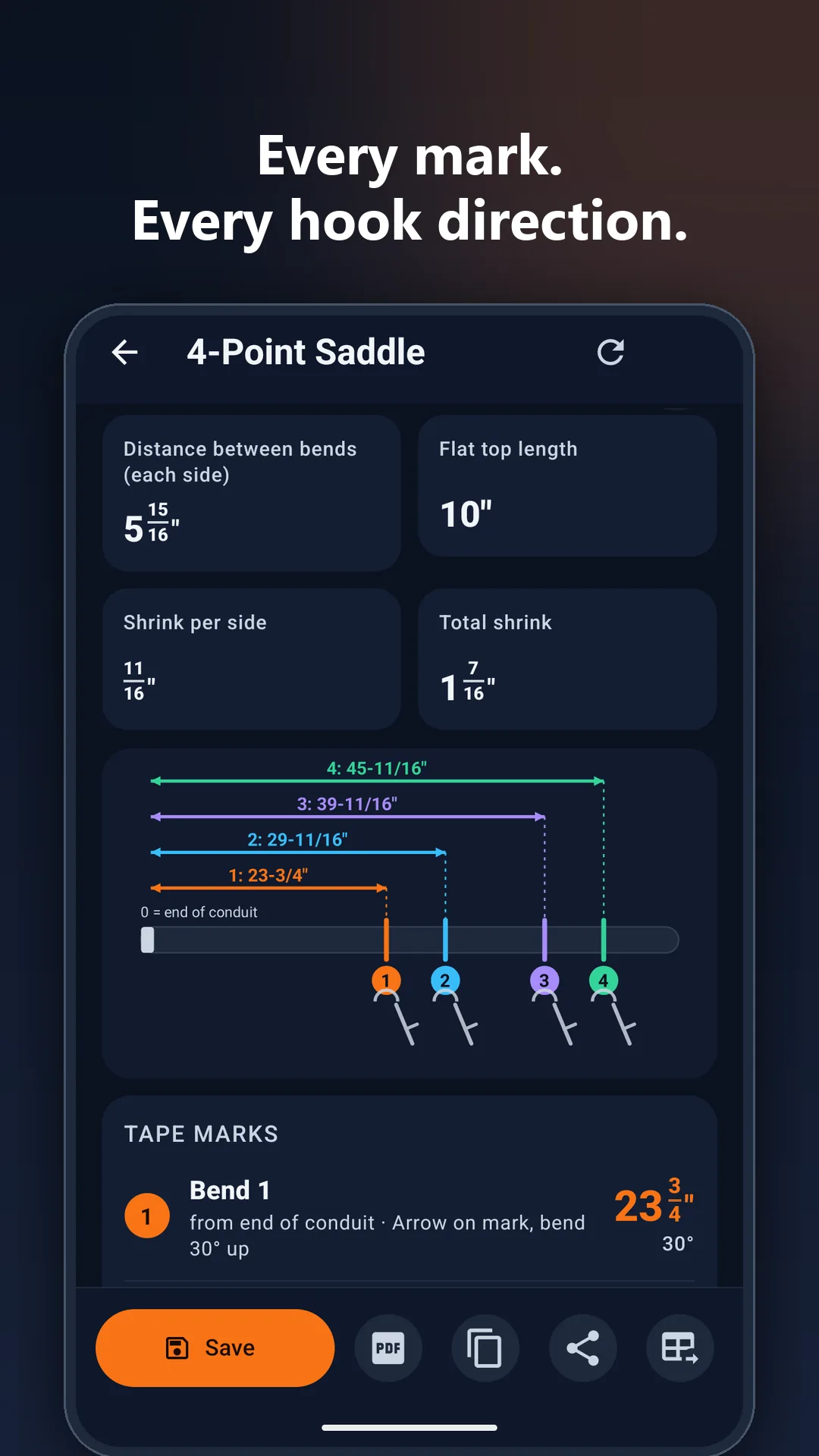
Every conduit in the rack, marked
- Both marks for every conduit, measured from the end of the pipe
- Offset spacing and shrink corrected for your bender
- Parallel kicks too, with the same adjustment
- Save the rack as a job and share a PDF with the crew
$7.99 one time · no subscription · no ads · works offline
Related calculators and charts
Distance between bends and shrink for any offset depth and angle.
Open →KickTravel and shrink for a single bend, or the angle from rise and run.
Open →ShrinkShrink for offsets, 3-point and 4-point saddles and kicks, and where to add it.
Open →Bending Multiplier ChartMultipliers, shrink per inch and a ready-made offset table from 1" to 24".
Open →Conduit Bending FormulasEvery formula behind offsets, saddles, 90s and kicks, with where each number comes from.
Open →