 Conduit Bending
By Blissom · Updated 2026-10-23
Layout values: check them against your own bender, on scrap first.
Short answer: add up every bend between two pull points; the total may not exceed 360°. Offsets count both bends, saddles count every bend, and a box or conduit body starts the count again.
The rule
Since the 2023 NEC, the rule sits in the "Bends" section of each raceway article: for EMT, 358.24(B) limits the total of all bends between pull points (for example conduit bodies and boxes) to 360°. Rigid metal conduit (344.24), IMC (342.24), PVC (352.24), flexible metal conduit (348.24) and the other conduit and tubing articles carry the same limit. Editions up to 2020 put it in the .26 sections and worded it as "the equivalent of four quarter bends"; the limit is the same. The 2026 NEC adds 300.24, which makes clear the limit applies across a run that changes raceway type, for example EMT into flexible metal conduit. Check which edition your jurisdiction has adopted.
A pull point is a properly installed, accessible box, conduit body or other fitting permitted to give access for pulling conductors: suitable pull boxes, junction boxes, device boxes and conduit bodies such as LBs. Ordinary couplings do not reset the count, and pull points must meet the accessibility and sizing rules (314.29 and the box and conduit body sizing sections). The count is per section, so a long run with an LB halfway along is two separate 360° budgets.
What each bend adds to the count
Count the angle of every bend actually made in the conduit. The bend type does not matter, only its degrees.
| Bend | Made of | Adds |
|---|---|---|
| 90° stub-up, elbow or sweep | one 90° | 90° |
| Kick | one bend, usually 10°–30° | 10°–30° |
| Box offset | two 10° bends | 20° |
| Offset at 22.5° | two 22.5° bends | 45° |
| Offset at 30° | two 30° bends | 60° |
| Offset at 45° | two 45° bends | 90° |
| 3-point saddle, 45° center | 45° + 22.5° + 22.5° | 90° |
| 3-point saddle, 60° center | 60° + 30° + 30° | 120° |
| 4-point saddle at 22.5° | four 22.5° bends | 90° |
| 4-point saddle at 45° | four 45° bends | 180° |
| Back-to-back 90s | two 90° | 180° |
| Segmented 90 | all shots together | 90° |
Factory elbows and sweeps count the same as field bends of the same angle.
Worked examples
A wall run into a panel
A run leaves a box with a 90° stub, crosses a ceiling with a 30° offset around a beam and a 45° saddle over a water pipe, and drops into a panel with another 90°.
- 90° + 60° (offset) + 90° (saddle) + 90° = 330°.
- 330° is within the limit, with 30° to spare. One more box offset (20°) would still fit; another 30° offset (60°) would not.
When a pull point is needed
The same run also needs a second offset at 45° to clear a duct.
- 330° + 90° = 420°, over the limit.
- Either install a properly sized, accessible pull box or suitable conduit body between the saddle and the second offset, or make the second offset with 22.5° bends (45° instead of 90°), which brings the run to 375°. That is still over, so here the pull point is the fix.
Staying under 360°
- Use smaller offset angles. A 22.5° offset counts 45°, a 45° offset counts 90°. When there is room, the shallow offset saves 45° of the budget. Shrink and distance between bends for each angle are on the offset calculator.
- Choose a 4-point saddle at 22.5° over a 3-point at 60°. 90° against 120°, and the conduit sits flatter.
- Combine moves. A rolling offset moves the run over and up with two bends instead of two separate offsets (four bends).
- Plan the pull points first. Put boxes and conduit bodies where the run changes direction most, then bend between them.
Why the limit exists
Bends increase the resistance the conductors meet as they are pulled. Pulling tension generally rises with friction and the accumulated bend angle, while sidewall pressure depends on the conductor tension, the bend radius and how the cables sit; too much of either can damage conductors or their insulation, so the NEC limits the total bends between pull points. Staying under 360° does not by itself guarantee an acceptable pull: long runs with large conductors can still need lubricant and a pulling machine.
Sources: NEC 2023: 358.24 (EMT), 344.24 (RMC), 342.24 (IMC), 352.24 (PVC), 348.24 (FMC); 358.26 and the other .26 sections in the 2020 and earlier editions; NEC 2026 300.24 (runs that change raceway type). Method.
Questions electricians ask
How many degrees of bends are allowed in a conduit run?
No more than 360° in total between pull points, the equivalent of four 90° bends. A pull point is a box, conduit body or other fitting where the wire can be pulled through and the pull restarted.
Does an offset count toward the 360 degrees?
Yes. An offset is two bends, so a 30° offset adds 60° and a 45° offset adds 90°. A small box offset of two 10° bends adds 20°.
Does a conduit body count as a pull point?
Yes, when it is accessible and suitable for pulling the conductors in it. Conduit bodies (LBs, LLs, LRs, Ts) and boxes installed that way are pull points, so the 360° count starts again after each one; couplings are not.
Does the 360 degree rule apply to PVC and rigid?
Yes. Each raceway article has the same rule in its .24 section (.26 before the 2023 NEC), for example 344.24 for rigid metal conduit, 352.24 for PVC and 358.24 for EMT.
Do large-radius sweeps count less than hand-bent 90s?
No. The rule counts degrees, not radius. A 36" sweep and a hand-bent 90 both count as 90°, although the sweep pulls more easily.
Lay out the whole run on one stick
- Run planner: several bends on one stick, every mark from the end
- Total shrink for the run, so the last bend lands where it should
- Offsets, saddles, kicks and 90s with your bender's take-up
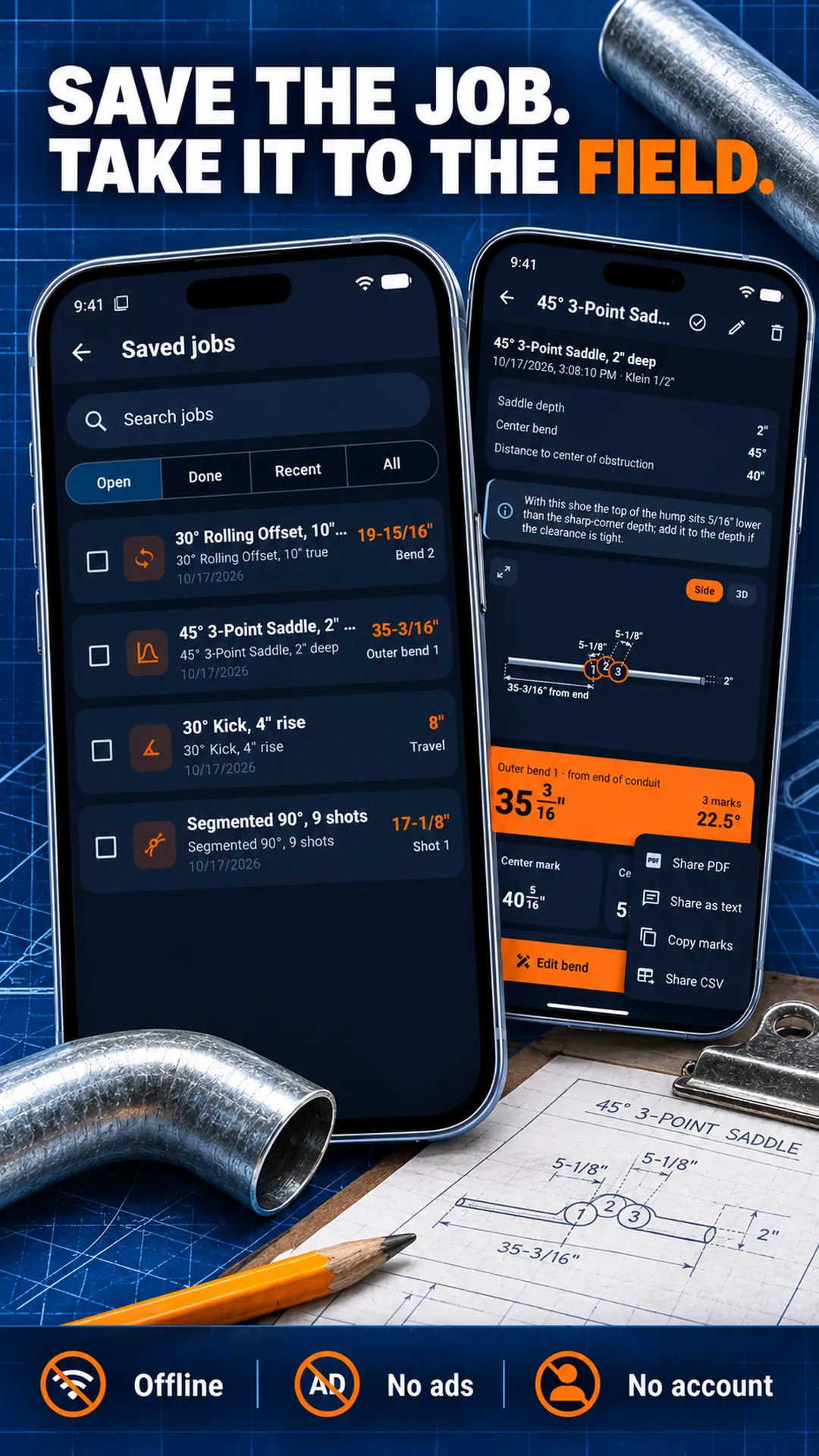
- Saved jobs and PDF bend sheets, offline
Android only. There is no iPhone version yet; the free calculators on this site work on any phone.
$7.99 one time · no subscription · no ads · works offline