By Blissom · Updated 2026-10-23
Layout values: check them against your own bender, on scrap first.

Download the 3/4" EMT chart as a one-page PDF
3/4" EMT and its bender
3/4" EMT is common for home runs and small equipment feeds; by fill area it takes up to sixteen #12 THHN or ten #10, before any ampacity adjustment. It is also the shoe you use for 1/2" rigid and IMC.
| Outside diameter | 0.922" |
| Inside diameter (from NEC internal area) | 0.824" |
| Internal area (NEC Chapter 9, Table 4) | 0.533 in² |
| Hand-bender take-up (deduct) | 6" |
| NEC minimum radius (Ch. 9, Table 2) | 4-1/2" |
| Klein 51607 centerline radius | 5-1/2" |
| Gain of a 90 (centerline) | 2-3/8" |
| Gain, legs to the back | 3-5/16" |
| Developed length of a 90 | 8-5/8" |
| Rigid / IMC that bends on this shoe | 1/2", if the shoe is rated for it (same 6" take-up) |
6" is the 3/4" EMT take-up in Klein's guides, and it carries over to 1/2" rigid when the shoe is rated for rigid. Confirm it on your own shoe once: arrow at 10" on a scrap, bend, measure, subtract 10.
Stub-up marks for 3/4" EMT
3/4" stubs are typically home runs out of a panel or risers up a wall to a junction box. Subtract 6", and remember that mixing 1/2" and 3/4" on one job is the usual way stubs end up an inch off.
| Stub height | Arrow mark from end |
|---|---|
| 8" | 2" |
| 10" | 4" |
| 12" | 6" |
| 14" | 8" |
| 16" | 10" |
| 18" | 12" |
| 20" | 14" |
| 24" | 18" |
| 30" | 24" |
| 36" | 30" |
| 42" | 36" |
| 48" | 42" |
With a 6" take-up, stubs shorter than about 8" leave too little conduit in the shoe. Bend a longer stub and cut it, or bend the 90 from the long end of the stick.
Back-to-back 90s on 3/4" EMT
On the 3/4" shoe the arrow mark sits 6" inside the star mark. For long 3/4" U-bends between two panels, mark the second 90 from the back of the first, not from the end of the stick.
| Back-to-back distance | Star mark | Arrow mark |
|---|---|---|
| 18" | 18" | 12" |
| 24" | 24" | 18" |
| 30" | 30" | 24" |
| 36" | 36" | 30" |
| 42" | 42" | 36" |
| 48" | 48" | 42" |
| 60" | 60" | 54" |
| 72" | 72" | 66" |
Star column: 3/4" back-to-back distance from the back of the first 90, hook away from it. Arrow column: 6" less, hook toward the first 90; that leg swings toward you, so stand clear. Same plane for both 90s.
Cut lengths for pieces with 90s
On a Klein 51607 (5-1/2" centerline radius) a 3/4" 90 saves 3.283" (about 3-5/16") against its two legs measured to the back, about 6-9/16" on a piece with two 90s. Greenlee’s 841AH (5-1/8") saves a little less; the gain-by-radius table covers both. The table uses the unrounded gain.
| Piece | Legs added | Cut length |
|---|---|---|
| Stub 12" and a 36" leg | 48" | 44-11/16" |
| Stub 18" and a 48" leg | 66" | 62-11/16" |
| U: 12" + 30" + 12" | 54" | 47-7/16" |
| U: 24" + 48" + 24" | 96" | 89-7/16" |
Worked example on 3/4" EMT
3/4" piece: 16" stub, 48" leg (both to the back of the 90).
- Arrow mark: 16 − 6 = 10" from the stub end.
- Cut length: 64" of legs − 3.283" gain = 60-11/16".
Gain by shoe radius
Gain = 0.429 × your shoe's centerline radius, plus 0.922" to the back of the 90.
| Centerline radius | Gain (centerline) | Gain to back of 90 | Developed 90 |
|---|---|---|---|
| 4-1/2" (NEC minimum) | 1-15/16" | 2-7/8" | 7-1/16" |
| 5-1/2" (Klein 51607) | 2-3/8" | 3-5/16" | 8-5/8" |
| 6" | 2-9/16" | 3-1/2" | 9-7/16" |
| 6-1/2" | 2-13/16" | 3-11/16" | 10-3/16" |
| 7" | 3" | 3-15/16" | 11" |
| 7-1/2" | 3-1/4" | 4-1/8" | 11-3/4" |
Gain at each angle on a 5-1/2" radius 3/4" shoe
At a 5-1/2" radius, a 45° bend on 3/4" gains about 1/4" and a 60° bend about 9/16", so on deep 45° and 60° offsets in 3/4" the field marks start to drift from the bend geometry. This is separate from the offset shrink allowance, which still applies.
| Bend angle | 10° | 22.5° | 30° | 45° | 60° | 90° |
|---|---|---|---|---|---|---|
| Gain (centerline) | 0.002" | 0.028" | 0.068" | 0.237" | 0.591" | 2.361" |
Offsets, saddles and kicks on a 5-1/2" 3/4" shoe
Theoretical minimum offset for two adjoining bends on this 5-1/2" 3/4" radius: 2 × radius × (1 − cos θ), rounded up. These are geometric lower bounds, not workable minimums: shoe length, hook clearance and the maker's instructions set the real limit, so check on your bender.
| Angle | Multiplier | Field shrink per inch | Theoretical minimum offset (5-1/2" radius) |
|---|---|---|---|
| 10° | 6.0 | 1/16" | 3/16" |
| 22.5° | 2.6 | 3/16" | 7/8" |
| 30° | 2.0 | 1/4" | 1-1/2" |
| 45° | 1.4 | 3/8" | 3-1/4" |
Marks for a 3/4" saddle, kick or offset; every bend counts toward the 360° maximum between pull points (NEC 2023 358.24(B); the 2026 NEC adds 300.24 for mixed raceway types).
How many wires fit in 3/4" EMT
By conduit area, 3/4" EMT takes up to sixteen #12 or ten #10 THHN of one size and insulation at 40%. Mixed wire sizes: conduit fill calculator.
| Wire | THHN / THWN | XHHW | THW |
|---|---|---|---|
| #14 | 22 | 15 | 10 |
| #12 | 16 | 11 | 8 |
| #10 | 10 | 8 | 6 |
| #8 | 6 | 5 | 4 |
| #6 | 4 | 3 | 3 |
| #4 | 2 | 2 | 1 |
3/4" fill counts are not circuit capacity: grounds count toward fill, and over three current-carrying wires usually need ampacity adjustment (NEC 310.15(C)(1)).
Bending 3/4" EMT well
A 3/4" bender is still a one-person floor bend, but it takes noticeably more foot pressure than 1/2". The 6" take-up and the larger shoe (5-1/8" to 5-1/2" radius on common models) mean 3/4" stubs come out a little taller than the same mark on 1/2", which is the most common mix-up when you switch shoes during a job.
- Using the 1/2" take-up (5") on a 3/4" shoe: every stub comes out 1" too tall.
- Bending 1/2" rigid on the 3/4" shoe with the 1/2" EMT numbers: rigid on a 3/4" EMT shoe rated for it uses that shoe’s 6" take-up.
- Dog-legged offsets: the stiffer conduit makes it easier to rotate less than 180° between bends; sight down the pipe before the second bend.
Sources: NEC 2023 358.24 and Chapter 9, Table 2; Klein Tools Conduit Bender Guide (stub take-up, offset multipliers and shrink, saddles). Method.
Questions electricians ask
What is the take-up for 3/4 inch EMT?
Klein lists 6 inches for its 3/4" shoes; read the number on yours. For a 12" stub the arrow goes 6" from the end.
Can you bend 1/2 rigid with a 3/4 EMT bender?
Yes. 1/2" rigid and IMC fit the 3/4" EMT shoe and use its 6" take-up.
How many #12 wires fit in 3/4 inch EMT?
Sixteen #12 THHN at 40% fill; ten #10 THHN.
How many #8 THHN fit in 3/4 inch EMT?
Six #8 THHN at the 40% limit (0.2132 in² allowed ÷ 0.0366 in² each = 5.8, and NEC Chapter 9 Note 7 rounds 0.8 and above up). Four #6 THHN fit, or two #4.
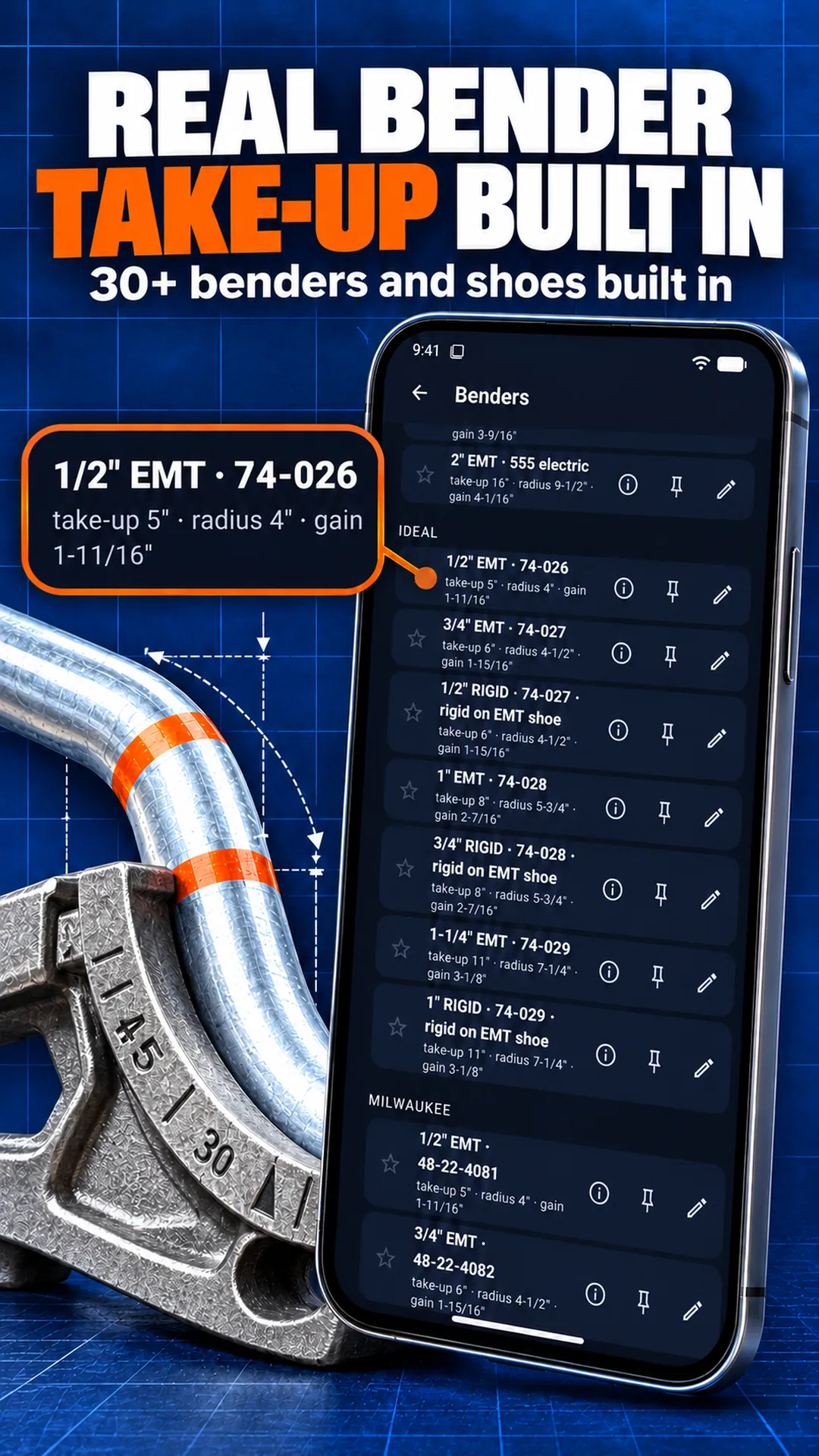
Your 3/4" shoe, already loaded
- 3/4" EMT and 1/2" rigid on the same shoe, with the right take-up for each
- Offsets corrected for the 4-1/2" radius
- Back-to-back and U-bends from the same mark
- Saved jobs and PDF bend sheets
Android only. There is no iPhone version yet; the free calculators on this site work on any phone.
$7.99 one time · no subscription · no ads · works offline