 Conduit Bending
Updated 2026-09-29
Tools
- A PVC heater: an electric hot box, a heating blanket or a hot-air bender made for PVC. They heat evenly without scorching.
- Gloves for handling hot conduit.
- A bending form or template at the radius you want, or a chalk layout on the floor.
- End plugs for 1-1/2" and larger.
- A wet rag or water to cool and set the bend.
Heating PVC correctly
- Mark the bend: where it starts and how long it is. The heated length should be at least the developed length of the bend, the arc itself: π × R ÷ 2 for a 90.
- Heat evenly: keep the conduit turning so every side softens the same. Uneven heat gives a bend that ovals or twists.
- Test for limp: the section is ready when it sags under its own weight. Brown or blistered PVC is overheated; cut it off.
- Form and hold: bend over the form to the angle, keep the bend in one plane, and hold it until it cools. A wet rag sets it faster.
Bending a 90 in PVC
There is no take-up printed on a heater, so work from the radius. For a stub measured from the floor to the end:
Example: a 24" stub in 1" PVC on a 5-3/4" radius (OD 1.315"): the bend starts 24 − (5.75 + 0.66) ≈ 17-9/16" from the end, and you heat about 9-1/16" beyond that point. Many electricians use factory elbows for 90s and save field bending for offsets and kicks.
Offsets, kicks and saddles
The geometry of a bend does not depend on the material, so the same numbers apply: distance between offset bends = depth × multiplier (30° = 2), shrink = depth × shrink per inch (30° = 1/4"). Heat each bend separately, make the first, let it set, then heat and make the second in the same plane. Use the offset calculator and the bending chart for the marks.
Minimum bend radius
| Trade size | Minimum radius (centerline) | PVC OD | Arc of a 90 |
|---|---|---|---|
| 1/2" | 4" | 0.840" | 6-5/16" |
| 3/4" | 4-1/2" | 1.050" | 7-1/16" |
| 1" | 5-3/4" | 1.315" | 9-1/16" |
| 1-1/4" | 7-1/4" | 1.660" | 11-3/8" |
| 1-1/2" | 8-1/4" | 1.900" | 12-15/16" |
| 2" | 9-1/2" | 2.375" | 14-15/16" |
Minimum radii per NEC Chapter 9, Table 2 for one-shot and full-shoe bends. Larger radii pull easier.
Mistakes
- Using a torch. Open flame scorches the surface and weakens the wall.
- Heating one side. The bend kinks on the cold side or twists.
- Moving it before it cools. PVC creeps back while warm; hold the angle until it is set.
- Too tight a radius, which flattens the pipe and reduces the internal diameter, a code violation.
- More than 360° of bends between pull points (352.26). Add a pull point.
Questions electricians ask
Can you bend PVC conduit without a heater?
Not properly. A heat gun can soften small sizes slowly but unevenly, and an open flame scorches and weakens PVC. Use a PVC heater (hot box), a heating blanket or an electric bender designed for PVC, or use factory elbows.
How long do you heat PVC conduit to bend it?
Until the whole section to be bent is uniformly soft and limp, typically a minute or two for 1/2" and longer for larger sizes, turning it constantly. It is ready when it droops under its own weight; follow the heater manufacturer's times.
Why plug the ends of PVC before bending?
On 1-1/2" and larger, plugging both ends traps air that holds the pipe round while it is soft, so the bend does not flatten or kink.
Is a field bend in PVC allowed by the NEC?
Yes. NEC 352.24 allows field bends made with bending equipment identified for the purpose, as long as the conduit is not damaged and its internal diameter is not effectively reduced, with a radius not less than Chapter 9, Table 2.
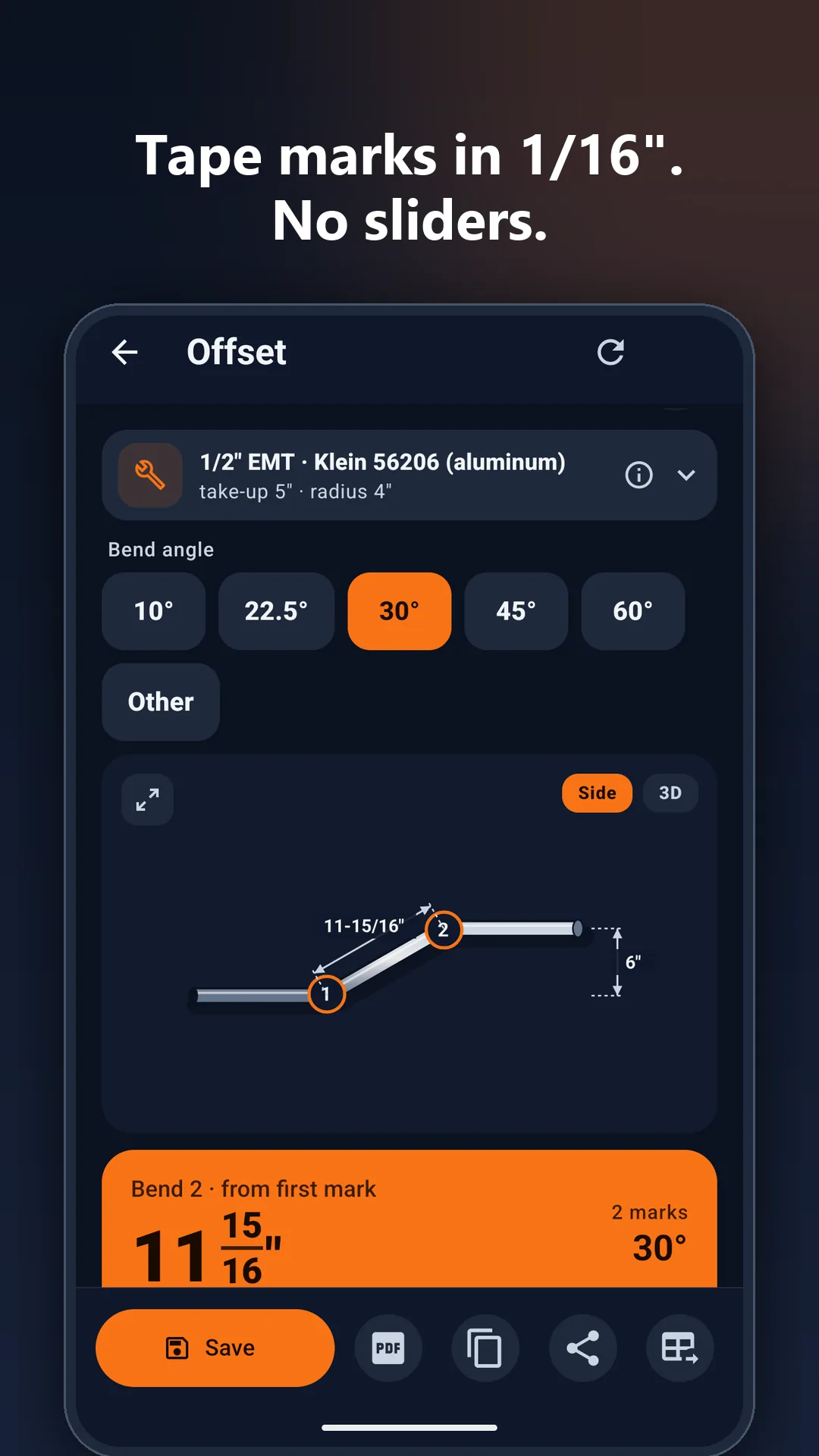
The marks for any conduit
- Offsets, saddles and kicks with shrink, for PVC, EMT or rigid
- Developed length of every bend, so you know how much to heat
- Metric or inches, offline on site
- Saved jobs and PDF bend sheets
$7.99 one time · no subscription · no ads · works offline
Keep going
Distance between bends and shrink for any offset depth and angle.
Open →Bending Multiplier ChartMultipliers, shrink per inch and a ready-made offset table from 1" to 24".
Open →How to Bend Rigid & IMCWhich bender for each size, take-up for rigid on EMT shoes, spring-back, hickeys.
Open →How to Bend ConduitA complete hand-bender guide from the first 90 to saddles, with the marks for each.
Open →Conduit Sizes ChartActual outside and inside diameters of EMT, rigid and PVC, 1/2" to 4".
Open →