By Blissom · Updated 2026-11-04

Fill table for 1" EMT
1" EMT has 0.864 in² inside. Every number below is the 40% limit divided by one conductor's area, with Note 7 rounding.
| Wire | THHN / THWN-2 | XHHW-2 | THW |
|---|---|---|---|
| #14 | 35 | 25 | 16 |
| #12 | 26 | 19 | 13 |
| #10 | 16 | 14 | 10 |
| #8 | 9 | 8 | 6 |
| #6 | 7 | 6 | 4 |
| #4 | 4 | 4 | 3 |
| #3 | 3 | 3 | 3 |
| #2 | 3 | 3 | 2 |
| #1 | 1 | 1 | 1 |
| #1/0 | 1 | 1 | 1 |
| #2/0 | 1 | 1 | 1 |
| #3/0 | 1 | 1 | 1 |
| #4/0 | 1 | 1 | 1 |
| 250 kcmil | 1 | 1 | 1 |
| 300 kcmil | 1 | 1 | 1 |
| 350 kcmil | 1 | 1 | — |
The single-conductor rows use 53%. THW is shown with the larger of its Table 5 dimensions, matching Annex C.
The derating ceiling
Each band in 310.15(C)(1) multiplies the 90 °C ampacity of THHN. The table shows the result and whether it still covers the breaker.
| Wire and breaker | Fits by fill | Current-carrying limit | What stops you first |
|---|---|---|---|
| #14 on 15 A | 35 | 9 | Derating |
| #12 on 20 A | 26 | 9 | Derating |
| #10 on 20 A | 16 | 20 | Fill |
| #10 on 30 A | 16 | 6 | Derating |
The band-by-band derating table (80%, 70%, 50% and lower) is the same for every pipe size; it is on the 3/4" EMT page. The fill count includes one ground, which never counts toward the current-carrying limit.
For #12 the cliff is between nine and ten. That ceiling of 9 is the same in 1/2", 1" or 2" pipe; a bigger raceway buys space, not ampacity.
#10 on 30 A stops at 6. At seven to nine it is 28 A. 240.4(B) allows the next standard breaker above an ampacity, but not on multioutlet circuits feeding receptacles, and the load still has to fit the 28 A. The table uses the plain test: ampacity at least the breaker.
More circuits with #10 on 20 A
Pull #10 and protect it at 20 A, and the 50% band leaves exactly 20 A. That keeps it legal up to 20 current-carrying conductors. In 1" the fill limit of 16 #10 becomes the ceiling instead.
This is common on long commercial home runs, where #10 is often pulled for voltage drop anyway. It costs wire and fill, so compare it to a second pipe.
Circuit count by method
Each circuit with its own neutral uses two current-carrying conductors. A 120/240 V multiwire circuit uses two for two circuits, because the shared neutral only carries the imbalance (310.15(E)). The tally below leaves one fill slot for an insulated ground of the same size.
| Wire and breaker | Max current-carrying | Own neutrals | Shared neutrals |
|---|---|---|---|
| #14 THHN, 15 A | 9 | 4 | 8 |
| #12 THHN, 20 A | 9 | 4 | 8 |
| #10 THHN, 20 A | 15 | 7 | 10 |
| #10 THHN, 30 A | 6 | 3 | 6 |
A 208Y/120 V circuit of two phases and a neutral counts its neutral. So does a four-wire wye circuit that mostly feeds nonlinear loads.
Three loads for a 1" run
Eight 20 A circuits on four multiwire sets
| Conductors | Area each (in²) | Subtotal (in²) |
|---|---|---|
| 8 × #12 THHN (hots) | 0.0133 | 0.1064 |
| 4 × #12 THHN (shared neutrals) | 0.0133 | 0.0532 |
| 1 × #12 THHN (ground) | 0.0133 | 0.0133 |
| Total, 13 conductors | 0.1729 | |
| Allowed: 40% of 0.864 in² | 0.3456 |
20.0% fill. Eight hots count, the neutrals do not: factor 70%, 21 A per conductor. Two more hots would cross into the 50% band and fail.
A 60 A feeder to a garage subpanel
| Conductors | Area each (in²) | Subtotal (in²) |
|---|---|---|
| 3 × #6 THHN (two hots and a neutral) | 0.0507 | 0.1521 |
| 1 × #10 THHN (ground (Table 250.122)) | 0.0211 | 0.0211 |
| Total, 4 conductors | 0.1732 | |
| Allowed: 40% of 0.864 in² | 0.3456 |
20.0% fill and only two current-carrying conductors. #6 is 65 A at 75 °C but 55 A at 60 °C, so it needs 75 °C rated terminations at both ends. Most current panelboards and breakers carry that marking; check yours. Otherwise use #4.
Ten 20 A circuits on #10
| Conductors | Area each (in²) | Subtotal (in²) |
|---|---|---|
| 10 × #10 THHN (hots) | 0.0211 | 0.2110 |
| 5 × #10 THHN (shared neutrals) | 0.0211 | 0.1055 |
| 1 × #10 THHN (ground) | 0.0211 | 0.0211 |
| Total, 16 conductors | 0.3376 | |
| Allowed: 40% of 0.864 in² | 0.3456 |
39.1% fill, right at the limit but legal. Ten current-carrying conductors at 50% leave 20 A, equal to the 20 A breakers. On #12 the same ten circuits would need a second pipe.
Split the run or go bigger
- Past nine #12 circuit conductors: a second raceway resets the count. Two 3/4" runs often bend easier than one big bundle.
- A full pipe with several bends: 26 #12 is legal, but a full 1" with 360° of bends is a hard pull. Add a pull point or step up to 1-1/4".
- Planned growth: leaving fill headroom is cheap. Leaving derating headroom means fewer conductors now, not a bigger pipe.
Hot locations add an ambient correction (310.15(B)) on top of the bundle factor. Values here are NEC 2023; verify against the edition your inspector enforces, and run mixed loads through the fill calculator.
Sources: NEC 2023: Chapter 9, Tables 1, 4 and 5 with Note 7 (fill); 310.15(C)(1) (adjustment for more than three current-carrying conductors), 310.15(E) and (F) (neutrals and grounds), Table 310.16, 240.4(D) and 110.14(C). Method.
Questions electricians ask
How many wires can you put in a 1 inch EMT?
26 #12 THHN, 35 #14 THHN, 16 #10 THHN or 9 #8 THHN, counting the ground. These are the NEC Chapter 9 maximums with Note 7 rounding.
How many 20 amp circuits can run in 1 inch conduit?
With #12 THHN: 4 with individual neutrals or 8 on 120/240 V shared neutrals. With #10 THHN on 20 A breakers: 7 or 10, because #10 stays above 20 A at the 50% factor.
Why can I not fill 1 inch EMT with 26 #12 circuits?
Above 9 current-carrying #12 conductors the factor drops to 50%, giving 15 A. That is below a 20 A breaker, so the conductors would not be protected at their ampacity.
Do grounds count in 1 inch conduit fill?
In fill, yes: an insulated ground uses its Table 5 area. In derating, no: 310.15(F) leaves grounding and bonding conductors out of the count.
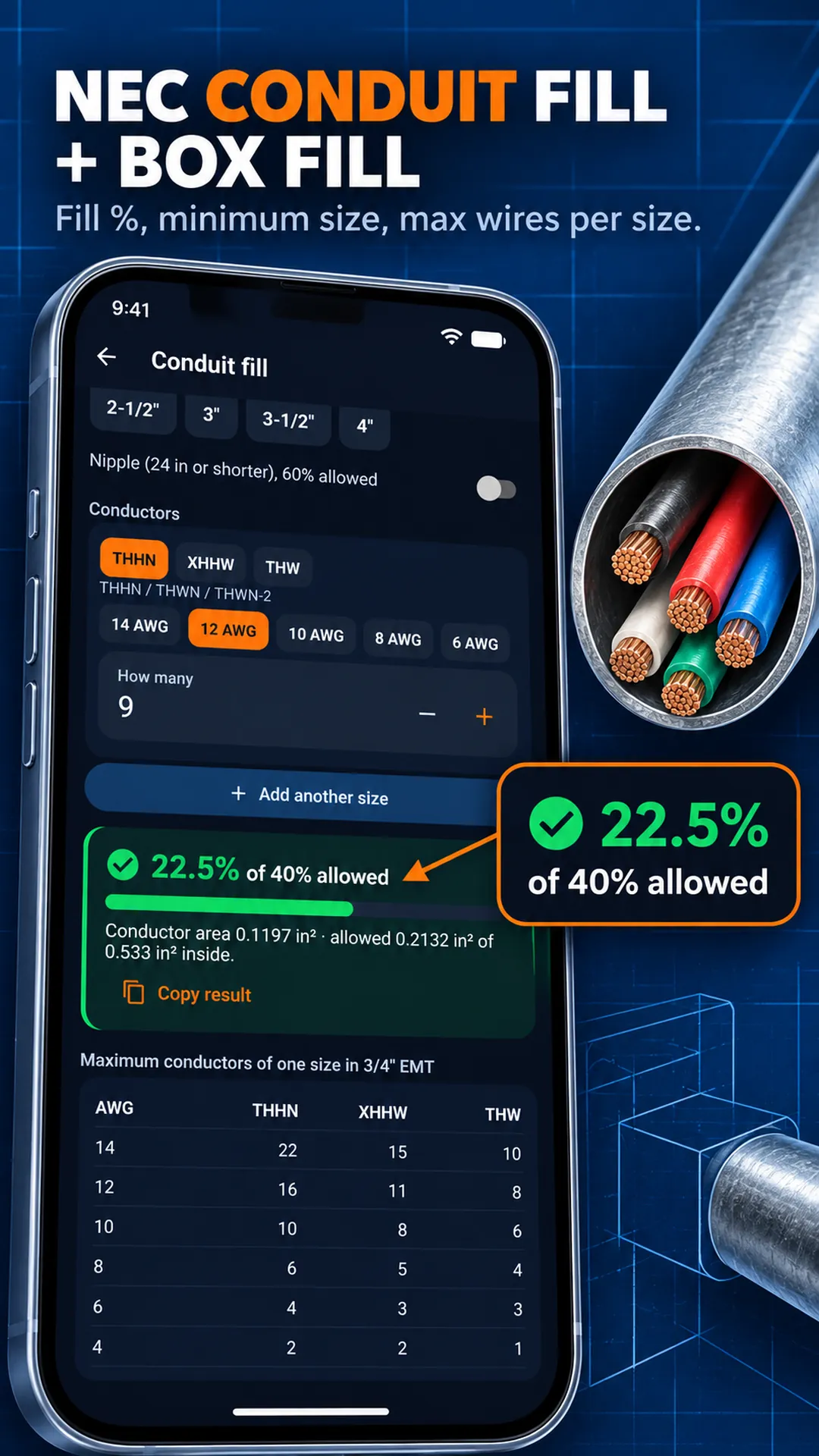
Size the pipe, then bend it
- NEC conduit fill with grounds and mixed sizes
- Box fill per 314.16 for every junction
- 1" offsets, saddles and 90s from your bender
- Offline, no account
Android only. There is no iPhone version yet; the free calculators on this site work on any phone.
$7.99 one time · no subscription · no ads · works offline