 Conduit Bending
By Blissom · Updated 2026-11-04
Short answer: straight pull = 8 × largest trade size. Angle or U pull = for each wall, 6 × the largest trade size in a row + the other trade sizes in that row, using the row that comes out largest. Entries of the same conductors at least 6 × the larger trade size apart. Rules apply to conductors 4 AWG and up.
The three rules of 314.28(A)
| Pull | Dimension | Minimum |
|---|---|---|
| Straight (in one end, out the opposite end) | Length between the entry and exit walls | 8 × largest trade size |
| Angle (in one wall, out an adjacent wall) | Each entry wall to its opposite wall | 6 × largest in the row + sum of the rest of the row |
| U (in and out the same wall) | Entry wall to the opposite wall | 6 × largest in the row + sum of the rest of the row |
| Angle or U | Spacing between entries carrying the same conductors | 6 × the larger of the two trade sizes |
The numbers are trade sizes, not measured diameters, and the result is in inches. A box with both a straight pull and an angle pull through it has to satisfy both rules in each direction.
Minimum straight-pull length by trade size
Only the largest raceway matters for a straight pull. The single-raceway angle distance is in the last column for comparison; add the rest of the row to it.
| Largest raceway | Straight pull: 8× | Angle/U, one raceway: 6× |
|---|---|---|
| 1" | 8" | 6" |
| 1-1/4" | 10" | 7.5" |
| 1-1/2" | 12" | 9" |
| 2" | 16" | 12" |
| 2-1/2" | 20" | 15" |
| 3" | 24" | 18" |
| 3-1/2" | 28" | 21" |
| 4" | 32" | 24" |
| 5" | 40" | 30" |
| 6" | 48" | 36" |
Three worked examples
1. Straight pull on a feeder run
Two 3" and one 2" raceway enter one end of the box and continue out the other end in line.
- Largest trade size: 3.
- 8 × 3 = 24" minimum length. The 2" does not change it.
- Width and depth: whatever fits the three raceways, locknuts and bushings on the end walls.
2. Angle pull with one row per wall
The same three raceways (two 3" and one 2") enter the left wall and turn 90° out the bottom wall through another 3", 3" and 2".
- Left wall row: 6 × 3 + (3 + 2) = 18 + 5 = 23" to the right wall.
- Bottom wall row: same raceways, same 23" to the top wall.
- The pair of 3" raceways carrying the same conductors: at least 6 × 3 = 18" apart.
- Minimum box: 23" × 23", depth to suit the 3" fittings.
3. U pull with two rows on one wall
Conductors come up through the bottom wall and go back down through it. The upper row has two 2" and two 1-1/2" raceways; the lower row has two 1" raceways.
- Row 1: 6 × 2 + (2 + 1-1/2 + 1-1/2) = 12 + 5 = 17".
- Row 2: 6 × 1 + 1 = 7".
- Row 1 governs: the top wall is at least 17" from the bottom wall. Rows are never added together.
- The two 2" raceways carrying the same conductors: at least 6 × 2 = 12" apart along the bottom wall.
Rows, walls and what "governs"
A row is a line of raceways side by side on one wall. When a wall has two or more rows, work out each row by itself and use the largest result. A wall without entries does not get its own calculation; it is just the "opposite wall" for the wall facing it.
In an angle pull the box usually ends up with two different dimensions, one from each entry wall. If both walls carry the same raceways, as in example 2, the box comes out square.
The 6× spacing between the entry and exit of the same conductors keeps a tight loop of large wire from being forced into the box. It also decides how far apart the knockouts go, so lay those out before cutting.
Smaller listed boxes: 314.28(A)(3)
Boxes and conduit bodies can be smaller than the calculation where they are listed and permanently marked with the maximum number and size of conductors permitted. The marking, not this calculation, then sets the limit. If the conductors you are pulling exceed the marking, size the box by 314.28(A)(1) and (A)(2).
Where pull box sizing goes wrong
- Adding both rows. Rows are calculated separately; only the largest row counts.
- Counting the largest raceway twice. It is 6 × the largest, plus the others, not plus all of them.
- Using outside diameters. The rule uses trade sizes. A 2" raceway adds 2, not its measured OD.
- Sizing for the straight pull only. If a 90° turn also happens in the same box, the angle rule applies too.
- Too many bends before the box. A correctly sized box still has to be where the run needs it; the 360° limit applies between pull points.
- Applying it to small conductors. Below 4 AWG, the box is sized by box fill, not 314.28.
Check the NEC edition your jurisdiction enforces and any engineered drawings for the job: these are minimums, and large pulls often need more room to work.
Sources: NEC 2023: 314.28(A)(1) straight pulls, 314.28(A)(2) angle and U pulls, 314.28(A)(3) smaller dimensions for listed boxes. Method.
Questions electricians ask
How do you size a pull box for a straight pull?
Multiply the trade size of the largest raceway by 8. Two 3" conduits and a 2" entering a straight pull box need a box at least 24" long between the walls where the conductors enter and leave (314.28(A)(1)).
What is the 6 times rule for pull boxes?
For angle and U pulls, the distance from each raceway entry to the opposite wall must be at least 6 times the largest trade size in that row, plus the sum of the other trade sizes in the same row on the same wall (314.28(A)(2)). Raceways that carry the same conductors must also enter at least 6 times the larger trade size apart.
Do pull box sizing rules apply to 12 AWG wire?
No. 314.28(A) applies where the box contains conductors 4 AWG and larger. Boxes with smaller conductors only have to meet the box fill rules of 314.16.
Is the pull box rule based on trade size or actual diameter?
On trade size. A 2" conduit counts as 2 whatever its actual outside diameter, so a 2" row partner adds 2" to the distance.
Can a pull box be smaller than 314.28 requires?
Only if it is listed and marked for the smaller dimensions and the conductor sizes in it, as 314.28(A)(3) allows. Check the marking against the conductors you are pulling.
Plan the run before you size the box
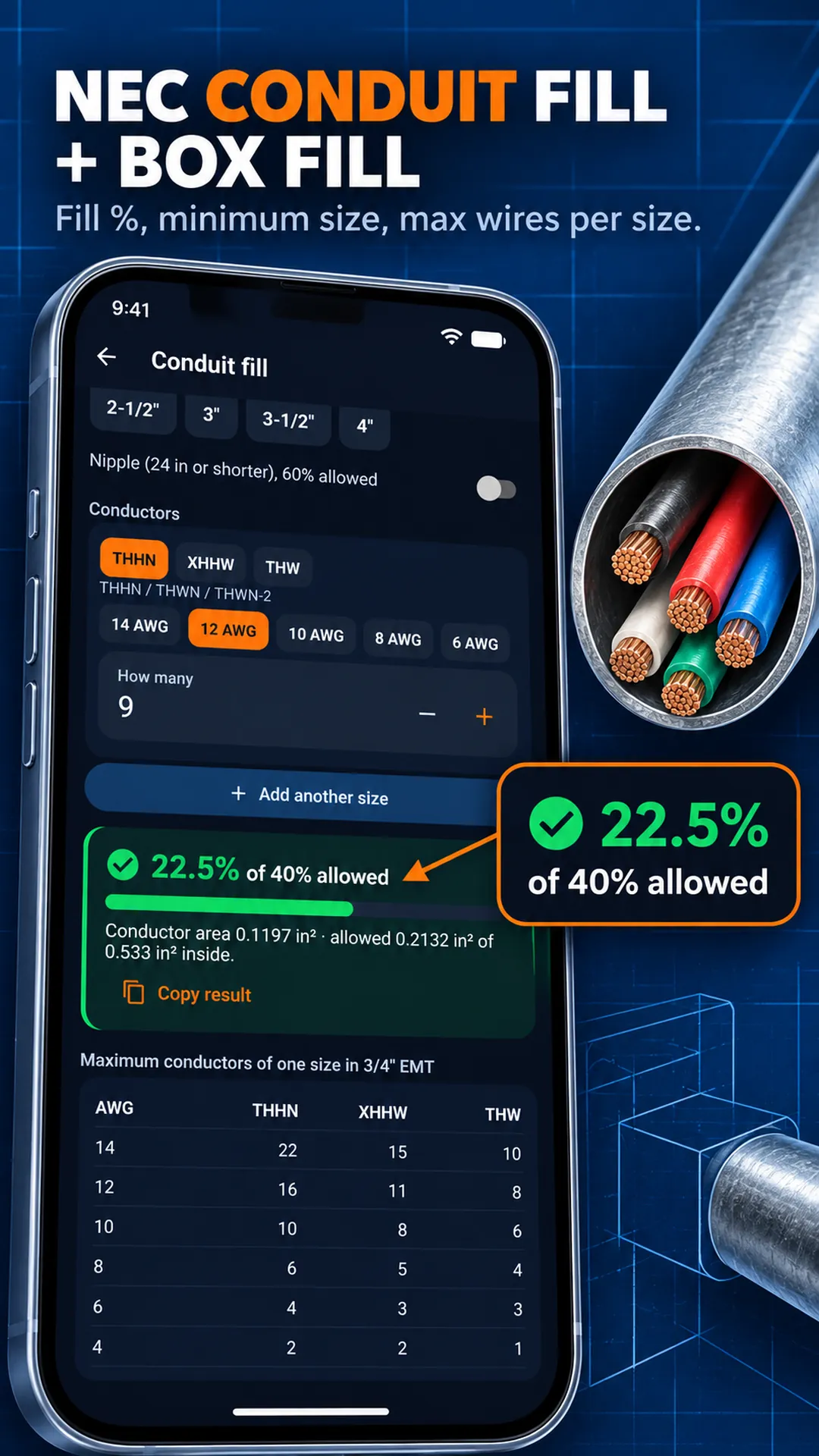
- NEC conduit fill and box fill for every run
- Every bend: offsets, saddles, kicks, 90s, segmented
- Marks measured from the end of the conduit
- Offline, no account
Android only. There is no iPhone version yet; the free calculators on this site work on any phone.
$7.99 one time · no subscription · no ads · works offline