By Blissom · Updated 2026-11-04
Layout values: check them against your own bender, on scrap first.

Formulas you need
All radii are to the conduit centerline. Lengths are rounded to the nearest 1/16".
Which spacing the exam wants: ÷ shots or ÷ (shots − 1)
There are two ways to share a developed length among the shots, and they give different answers to the same question:
- Developed length ÷ shots. The arc is cut into as many equal pieces as there are shots, and each shot is bent in the middle of its piece: the first mark sits half a space past the start of the curve and the last mark half a space before the end. This is how segment-bender manuals lay it out, how the segmented 90 calculator and our exam questions work, and what the standard question expects: 60" in 15 shots is 4" between shots.
- Developed length ÷ (shots − 1). The first and last shots are put exactly on the start and end of the arc, so there is one fewer space than shots: 60" in 15 shots becomes 4-5/16". Use it only when the question says the shots land on the ends of the arc.
If an answer list has both numbers, the plain wording ("developed length of 60 inches, 15 shots, ___ between shots") wants developed length ÷ shots.
Spacing between shots from the developed length
The most common segmented question on apprentice tests gives the developed length and the number of shots and asks for the spacing. Divide the developed length by the number of shots.
A 90° segmented bend with 10 shots and a developed length of 45 inches will have ___ between shots.
- a. 2-7/8"
- b. 4-1/2"
- c. 5"
- d. 9"
Answer: b. 4-1/2".
- Spacing = developed length ÷ shots = 45 ÷ 10 = 4-1/2".
- Degrees per shot = 90 ÷ 10 = 9°. The 9" option is that number mistaken for inches.
- 5" comes from dividing by 9 (shots − 1); 2-7/8" comes from dividing the radius (45 ÷ 1.571 = 28.65") instead of the developed length.
A 90° segmented bend with 9 shots and a developed length of 54 inches will have ___ between shots.
- a. 6"
- b. 10"
- c. 6-3/4"
- d. 3-13/16"
Answer: a. 6".
- 54 ÷ 9 = 6" between shots.
- Each shot is 90 ÷ 9 = 10°.
- Behind it is a 34-3/8" radius (54 ÷ 1.571).
A 90° segmented bend with 15 shots and a developed length of 75 inches will have ___ between shots.
- a. 5-3/8"
- b. 6"
- c. 5"
- d. 3-3/16"
Answer: c. 5".
- 75 ÷ 15 = 5".
- 6° per shot. Fifteen shots make a smooth sweep, but every mark has to be accurate because small errors add up over fifteen bends.
A 90° segmented bend is laid out in 18 shots with a developed length of 63". What is the spacing between shots, and how many degrees is each shot?
Answer: 3-1/2" between shots, 5° per shot.
- Spacing: 63 ÷ 18 = 3.50" = 3-1/2".
- Degrees: 90 ÷ 18 = 5°.
A 90° segmented bend with 15 shots and a developed length of 60" is laid out so the first and last shots sit exactly on the start and end of the arc. What is the spacing between shots?
- a. 4"
- b. 4-5/16"
- c. 4-5/8"
- d. 6"
Answer: b. 4-5/16".
- With a shot on each end of the arc, 15 shots have only 14 spaces between them.
- Spacing = 60 ÷ 14 = 4.286" = 4-5/16".
- This is the other convention. When a question just says "developed length" and "shots" without saying the shots land on the ends, the expected answer is 60 ÷ 15 = 4", with the first shot half a space in from the start of the arc.
Number of shots and degrees per shot
Degrees per shot = total angle ÷ shots. Shots = total angle ÷ degrees per shot. Count shots, not spaces.
A 90° segmented bend is made with 6° shots. How many shots does it take?
- a. 9
- b. 14
- c. 15
- d. 16
Answer: c. 15.
- Shots = 90 ÷ 6 = 15.
- Answering 14 counts the spaces between shots instead of the shots themselves.
A 60° segmented bend is made in 8 shots. How many degrees is each shot?
Answer: 7.5° per shot.
- Degrees per shot = total angle ÷ shots = 60 ÷ 8 = 7.5°.
- The sweep counts 60°, not 8 bends, toward the 360° between pull points.
A 90° sweep has a developed length of 66". The layout calls for marks 5-1/2" apart. How many shots is it, and how many degrees per shot?
Answer: 12 shots of 7.5°.
- Shots = developed length ÷ spacing = 66 ÷ 5.5 = 12.
- Degrees per shot = 90 ÷ 12 = 7.5°.
A segmented 90 has a 30" centerline radius and 12 shots. Find the developed length, the spacing and the degrees per shot.
Answer: Developed length 47-1/8", spacing 3-15/16", 7.5° per shot.
- Developed length = 1.571 × 30 = 47.12" = 47-1/8".
- Spacing = 47.12 ÷ 12 = 3.927" = 3-15/16".
- 90 ÷ 12 = 7.5° per shot.
Developed length and radius
Developed length is the length of the arc along the centerline: R × π ÷ 2 (1.571 × R) for a 90, and R × angle in radians (R × θ × π ÷ 180) for any other angle.
What is the developed length of a 90° bend with a 36" centerline radius?
- a. 72"
- b. 28-1/4"
- c. 56-9/16"
- d. 113-1/8"
Answer: c. 56-9/16".
- 1.571 × 36 = 56.55" = 56-9/16".
- 113-1/8" is a half circle (π × R), 28-1/4" is a 45°, and 72" is just 2 × R, the length of the two straight legs into a sharp corner.
What is the developed length of a 45° segmented bend with a 40" centerline radius?
Answer: 31-7/16".
- Developed length = R × angle × π ÷ 180.
- 40 × 45 × 3.1416 ÷ 180 = 31.416" = 31-7/16".
- A 45° is half of a 90 on the same radius: 1.571 × 40 ÷ 2 gives the same number.
A segmented 90 has a developed length of 50". What is its centerline radius?
- a. 15-15/16"
- b. 25"
- c. 31-13/16"
- d. 78-9/16"
Answer: c. 31-13/16".
- R = developed length ÷ 1.571 = 50 ÷ 1.5708 = 31.831" = 31-13/16".
- Multiplying instead of dividing gives 78-9/16"; dividing by π gives 15-15/16", the radius of a half circle.
A 30° segmented kick is bent on a 48" radius in 5 shots. How many degrees per shot, and how far apart are the marks?
Answer: 6° per shot, marks 5" apart.
- 30 ÷ 5 = 6° per shot.
- Developed length = 48 × 30 × π ÷ 180 = 25.133".
- Spacing = 25.133 ÷ 5 = 5.027" = 5".
Gain, cut length and mark positions
Gain of a 90 = R × (2 − π ÷ 2) = 0.429 × R. First mark goes half a spacing past the start of the curve; measure every mark from that same start point.
What is the gain of a segmented 90 with a 24" centerline radius?
- a. 10-5/16"
- b. 13-11/16"
- c. 37-11/16"
- d. 48"
Answer: a. 10-5/16".
- Gain = 2 × R − developed length = 48 − 37.699 = 10.301" = 10-5/16" (0.429 × 24).
- 13-11/16" is R × (π ÷ 2 − 1), a common slip of the formula; 37-11/16" is the developed length itself.
A sweep on a 24" radius has legs of 60" and 48", each measured from the conduit end to the corner point where the two straight centerlines would meet. How long a piece of conduit does it take?
Answer: 97-11/16".
- Add the legs: 60 + 48 = 108".
- Subtract the gain of the 24" radius: 10.301".
- 108 − 10.301 = 97.699" = 97-11/16".
A segmented 90 on a 36" radius is made in 10 shots. The curve starts 20" from the end of the conduit. Where are the first and the last marks?
Answer: First mark 22-13/16", last (10th) mark 73-3/4" from the end.
- Developed length 56.549", spacing 56.549 ÷ 10 = 5.655".
- First mark: 20 + half a spacing = 20 + 2.827 = 22-13/16".
- Last mark: 20 + 9.5 spacings = 20 + 53.721 = 73-3/4". The curve ends half a spacing past it, at 76-9/16".
- Work every mark out from the start point rather than adding one rounded spacing at a time, or the rounding piles up.
A 90 on a 48" radius is laid out in 6 shots. Compare the spacing from the developed-length method with the tangent method, 2 × R × tan(degrees per shot ÷ 2).
Answer: Developed-length method 12-9/16"; tangent method 12-5/8".
- Developed length 75.398" ÷ 6 = 12.566".
- Tangent: 2 × 48 × tan 7.5° = 12.639".
- The difference is 0.072" per space. It grows with fewer shots and larger radii; exam keys use the developed-length method.
Segmented bends and the 360° rule
A segmented bend counts its total angle toward the 360° maximum between pull points, however many shots it took (NEC 358.24(B) for EMT in the 2023 edition, 358.26 in 2020).
A run between pull points already has two 90s and an offset made with two 30° bends. Can a 12-shot segmented 90 be added?
- a. No, the 12 shots count as 12 more bends
- b. No, the total would be 420°
- c. Yes, the total would be 330°
- d. Yes, segmented bends do not count
Answer: c. Yes, the total would be 330°.
- Two 90s = 180°. The offset = 2 × 30° = 60°. The sweep = 90°.
- 180 + 60 + 90 = 330°, within 360°, with 30° to spare.
A run has a 3-point saddle with a 45° center and two segmented 90s. How many degrees are left for a kick before the next pull point?
Answer: 90°.
- Saddle: 45° + 22.5° + 22.5° = 90°.
- Two sweeps: 180°.
- 360 − 90 − 180 = 90° left.
Common traps
- The wrong spacing convention. Dividing by shots − 1 when the question gives no reason to. The plain question wants developed length ÷ shots.
- Degrees for inches. 90 ÷ 10 shots is 9° per shot; it is not 9" between shots. Answer lists often include that number on purpose.
- Radius for developed length. Spacing comes from the length of the arc, not the radius. If the question gives the radius, multiply by 1.571 first.
- Spaces for shots. 15 shots have 14 spaces between them. Count what the question asks for.
- Adding rounded spacings. On the pipe, measure every mark from the start of the curve. Adding 4-11/16" ten times drifts from the true position.
- Counting shots toward 360°. A segmented 90 counts 90°, not one bend per shot.
- Forgetting other angles. For a 45° or 30° sweep, use R × angle × π ÷ 180, not 1.571 × R.
For more mixed questions, take the practice test or work through the concentric bend problems, which use the same spacing method for every conduit on a rack.
Sources: NEC 2023: Chapter 9 Tables 1, 4 and 5 (fill), 314.16 (box fill), 358.24 and Chapter 9 Table 2 (bends); Answers checked against the calculation engine used by the Conduit Bending Calculator app. Method.
Questions electricians ask
Do you divide the developed length by the number of shots or by shots minus one?
By the number of shots, for the usual exam question. Each shot then sits in the middle of an equal piece of the arc, with the first shot half a space past the start of the curve. Dividing by shots minus one is only right when the layout puts a shot exactly on the start and on the end of the arc, and the question will say so.
How many degrees does a segmented 90 count toward the 360° limit?
90°. The shots are pieces of one 90° change of direction, so a 90 made in 15 shots counts the same 90° as a 90 made in one hand-bender bend.
How do you find the radius from the developed length?
Divide by 1.571 (π ÷ 2) for a 90. A 50" developed length is a radius of about 31-13/16". For other angles, divide by the angle in radians (degrees × π ÷ 180).
Why does the tangent method give a slightly different spacing?
It spaces the shots as the corners of a polygon whose sides touch the arc, which makes each space a little longer than an equal share of the arc. The difference is a few hundredths of an inch for common layouts; exam keys use developed length ÷ shots.
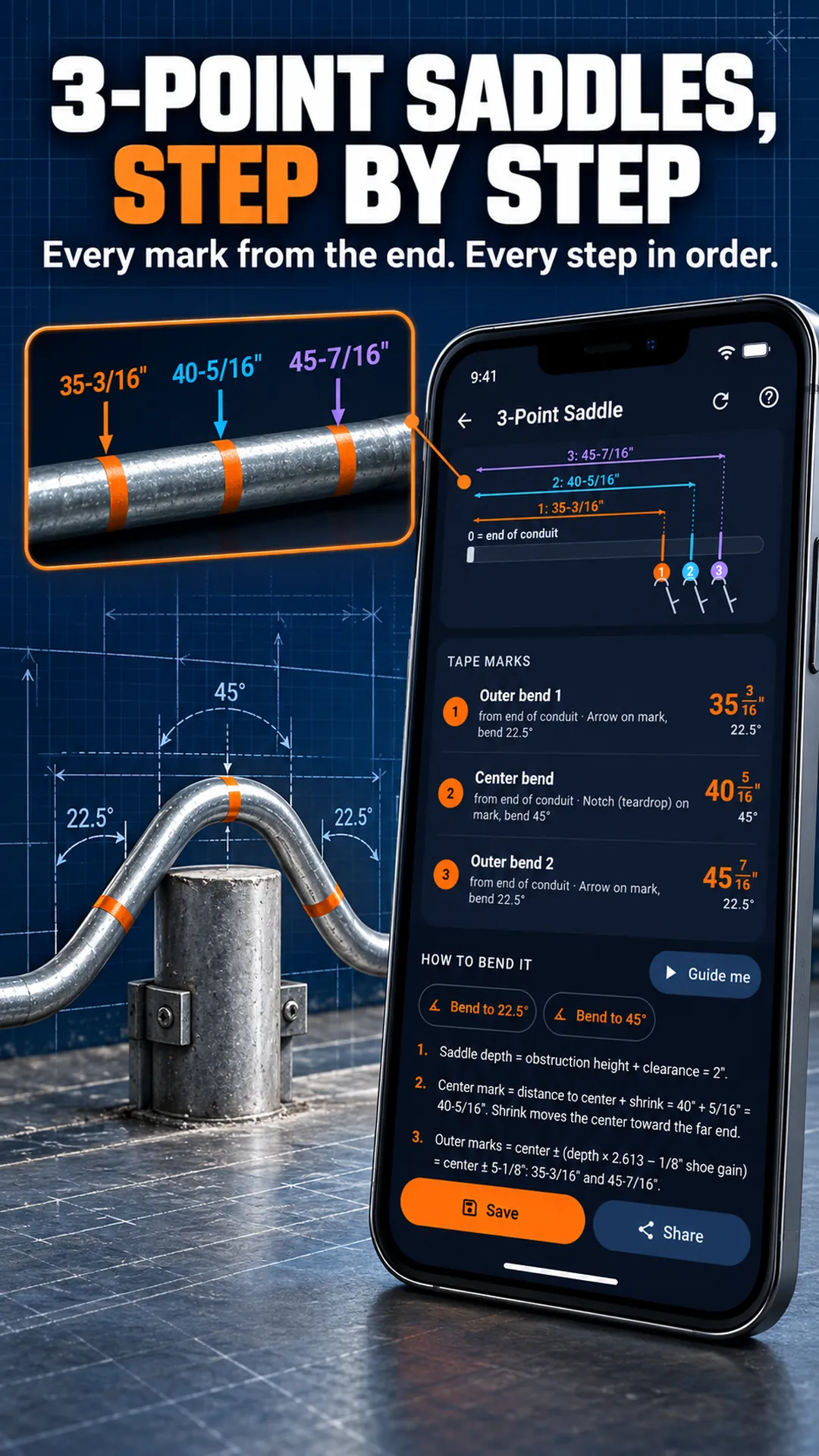
Check every shot against the exact answer
- Segmented bends from the pipe end, with every mark listed
- Steps written out for every bend type on the exam
- NEC conduit fill and box fill in the same app
- Works offline in class and on site
Android only. There is no iPhone version yet; the free calculators on this site work on any phone.
$7.99 one time · no subscription · no ads · works offline