By Blissom · Updated 2026-11-04

Rules you need (NEC 2023, 314.16(B))
Counting conductors
Each conductor that enters the box and ends or is spliced there counts once; one that passes through unbroken also counts once. Pigtails and jumpers that never leave the box count zero (314.16(B)(1)).
A 4" octagon box 1-1/4" deep (12.5 in³) has no devices, clamps or grounds. How many #14 conductors may it hold?
- a. 6
- b. 5
- c. 7
- d. 8
Answer: a. 6.
- 12.5 ÷ 2.00 = 6.25.
- Round down: 6. Box fill has no rounding up; the Note 7 rule is for raceways only.
A 3" × 2" × 3-1/2" device box (18.0 in³) has no devices, clamps or grounds. How many #12 conductors may it hold?
- a. 7
- b. 8
- c. 9
- d. 6
Answer: b. 8.
- 18 ÷ 2.25 = 8.00, exactly 8.
- 6 would be the answer if the box also held a device on #12 (2 × 2.25 in³).
Two 14-2 NM cables with ground enter a single-gang box with internal clamps and feed a single-pole switch. What box volume is required?
- a. 14.00 in³
- b. 16.00 in³
- c. 18.00 in³
- d. 12.00 in³
Answer: b. 16.00 in³.
- 4 insulated #14 = 4 × 2.00 = 8.00 in³.
- Grounds (two, up to four count as one) = 2.00. Switch yoke = 2 × 2.00 = 4.00. Clamps = 2.00.
- Total 16.00 in³. 14.00 in³ misses the clamps or the grounds, 18.00 in³ counts each ground separately, 12.00 in³ leaves out the switch.
In a 4" square × 1-1/2" box fed by EMT (no wire-type grounds, no clamps), three #12 pass straight through unbroken and four #12 are spliced. What volume do they need?
Answer: 15.75 in³, which fits the 21 in³ box.
- Pass-throughs count once each: 3.
- Spliced conductors count once each: 4.
- 7 × 2.25 = 15.75 in³.
Three 12-2 cables with ground enter a box through external connectors (no internal clamps). A receptacle is connected with three pigtails (hot, neutral, ground). What volume is required?
- a. 20.25 in³
- b. 27.00 in³
- c. 22.50 in³
- d. 24.75 in³
Answer: a. 20.25 in³.
- 6 insulated #12 = 13.50 in³. Grounds (three) = one allowance, 2.25. Receptacle yoke = 4.50.
- Pigtails start and end in the box and count zero. Total 20.25 in³.
- 27.00 in³ counts the three pigtails; 24.75 in³ counts each ground; 22.50 in³ adds clamps that are not there.
Devices, clamps and fixture studs
Device yoke: 2 allowances of the largest conductor connected to that device. Internal clamps: 1 allowance of the largest conductor, however many clamps. Each luminaire stud or hickey: 1 allowance of the largest conductor (one per type of fitting).
A box has a receptacle on a #12 circuit (two 12-2 cables) and a switch on a #14 circuit (one 14-2 cable), all with grounds, plus internal clamps. What volume is required?
- a. 26.00 in³
- b. 26.50 in³
- c. 23.75 in³
- d. 30.50 in³
Answer: a. 26.00 in³.
- 4 × #12 = 9.00 in³; 2 × #14 = 4.00 in³.
- Receptacle yoke on #12: 2 × 2.25 = 4.50. Switch yoke on #14: 2 × 2.00 = 4.00 (largest conductor connected to that device, not in the box).
- Three grounds count as one of the largest, #12: 2.25. Clamps, largest conductor in the box: 2.25.
- Total 26.00 in³. Counting the switch at #12 gives 26.50 in³.
A device box has three internal cable clamps. How many volume allowances do the clamps count?
- a. 1, for the largest conductor
- b. 3, one for each clamp
- c. 2 per clamp
- d. None
Answer: a. 1, for the largest conductor.
- One or more internal clamps count as a single allowance of the largest conductor in the box (314.16(B)(2)).
A 4" octagon ceiling box 1-1/2" deep (15.5 in³) has internal clamps, a fixture stud and one 14-2 cable with ground. What volume is required, and does it fit?
Answer: 10.00 in³; it fits.
- 2 × #14 = 4.00. Ground = 2.00. Fixture stud = 2.00. Clamps = 2.00.
- Total 10.00 in³ of 15.5 in³.
The same ceiling box gets a hickey on the stud as well. What is required now?
Answer: 12.00 in³.
- A stud and a hickey are two different types of fitting, so each counts one allowance of the largest conductor: 2 × 2.00 = 4.00 in³.
- 10.00 in³ + 2.00 = 12.00 in³.
Equipment grounding conductors
Since the 2020 NEC, up to four equipment grounding conductors count as one allowance of the largest one; each additional EGC adds 1/4 allowance (314.16(B)(5)).
Five 14-2 cables with ground are spliced in a 4" square × 2-1/8" box (30.3 in³) with internal clamps (no devices). What volume is required under the 2023 NEC?
- a. 24.50 in³
- b. 24.00 in³
- c. 32.00 in³
- d. 22.50 in³
Answer: a. 24.50 in³.
- 10 × #14 = 20.00 in³.
- Grounds: the first four count as one (2.00), the fifth adds 1/4 × 2.00 = 0.50.
- Clamps 2.00. Total 24.50 in³, within 30.3 in³. 24.00 in³ is the old one-allowance count.
How much volume do eight #12 equipment grounding conductors count in a box?
Answer: 4.50 in³ (two allowances).
- First four: 1 allowance. Four more: 4 × 1/4 = 1 allowance.
- 2 × 2.25 = 4.50 in³.
A junction box has a 10-2 cable and two 12-2 cables, all with grounds, spliced through internal clamps. What volume is required?
Answer: 19.00 in³.
- 2 × #10 = 5.00; 4 × #12 = 9.00.
- Grounds count once at the largest EGC, the #10: 2.50.
- Clamps count the largest conductor, #10: 2.50. Total 19.00 in³.
Plaster rings and choosing the box
A plaster ring, extension ring or raised cover adds its marked volume to the box. Pick the smallest box whose volume (plus any marked ring volume) covers the total.
A 4" square × 1-1/2" box (21.0 in³) with a single-gang plaster ring marked 3.6 in³ holds three 12-2 cables with ground, a receptacle and internal clamps. Does it pass?
- a. No, 22.50 in³ is more than 21.0 in³
- b. Yes, 22.50 in³ is within 24.60 in³
- c. Yes, because the receptacle sits in the ring and does not count
- d. No, plaster rings never add volume
Answer: b. Yes, 22.50 in³ is within 24.60 in³.
- 6 × 2.25 = 13.50; grounds 2.25; receptacle 4.50; clamps 2.25: 22.50 in³.
- The ring's marked 3.6 in³ adds to the box: 21.0 + 3.6 = 24.60 in³. A ring with no marked volume adds nothing.
Four 12-2 cables with ground are spliced in a junction box with internal clamps. What is the smallest standard metal square box?
- a. 4 × 1-1/2 square (21.0 in³)
- b. 4-11/16 × 1-1/4 square (25.5 in³)
- c. 4 × 2-1/8 square (30.3 in³)
- d. 4 × 2-1/8 round / octagon (21.5 in³)
Answer: b. 4-11/16 × 1-1/4 square (25.5 in³).
- 8 × 2.25 = 18.00; grounds 2.25; clamps 2.25: 22.50 in³.
- 21.0 in³ is too small. The next square box up is the 4-11/16 × 1-1/4 square at 25.5 in³.
A switch box has a 14-2 in and a 14-2 out (both with ground), a single-pole switch and internal clamps. What is the smallest 3 × 2 device box?
- a. 3 × 2 × 2-3/4 device (14 in³)
- b. 3 × 2 × 3-1/2 device (18 in³)
- c. 4 × 2-1/8 × 2-1/8 device (14.5 in³)
- d. 3 × 2 × 2-1/2 device (12.5 in³)
Answer: b. 3 × 2 × 3-1/2 device (18 in³).
- 4 × 2.00 + grounds 2.00 + switch 4.00 + clamps 2.00 = 16.00 in³.
- Leaving out the clamps gives 14.00 and the 3 × 2 × 2-3/4 device, a box that fails inspection. Required: 3 × 2 × 3-1/2 device.
A 4" square × 2-1/8" box (30.3 in³) has a receptacle on #12, internal clamps and #12 grounds. How many #12 insulated conductors may enter it?
Answer: 9.
- Fixed items: receptacle 4.50, clamps 2.25, grounds 2.25 = 9.00 in³.
- 30.3 − 9.00 = 21.30 in³ left. ÷ 2.25 = 9.47, so 9.
A 4-11/16" square × 2-1/8" box (42.0 in³) holds #6 conductors and one #10 equipment grounding conductor. How many #6 conductors may it hold?
- a. 7
- b. 8
- c. 15
- d. 13
Answer: a. 7.
- #6 = 5.00 in³ each. The #10 ground = 2.50.
- 42 − 2.50 = 39.50; ÷ 5.00 = 7.90, so 7.
- 8 forgets the ground. Table 314.16(B) stops at #6; larger conductors fall under 314.28 pull and junction box sizing.
Common traps
- Forgetting the grounds. Grounds always add at least one allowance, even though there may be several of them.
- Counting each ground. Up to four count as one. The fifth and later add 1/4 each, not a full allowance.
- Counting pigtails. A conductor that starts and ends in the box counts zero.
- One allowance for a device. A yoke counts two, at the size of the conductor connected to that device.
- One allowance per clamp. All internal clamps together count once; external connectors count nothing.
- Leaving out the plaster ring. A ring with a marked volume adds to the box and can be what makes it pass.
- Rounding up. 12.5 in³ holds six #14, not seven.
- Using the ground size for the clamps. Clamps, studs and hickeys count at the largest conductor in the box; grounds count at the largest EGC.
Work your own box in the box fill calculator, which lists metal box volumes from Table 314.16(A). For raceways, see the conduit fill problems.
Sources: NEC 2023: Chapter 9 Tables 1, 4 and 5 (fill), 314.16 (box fill), 358.24 and Chapter 9 Table 2 (bends); Answers checked against the calculation engine used by the Conduit Bending Calculator app. Method.
Questions electricians ask
How do grounds count in box fill under the 2023 NEC?
Up to four equipment grounding conductors count as one allowance of the largest one. Each EGC beyond four adds a quarter allowance. Before the 2020 edition, all EGCs counted as one allowance.
Does a device count by the largest wire in the box?
No. Each yoke or strap counts two allowances of the largest conductor connected to that device. A switch wired with #14 counts 2 × 2.00 in³ even if #12 conductors are in the same box.
Do plaster rings and extension rings add volume?
Yes, when they are marked with their volume, or for extension rings made to the dimensions of Table 314.16(A). An unmarked plaster ring adds nothing to the count.
Do you round up in box fill?
No. The total of the allowances must not exceed the box volume. The 0.8 round-up rule is Chapter 9, Note 7, for conductors in raceways, not boxes.
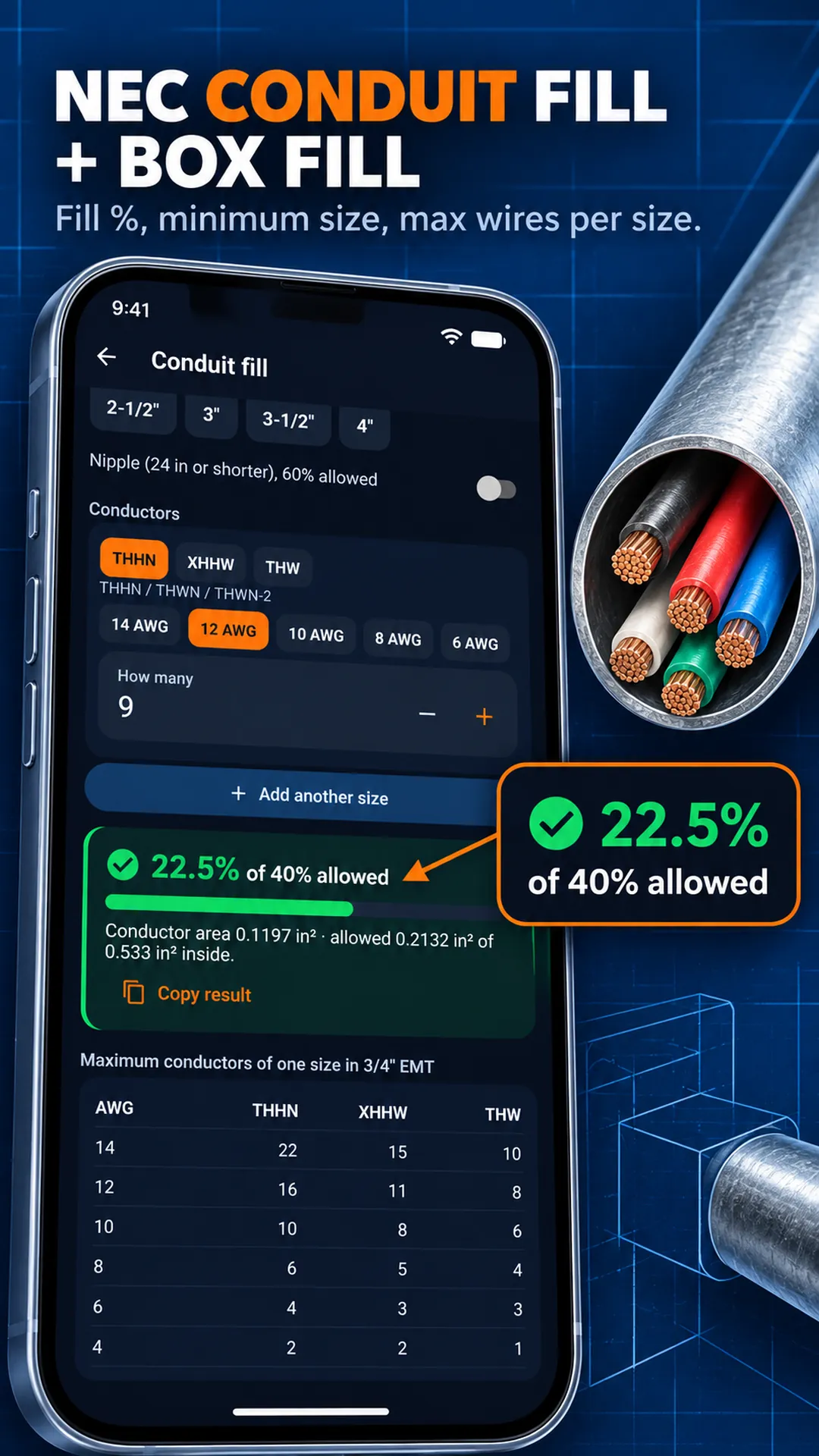
Box fill and conduit fill, checked exactly
- Box fill per 314.16 with devices, clamps and grounds
- Smallest listed box that works
- NEC conduit fill and every bend type on the exam
- Works offline in class and on site
Android only. There is no iPhone version yet; the free calculators on this site work on any phone.
$7.99 one time · no subscription · no ads · works offline