By Blissom · Updated 2026-11-04

Minimum bend radius, Chapter 9 Table 2
| Trade size | One-shot & full-shoe benders | Other bends | Developed length of a 90 at the minimum (one-shot) |
|---|---|---|---|
| 1/2" | 4" | 4" | 6-5/16" |
| 3/4" | 4-1/2" | 5" | 7-1/16" |
| 1" | 5-3/4" | 6" | 9-1/16" |
| 1-1/4" | 7-1/4" | 8" | 11-3/8" |
| 1-1/2" | 8-1/4" | 10" | 12-15/16" |
| 2" | 9-1/2" | 12" | 14-15/16" |
| 2-1/2" | 10-1/2" | 15" | 16-1/2" |
| 3" | 13" | 18" | 20-7/16" |
| 3-1/2" | 15" | 21" | 23-9/16" |
| 4" | 16" | 24" | 25-1/8" |
| 5" | 24" | 30" | 37-11/16" |
| 6" | 30" | 36" | 47-1/8" |
Radius to the centerline of the conduit, NEC 2023. The developed length is the length of conduit inside the arc of a 90°: π/2 × radius. Verify the edition your inspector enforces.
Which column applies
The bending section of each raceway article sends you to Table 2: 358.24 for EMT, 344.24 for rigid, 342.24 for IMC, 352.24 for PVC. For EMT, 358.24 names the one-shot and full-shoe column directly.
A one-shot or full-shoe bender forms the bend around a shoe of fixed radius, as an EMT hand bender or a mechanical or hydraulic bender with a full shoe does. Bends not made that way, heat-bent PVC being the usual example, fall under the "other bends" column, which is larger from 3/4" up. The two columns are the same only at 1/2".
Hand bender shoes vs the minimum
A hand bender's shoe sets its centerline radius, so every bend it makes is the same. The common EMT shoes are comfortably above Table 2:
| EMT size | Shoe | Shoe centerline radius | Table 2 minimum | Margin |
|---|---|---|---|---|
| 1/2" | Klein 51606 | 4-5/8" | 4" | +5/8" |
| 3/4" | Klein 51607 | 5-1/2" | 4-1/2" | +1" |
| 1" | Greenlee 842AH | 6-1/2" | 5-3/4" | +3/4" |
The shoe radius also explains the take-up and gain printed on the bender: a 90 on a larger radius uses more conduit in the arc. On the 3/4" shoe above, the arc of a 90 is 8-5/8" long, against 7-1/16" at the bare minimum. Take-up and deduct values by bender are on the bender deduct chart.
Where it gets tight is everything that is not a standard shoe: a 90 kinked over a step, a bend finished by stepping on the conduit past the shoe, or a cheap shoe made for a different conduit size.
Measuring a bend's radius in the field
1. Set a 90 in a framing square
Lay the 90 into the inside corner of a framing square so both legs touch the square's arms. The outside of the conduit leaves each arm at a distance from the corner equal to the centerline radius plus half the outside diameter.
R = distance from corner to where the conduit lifts off − OD ÷ 2
A 3/4" EMT 90 from a 5-1/2" shoe (OD 0.922") leaves the arms about 5-15/16" from the corner. That point is hard to see exactly; slide a sheet of paper along the arm until it stops.
2. Chord and rise, for any angle
Hold a straightedge of known length (the chord) across the inside of the bend so both ends touch the conduit, and measure the gap from the middle of the straightedge to the conduit (the rise).
Inside radius = chord² ÷ (8 × rise) + rise ÷ 2; centerline R = inside radius + OD ÷ 2
Example on 3/4" EMT: a 6" chord with a 1" rise gives 6² ÷ (8 × 1) + 1 ÷ 2 = 5" inside, plus 7/16" = 5-7/16" to the centerline. That clears both the 4-1/2" one-shot and the 5" other-bends minimum. The rise is small, so read it to 1/32" if you can: a 1/16" error in the rise moves the answer by several sixteenths.
3. From the developed length
Mark the conduit where the bend will start and where it will end before bending, or measure along the outside of a finished bend with a flexible tape and convert. For a 90, R = 2 × arc length ÷ π on the centerline.
Example: an 8.5" centerline arc on a 90 gives 2 × 8.5 ÷ π = 5-7/16". For a bend of any angle θ, R = arc × 180 ÷ (π × θ).
Why radius matters for the pull
The rule in each bending section has two parts: the bend may not damage the conduit or effectively reduce its internal diameter, and its radius may not be less than Table 2. A bend under the minimum is where the conduit starts to flatten or kink, and a flattened bend narrows the path the conductors have to get through.
The radius also affects the pull itself. As the conductors go around a bend under tension, they press against its inside wall; the tighter the bend, the more concentrated that sidewall pressure. That is why big feeders get large-radius sweeps even where a hand-bent 90 would be legal, and why the 360° limit exists alongside the radius rule.
PVC and heat bends
Factory elbows are not field bends. Bends you make with a heater or hot box are, and 352.24 applies Table 2 to them. Bend around a form or a bending tool sized for the radius rather than by eye; a freehand heat bend easily ends up tighter than the minimum at the middle of the arc, and the wall can wrinkle or oval on the inside. The PVC bending guide covers heating, plugs and forms.
Segmented bends on large rigid conduit are the other case where you build the radius yourself. The segmented 90 calculator spaces the shots for a chosen radius; pick one at or above the column that applies.
Bends that fail inspection or the pull
- Kinked or flattened inside of the bend. Usually from bending on the wrong shoe size or pushing past the shoe. Cut it out; it reduces the internal diameter.
- Heat-bent PVC 90 tighter than Table 2. Common when the bend is made over a knee. Use a form.
- Wrinkled PVC. Underheated or bent too fast. The wrinkles catch insulation on the pull.
- Segments too few on a big rigid 90. The bend becomes a series of sharp corners even if the overall radius looks right.
- Mixing up inside and centerline radius. Measured on the inside, a legal bend looks half an OD too tight.
Sources: NEC 2023: Chapter 9, Table 2 (radius of conduit and tubing bends), 358.24, 344.24, 342.24 and 352.24. Method.
Questions electricians ask
What is the minimum bend radius for 3/4 EMT?
4-1/2" to the centerline with a one-shot or full-shoe bender (Chapter 9, Table 2, as 358.24 requires for EMT). Common 3/4" EMT hand benders have a centerline radius around 5-1/2", which is above the minimum.
What is the minimum bend radius for PVC conduit?
The same Chapter 9, Table 2 applies to PVC through 352.24. A heat-bent PVC bend is not made on a one-shot or full-shoe bender, so compare it with the "other bends" column: 4" for 1/2", 5" for 3/4", 6" for 1", 12" for 2".
What is the bend radius for rigid conduit?
Rigid and IMC use Chapter 9, Table 2 through 344.24 and 342.24. With a one-shot or full-shoe bender, 2" is 9-1/2", 3" is 13", 4" is 16". Other bends: 12", 18" and 24".
How do you measure the radius of a conduit bend?
Set a 90 into a framing square: the outside of the conduit leaves each leg at the radius plus half the outside diameter from the corner. Or lay a straightedge of known length across the inside of the bend, measure the rise to the conduit, and use radius = chord² ÷ (8 × rise) + rise ÷ 2, then add half the OD.
Is bend radius measured to the inside or centerline?
Table 2 gives the radius to the centerline of the conduit. A measurement on the inside of the bend is half an outside diameter smaller; on the outside it is half an OD larger.
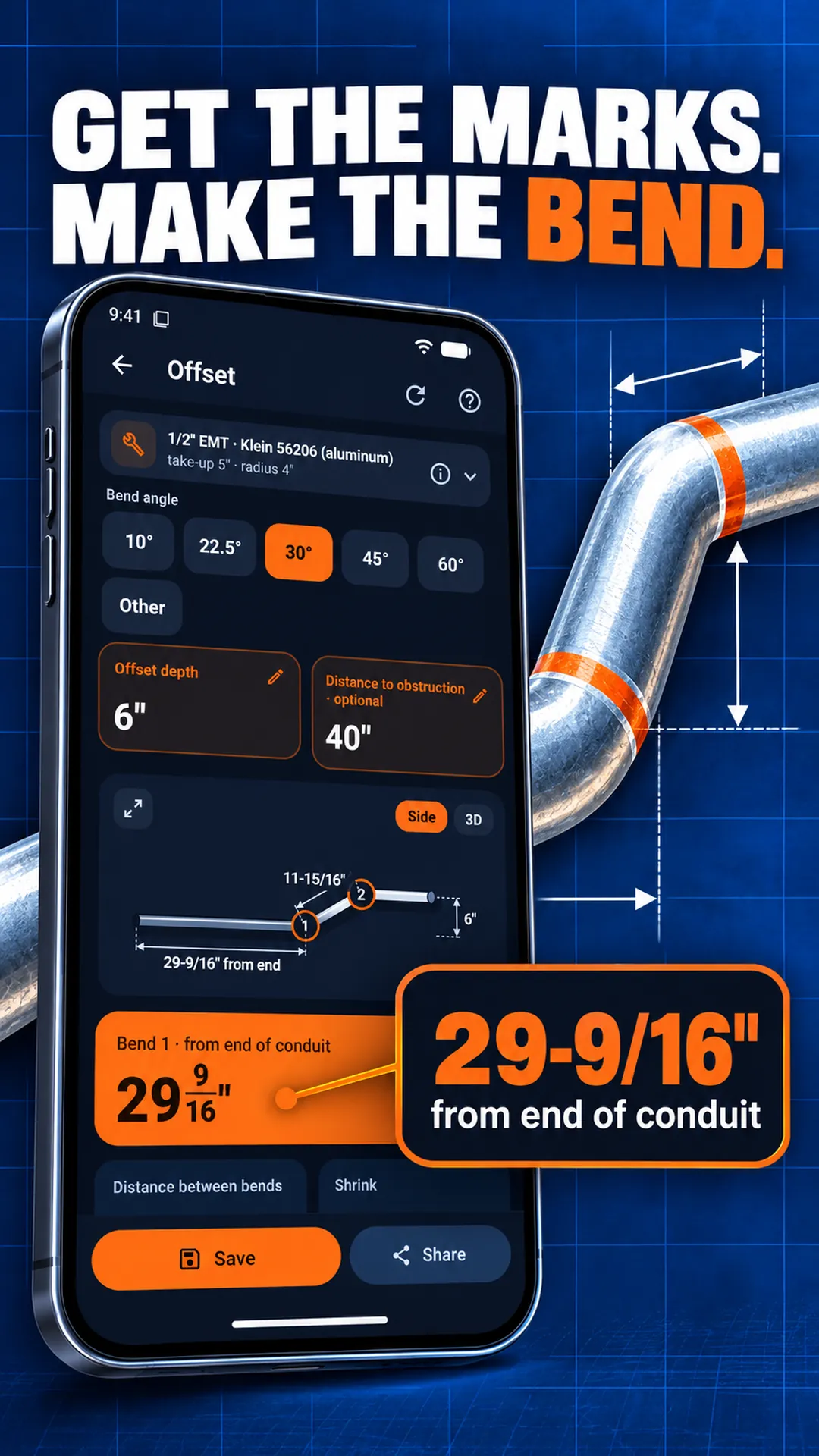
Bends calculated on your shoe radius
- Every bend: offsets, saddles, kicks, 90s, segmented
- NEC conduit fill and box fill
- Marks from the end of the conduit
- Offline, no account
Android only. There is no iPhone version yet; the free calculators on this site work on any phone.
$7.99 one time · no subscription · no ads · works offline