 Conduit Bending
By Blissom · Updated 2026-11-04
Short answer: length change (in) = 0.0000338 × length (in) × temperature range (°F). If it is 1/4" or more between fixed points, install expansion fittings: total change ÷ stroke, rounded up. Open each one stroke × (Tmax − Tinstall) ÷ (Tmax − Tmin) on the day you install it.
The formula
ΔL (in) = 3.38 × 10⁻⁵ × L (in) × ΔT (°F)
ΔL (mm) = 6.084 × 10⁻⁵ × L (mm) × ΔT (°C)
ΔT is the difference between the coldest and hottest temperature the conduit itself will reach, not just the air. Conduit in direct sun runs hotter than the surrounding air, so a rooftop or south-wall run needs a higher maximum than the weather report gives. There is no single correction in the code for that; use local experience or the design documents.
Length change per 100 ft
This mirrors Table 352.44. The last column is the longest straight run that stays under the 1/4" threshold at that range.
| Temperature range | Change per 100 ft | Longest run without a fitting |
|---|---|---|
| 25 °F | 1.01" (1") | 24.7 ft |
| 50 °F | 2.03" (2") | 12.3 ft |
| 75 °F | 3.04" (3-1/16") | 8.2 ft |
| 100 °F | 4.06" (4-1/16") | 6.2 ft |
| 125 °F | 5.07" (5-1/16") | 4.9 ft |
| 150 °F | 6.08" (6-1/16") | 4.1 ft |
The change is linear: 200 ft moves twice as much as 100 ft, and half the temperature range halves it.
When 352.44 requires a fitting
Measure between securely mounted items: boxes, cabinets, elbows and other terminations. A straight run between two of those that changes 1/4" (6 mm) or more needs expansion fittings. At a 100 °F range that happens at about 6 ft, so most exposed outdoor runs need one.
Each elbow is a fixed point, which splits the run into separate straight sections. Calculate each section on its own and put the fittings in the sections that need them.
Where a raceway crosses a structural expansion joint in the building, 300.7(B) also calls for expansion, expansion-deflection or deflection fittings to take that movement. That is a separate requirement from the conduit's own thermal growth.
Setting the piston: why "hot = closed"
The conduit is longest when it is hottest. At that moment the fitting must be fully closed, with the inner barrel pushed all the way in. At the coldest temperature the conduit is shortest and the fitting is pulled fully open. Installing on any day in between, open the fitting by the share of the range that is still above you:
Open distance = stroke × (Tmax − Tinstall) ÷ (Tmax − Tmin)
Install it on a cold morning and it goes in nearly fully open; install it in the afternoon sun and it goes in nearly closed. Mark the setting on the barrel before you glue, and check the manufacturer's instructions for the fitting you use, including how it should be supported and which side is fixed.
Worked examples
Rooftop run, 160 ft between two elbows
The design range for the conduit is 0 °F to 120 °F; the fitting has a 6" stroke.
- ΔL = 3.38 × 10⁻⁵ × (160 × 12) × 120 = 7.79", well over 1/4".
- Fittings: 7.79 ÷ 6 = 1.30, rounded up = 2.
- Setting by installation temperature:
- At 30 °F: 6 × (120 − 30) ÷ 120 = 4-1/2" open
- At 60 °F: 6 × (120 − 60) ÷ 120 = 3" open
- At 90 °F: 6 × (120 − 90) ÷ 120 = 1-1/2" open
Short run, box to elbow
8 ft of PVC on an outside wall with a 60 °F range: 3.38 × 10⁻⁵ × 96 × 60 = 0.19". That is under 1/4", so no fitting is required for this section.
Troubleshooting PVC that moves
- Bowed conduit between straps. The run grew with nowhere to go: no fitting, too few, or the fitting was installed closed on a cold day.
- Pulled-apart joints or connectors out of boxes. The run shrank in the cold. Fittings installed fully closed in cold weather, or straps clamped so tight the conduit could not slide to the fitting.
- Fitting bottomed out on a hot day. It was set with the air temperature but the conduit in the sun runs hotter. Widen the range.
- Straps that grip. Between fixed points the conduit has to slide toward the fitting. Use straps that guide it without crushing it, and still meet the PVC support spacing of Table 352.30.
- One long calculation across elbows. Elbows are fixed points; each straight section gets its own number.
Verify against the NEC edition your inspector enforces and the instructions for the fitting you install.
Sources: NEC 2023: 352.44 and Table 352.44 (expansion characteristics of PVC rigid nonmetallic conduit), 300.7(B); PVC expansion fitting manufacturer installation instructions. Method.
Questions electricians ask
How much does PVC conduit expand?
By 3.38 × 10⁻⁵ inch per inch per °F (NEC 352.44): 4.06" per 100 ft for a 100 °F range, 2.03" for a 50 °F range.
When is a PVC expansion fitting required?
When the expected length change in a straight run between securely mounted items such as boxes, cabinets and elbows is 1/4" (6 mm) or more (352.44).
How do you set a PVC expansion joint?
Open it in proportion to how far the installation temperature is below the hottest expected conduit temperature: stroke × (Tmax − Tinstall) ÷ (Tmax − Tmin). Installed on the hottest day it is closed; on the coldest day it is fully open.
How many expansion fittings do I need?
Divide the total length change by the stroke of the fitting and round up. Check the travel marked on the fitting you buy; the calculator lets you enter it.
Does buried PVC need expansion fittings?
352.44 applies to the expected length change of the run. Buried conduit sees a much smaller temperature range than exposed conduit, but transitions out of the ground into the sun often do need one; work it out with the actual range.
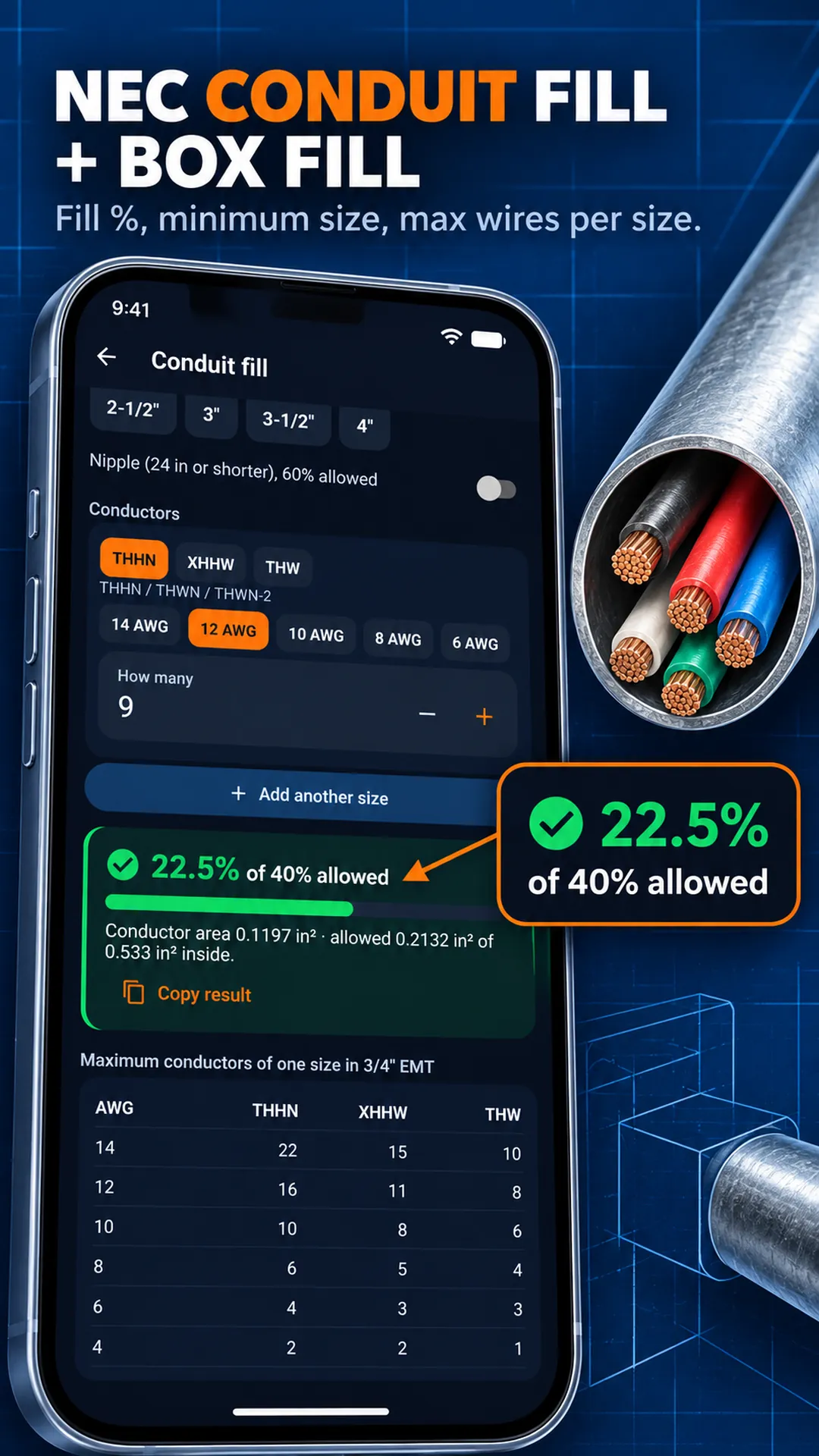
Your PVC run, bends and fill in one place
- NEC conduit fill and box fill
- All bends: offsets, saddles, kicks, 90s, segmented
- Marks measured from the end of the stick
- Works offline on the roof or in the trench
Android only. There is no iPhone version yet; the free calculators on this site work on any phone.
$7.99 one time · no subscription · no ads · works offline