By Blissom · Updated 2026-11-04
Layout values: check them against your own bender, on scrap first.

Formulas you need
Table values: 22.5° = 2.6 and 3/16" per inch; 30° = 2 and 1/4"; 45° = 1.4 and 3/8"; 60° = 1.2 and 1/2". Bending toward the obstruction, add the shrink to the measurement.
True offset
The rise and the roll are the two sides of a right triangle; the true offset is the diagonal: √(rise² + roll²). You bend the true offset, not the rise or the roll.
A rolling offset has to rise 8" and roll over 6". The true offset is:
- a. 14"
- b. 2"
- c. 10"
- d. 7"
Answer: c. 10".
- √(8² + 6²) = √(64 + 36) = √100 = 10".
- 14" adds the sides, 2" subtracts them and 7" averages them; none is the diagonal.
A rolling offset rises 10" and rolls 10". The true offset is:
- a. 20"
- b. 14-1/8"
- c. 10"
- d. 17-5/16"
Answer: b. 14-1/8".
- √(10² + 10²) = √200 = 14.142" = 14-1/8".
- With equal rise and roll the true offset is 1.414 × either one, and the roll angle is 45°.
A conduit must rise 12" and move over 5". What offset do you bend?
Answer: A 13" true offset.
- √(144 + 25) = √169 = 13".
- Bend a 13" offset, with the conduit rolled so the bends point along the diagonal.
A rolling offset rises 7" and rolls 15". Find the true offset to the nearest 1/16".
Answer: 16-9/16".
- √(49 + 225) = √274 = 16.553".
- Rounded to the tape: 16-9/16".
Travel, shrink and marks
Distance between bends (travel) = true offset × multiplier. Shrink = true offset × shrink per inch. Table values: 22.5° = 2.6 and 3/16", 30° = 2 and 1/4", 45° = 1.4 and 3/8", 60° = 1.2 and 1/2".
A rolling offset rises 6" and rolls 8". Using 45° bends, how far apart are the bends?
- a. 14"
- b. 20"
- c. 19-5/8"
- d. 10"
Answer: a. 14".
- True offset: √(36 + 64) = 10".
- Travel: 10 × 1.4 = 14". With the exact multiplier (1.414) it is 14-1/8".
- 20" uses the 30° multiplier; 19-5/8" multiplies the rise plus the roll (14") instead of the true offset.
A rolling offset rises 16" and rolls 12" with 30° bends. Find the distance between bends and the shrink.
Answer: 40" between bends, 5" of shrink.
- True offset √(256 + 144) = √400 = 20".
- Travel 20 × 2 = 40".
- Shrink 20 × 1/4" = 5".
A rolling offset rises 9" and rolls 4" with 22.5° bends. Find the distance between bends and the shrink.
Answer: 25-5/8" between bends, 1-7/8" of shrink.
- True offset √(81 + 16) = √97 = 9.849".
- Travel 9.849 × 2.6 = 25.607" = 25-5/8".
- Shrink 9.849 × 3/16 = 1.847" = 1-7/8".
A rolling offset rises 5" and rolls 12" and must be complete 72" from the end of the conduit, bending toward the obstruction with 30° bends. Where do the two marks go?
- a. 46" and 72"
- b. 49-1/4" and 75-1/4"
- c. 42-3/4" and 68-3/4"
- d. 59" and 85"
Answer: b. 49-1/4" and 75-1/4".
- True offset √(25 + 144) = 13". Travel 13 × 2 = 26". Shrink 13 × 1/4" = 3-1/4".
- Bending toward the obstruction, add the shrink: second mark at 72 + 3-1/4 = 75-1/4".
- First mark 26" before it: 49-1/4".
- Forgetting the shrink leaves the offset 3-1/4" short; subtracting it makes it 6-1/2" short.
Roll angle
Roll angle from vertical = tan⁻¹(roll ÷ rise). Rotate the conduit that much in the bender and keep both bends in that one rolled plane.
A rolling offset rises 10" and rolls 4". How far is the conduit rolled from vertical?
Answer: 21.8° from vertical (68.2° from horizontal).
- tan⁻¹(4 ÷ 10) = tan⁻¹(0.4) = 21.80°.
- A protractor or a level with a degree scale on the conduit sets the roll; a small roll error turns into a dog-leg at the far end.
A rolling offset has equal rise and roll. The conduit is rolled:
- a. 30°
- b. 45°
- c. 60°
- d. 90°
Answer: b. 45°.
- tan⁻¹(1) = 45°: the bends point exactly along the diagonal of the square formed by the rise and the roll (5" and 5" gives 45°).
The conduit is rolled 30° from vertical and the true offset is 14". How much rise and how much roll does that produce?
Answer: Rise 12-1/8", roll 7".
- Rise = true offset × cos 30° = 14 × 0.866 = 12.124".
- Roll = true offset × sin 30° = 14 × 0.5 = 7".
- Check: √(12.124² + 7²) = 14.000".
Choosing the bend angle for the space you have
The steeper the bends, the shorter the travel and the more the shrink. Pick the shallowest angle whose travel fits the space; a table of constants gives the multiplier (cosecant) and the run (cotangent) for each angle.
A rolling offset rises 8" and rolls 15". There is room for at most 25" between bend centers. Which is the shallowest standard angle that fits?
- a. 22.5°
- b. 30°
- c. 45°
- d. 60°
Answer: c. 45°.
- True offset √(64 + 225) = 17".
- 22.5°: 17 × 2.6 = 44-3/16". 30°: 17 × 2 = 34". 45°: 17 × 1.4 = 23-13/16" (exact 17 × 1.414 = 24.04"). 60°: 17 × 1.2 = 20-3/8".
- 45° is the shallowest that fits under 25". 60° also fits but costs more shrink and a harder pull.
A rolling offset rises 6" and rolls 8". The two bends have to fall 17-5/16" apart measured along the run (parallel to the conduit). What bend angle do you use?
Answer: 30°.
- True offset √(36 + 64) = 10".
- Angle = tan⁻¹(true offset ÷ run) = tan⁻¹(10 ÷ 17.3125) = 30.01°.
- The run constant (cot θ) for 30° is 1.732, and 10 × 1.732 = 17.32".
A rolling offset rises 7" and rolls 7" with 45° bends. How far along the run does the offset advance between bends?
Answer: 9-7/8".
- True offset √(49 + 49) = 9.899".
- Run constant for 45° = cot 45° = 1.000, so the run equals the true offset: 9-7/8".
- The travel along the conduit is longer: 9.899 × 1.4 = 13-7/8".
Using the box method, you measure 11" up and 14" over from the existing conduit, then hold the tape across the diagonal of that box. What should the tape read, and how far apart are the 30° bends?
Answer: The diagonal (true offset) reads 17-13/16"; the bends go 35-5/8" apart.
- √(121 + 196) = √317 = 17.804" = 17-13/16".
- Travel 17.804 × 2 = 35-5/8"; shrink 4-7/16".
- Measuring the diagonal directly is a check on the arithmetic: if the tape and the square root disagree, one of the sides was measured wrong.
What measuring wrong costs you
Most bad rolling offsets come from bending the wrong number, not from the bender.
A rolling offset rises 9" and rolls 6" with 30° bends. A helper adds the rise and roll and bends a 15" offset. How far off are the bends?
Answer: 8-3/8" too far apart.
- Right: true offset √(81 + 36) = 10.817", travel 21-5/8".
- Wrong: 15 × 2 = 30".
- Error: 30 − 21.633 = 8-3/8", and the conduit misses the target by 4-3/16" of offset.
You bend the correct true offset but forget to roll the conduit, so both bends are made straight up. The result is:
- a. A correct rolling offset
- b. An offset with the full true offset straight up and no roll
- c. A kick
- d. An offset with only the rise
Answer: b. An offset with the full true offset straight up and no roll.
- The bends produce whatever offset you bent, in the plane you bent it.
- Unrolled, the conduit climbs the full true offset (more than the rise) and does not move over at all.
A rolling offset rises 12" and rolls 16" toward an obstruction with 30° bends, and the bender forgets the shrink. How short does the offset finish?
Answer: 5" short.
- True offset √(144 + 256) = 20".
- Shrink 20 × 1/4" = 5". That is how far before the measured point the offset finishes.
- Bending away from a fixed starting point, shrink only shortens the far end of the conduit.
Common traps
- Adding the rise and the roll. 8" up and 6" over is a 10" true offset, not 14". The sum is always too big.
- Bending only the rise. The rise is one side of the triangle; the conduit has to travel the diagonal.
- Mixing up the roll angle. tan⁻¹(roll ÷ rise) is measured from vertical. Measured from horizontal it is 90° minus that.
- Forgetting to roll. A true offset bent straight up climbs too far and does not move over at all.
- Dropping the shrink. Bending toward an obstruction, a 20" true offset at 30° finishes 5" short unless the shrink is added.
- Rolling between bends. Both bends must be in the same rolled plane, or the conduit dog-legs.
- Picking an angle that does not fit. Check the travel against the space first. Shallower bends pull easier but need more room.
The rolling offset calculator gives the true offset, roll angle and both marks for any rise and roll. For the plain offsets and kicks, see the exam questions page.
Sources: NEC 2023: Chapter 9 Tables 1, 4 and 5 (fill), 314.16 (box fill), 358.24 and Chapter 9 Table 2 (bends); Answers checked against the calculation engine used by the Conduit Bending Calculator app. Method.
Questions electricians ask
Is a rolling offset bent differently from a regular offset?
The two bends are the same: same multiplier, same shrink. The difference is the number you bend (the true offset, not the rise or the roll) and that the conduit is rotated in the bender so both bends lie in the rolled plane.
Which multiplier do exams use for rolling offsets?
The hand-bender table values: 2.6 for 22.5°, 2 for 30°, 1.4 for 45°, 1.2 for 60°, with shrink of 3/16", 1/4", 3/8" and 1/2" per inch of true offset. Where the exact trigonometry differs (1.414 at 45°), the worked answers say so.
How do I set the roll angle on the conduit?
Work out tan⁻¹(roll ÷ rise) for the angle from vertical, then rotate the conduit that much before the first bend, using a protractor or a level with a degree scale. Keep the same roll for the second bend.
What is the box method for rolling offsets?
Measure the rise and the roll as the two sides of a box (rectangle) between the existing conduit and the target, then measure the diagonal of that box with a tape. The diagonal is the true offset, and it checks the square-root arithmetic.
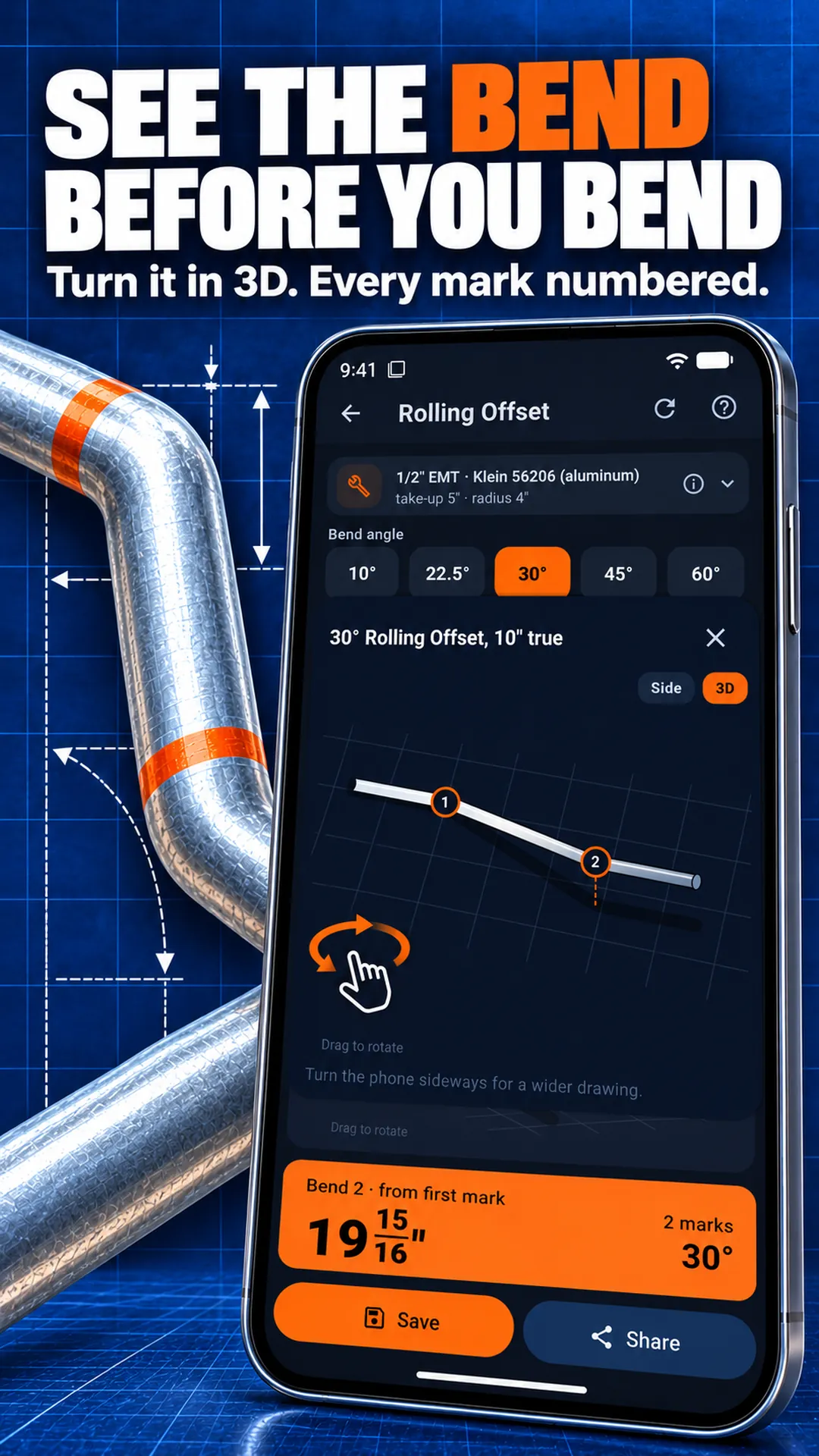
See the rolling offset in 3D, then check your math
- Rolling offsets with true offset, roll angle and both marks
- Steps written out for every bend type on the exam
- Exact trig or sticker multipliers, side by side
- Works offline, plus NEC conduit fill and box fill
Android only. There is no iPhone version yet; the free calculators on this site work on any phone.
$7.99 one time · no subscription · no ads · works offline