By Blissom · Updated 2026-11-04

Quick answers
- Internal area 2.036 in², 40% usable for three or more conductors (Chapter 9 Tables 1 and 4).
- #12 THHN: 61 fit, but only 9 may be current-carrying on 20 A breakers.
- #10 THHN protected at 20 A: up to 20 current-carrying before the 45% band.
- Single-phase feeders up to 150 A copper fit with room to spare.
Single- and three-phase feeders
| Conductors | Area each (in²) | Subtotal (in²) |
|---|---|---|
| 3 × #1/0 THHN (two hots and a neutral) | 0.1855 | 0.5565 |
| 1 × #6 THHN (ground, Table 250.122) | 0.0507 | 0.0507 |
| Total, 4 conductors | 0.6072 | |
| Allowed: 40% of 2.036 in² | 0.8144 |
29.8% fill. The single-phase neutral carries only imbalance, so two conductors count and no adjustment applies. Above 100 A, 110.14(C)(1)(b) permits the 75 °C column.
| Conductors | Area each (in²) | Subtotal (in²) |
|---|---|---|
| 4 × #3 THHN (three phases and a neutral) | 0.0973 | 0.3892 |
| 1 × #8 THHN (ground) | 0.0366 | 0.0366 |
| Total, 5 conductors | 0.4258 | |
| Allowed: 40% of 2.036 in² | 0.8144 |
20.9% fill. With linear load this is three counted conductors and #3 gives its full 100 A at 75 °C, provided the 100 A equipment is marked for 75 °C terminations. The next section is what happens when it is not linear.
When the neutral pushes up wire size
Feed an office floor of computers and LED lighting and the third harmonic currents add up in the neutral. 310.15(E) then makes it count, and four conductors put the set into the 80% band.
| Phase wire | 90 °C × 80% | 75 °C limit | Usable | On 100 A | Fill |
|---|---|---|---|---|---|
| #3 THHN | 92 A | 100 A | 92 A | too low | 20.9% |
| #2 THHN | 104 A | 115 A | 104 A | OK | 24.5% |
#3 falls short, so the phases and neutral go to #2. The pipe absorbs it easily: 24.5% fill in 1-1/2". This is the case where the larger raceway pays off, because 1-1/4" would also have taken it but with less room to pull.
Large #10 branch bundles
Commercial home runs often bundle many 20 A circuits on #10. #10 THHN at 50% is 20 A, so the 10–20 band holds; at 21 it drops to 18 A and fails.
| Conductors | Area each (in²) | Subtotal (in²) |
|---|---|---|
| 20 × #10 THHN (hots) | 0.0211 | 0.4220 |
| 10 × #10 THHN (shared neutrals) | 0.0211 | 0.2110 |
| 1 × #10 THHN (ground) | 0.0211 | 0.0211 |
| Total, 31 conductors | 0.6541 | |
| Allowed: 40% of 2.036 in² | 0.8144 |
32.1% fill, legal, and exactly 20 counted conductors. That is the most this pipe can carry for 20 A circuits. It is also a stiff pull: 31 conductors through a run with bends.
Each multiwire set needs simultaneous disconnect (210.4(B)). Ten sets of two hots with one neutral each is the layout assumed.
Derating bands
| Wire and breaker | Fits by fill | Current-carrying limit | What stops you first |
|---|---|---|---|
| #14 on 15 A | 84 | 9 | Derating |
| #12 on 20 A | 61 | 9 | Derating |
| #10 on 20 A | 38 | 20 | Derating |
| #10 on 30 A | 38 | 6 | Derating |
The band-by-band derating table (80%, 70%, 50% and lower) is the same for every pipe size; it is on the 3/4" EMT page. The fill count includes one ground, which never counts toward the current-carrying limit.
Grounds are left out of every count (310.15(F)). Results are capped at the termination rating, typically 60 °C for 100 A and below unless the equipment is marked 75 °C. A hot location adds a 310.15(B) correction as well.
| Wire and breaker | Each with own neutral | 120/240 V shared neutral |
|---|---|---|
| #14 THHN, 15 A | 4 | 8 |
| #12 THHN, 20 A | 4 | 8 |
| #10 THHN, 20 A | 10 | 20 |
| #10 THHN, 30 A | 3 | 6 |
Complete 1-1/2" fill table
| Wire | THHN / THWN-2 | XHHW-2 | THW |
|---|---|---|---|
| #14 | 84 | 58 | 39 |
| #12 | 61 | 45 | 31 |
| #10 | 38 | 33 | 24 |
| #8 | 22 | 18 | 14 |
| #6 | 16 | 14 | 11 |
| #4 | 10 | 10 | 8 |
| #3 | 8 | 8 | 7 |
| #2 | 7 | 7 | 6 |
| #1 | 5 | 5 | 4 |
| #1/0 | 4 | 4 | 3 |
| #2/0 | 3 | 3 | 3 |
| #3/0 | 3 | 3 | 2 |
| #4/0 | 2 | 2 | 1 |
| 250 kcmil | 1 | 1 | 1 |
| 300 kcmil | 1 | 1 | 1 |
| 350 kcmil | 1 | 1 | 1 |
| 400 kcmil | 1 | 1 | 1 |
| 500 kcmil | 1 | 1 | 1 |
| 600 kcmil | 1 | 1 | 1 |
| 750 kcmil | 1 | 1 | 1 |
Chapter 9 Note 7 rounding; 53% when only one conductor is installed. THW uses the conservative Table 5 dimensions Annex C uses. Bare grounds take their Table 8 area.
Pulling and sizing up
- Big bundles and heavy feeders need a puller and a clean run. Keep bends between pull points at or under 360°.
- Want spare capacity for a later feeder upgrade? Size for the next ampacity step now, or step to 2" EMT.
- More than 20 counted #10 for 20 A circuits needs a second raceway, not a bigger one.
For any mix not shown, use the conduit fill calculator. NEC 2023; verify against the edition your inspector enforces.
Sources: NEC 2023: Chapter 9, Tables 1, 4 and 5 with Note 7 (fill); 310.15(C)(1) (adjustment for more than three current-carrying conductors), 310.15(E) and (F) (neutrals and grounds), Table 310.16, 240.4(D) and 110.14(C). Method.
Questions electricians ask
How many wires fit in 1 1/2 EMT?
61 #12 THHN, 84 #14, 38 #10, 7 #2 or 4 1/0 THHN, with any insulated ground counted as one of them.
Will a 150 amp feeder fit in 1-1/2 EMT?
Three 1/0 THHN copper and a #6 ground use 29.8% of 1-1/2" EMT, under the 40% limit. 1/0 copper is 150 A at 75 °C, the column 110.14(C)(1)(b) allows for circuits over 100 A.
How many 20 amp circuits can share 1-1/2 conduit?
On #12, no more than 9 current-carrying conductors whatever the pipe size. On #10 protected at 20 A, up to 20, which fits as 20 circuits on shared neutrals.
Does a three-phase neutral count for derating?
If the major part of the load is nonlinear, such as computers, LED drivers or VFDs, the neutral of a four-wire wye circuit counts (310.15(E)). With mostly linear load it carries only the imbalance and does not.
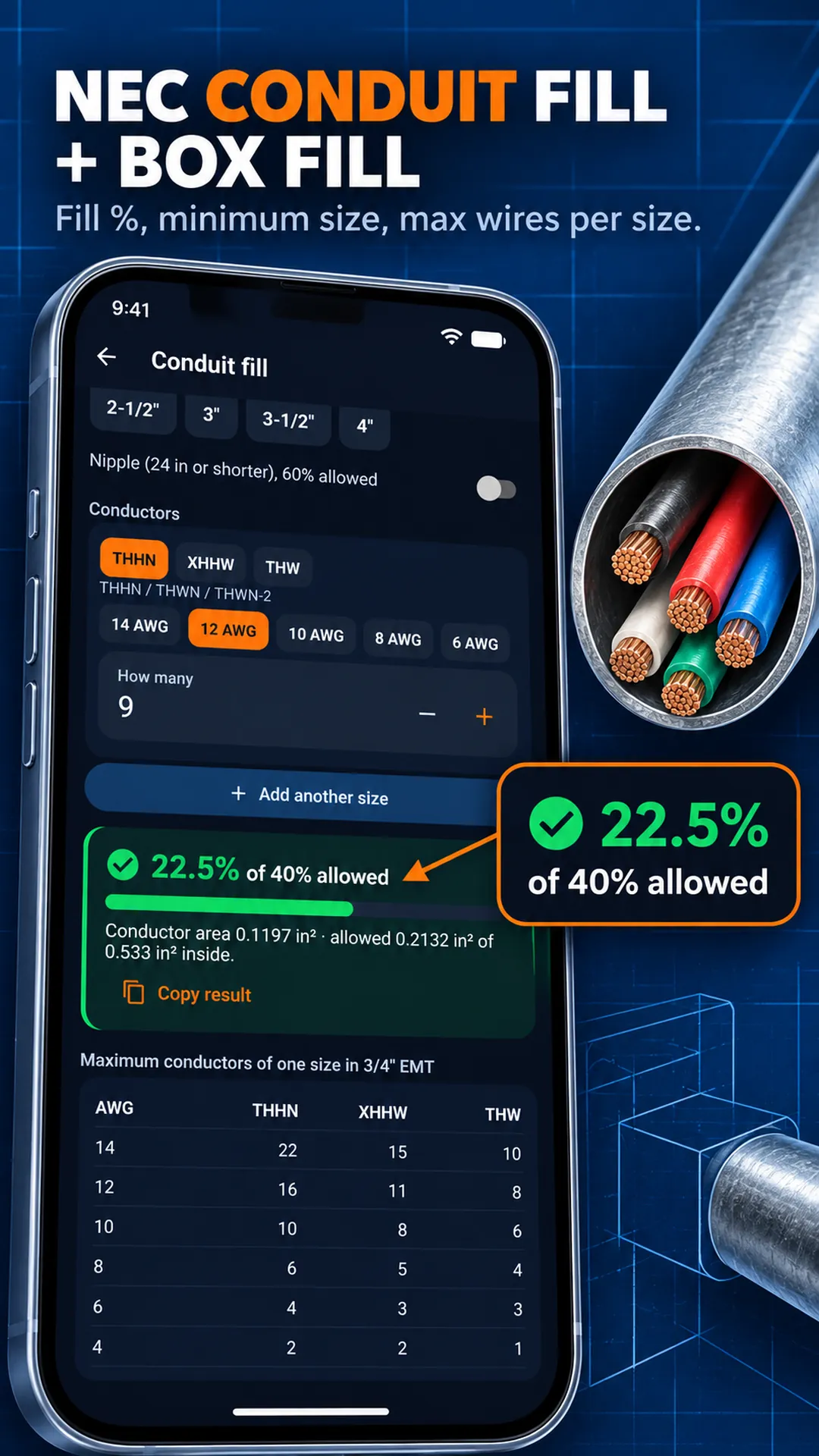
Feeder fill checks in your pocket
- NEC conduit fill for feeders, grounds and mixes
- Picks the smallest trade size that passes
- Bending math for large EMT, from your bender
- Box fill and offline use on site
Android only. There is no iPhone version yet; the free calculators on this site work on any phone.
$7.99 one time · no subscription · no ads · works offline