By Blissom · Updated 2026-11-04
Layout values: check them against your own bender, on scrap first.

Why conduit springs back
Bending stretches the outside of the bend and squeezes the inside. Most of that is permanent, but part is elastic, and the elastic part recovers when the handle goes light. The pipe opens up a degree or a few.
How much it opens depends on several things:
- Size: bigger conduit tends to spring more.
- Material: rigid and IMC are stiffer than EMT; aluminum conduit behaves differently from steel.
- The bender: shoes differ in radius and fit, so the same pipe can act differently in an aluminum or an iron head.
- The angle: a 90 shows spring-back more than a 10° kick.
- The stick: pipe from different batches can vary.
No chart predicts it for every combination. Learn your own bender on scrap.
Over-bending on purpose
- Bend to the sight line or the level, then keep going about 2–3° past it.
- Let the handle off completely.
- Check the angle: torpedo level on a stub, angle finder or the shoe's degree lines on smaller angles.
- Short? Re-seat and add a degree. Long? See the fixes below.
- Write what you learned on the handle ("3/4 EMT: +2°"), so the next 90 is one pull.
Bender instructions generally say to allow for spring-back without giving one number for every case. The 2–3° figure is a starting point for EMT on a hand bender, not a rule.
Fixing an over-bent 90
An over-bent 90 leans the stub past plumb. Even a few degrees shows at the top of a tall stub:
| Stub height | 1° off | 2° off | 3° off | 5° off |
|---|---|---|---|---|
| 10" | 3/16" | 3/8" | 1/2" | 7/8" |
| 24" | 7/16" | 13/16" | 1-1/4" | 2-1/16" |
| 48" | 13/16" | 1-11/16" | 2-1/2" | 4-3/16" |
Lean at the top = stub height × sin(error). The same numbers apply to an under-bent stub leaning the other way.
- Back-bend in the bender. Seat the bend in the shoe where it was made and push the stub back toward plumb, the reverse of the original pull.
- Or use the handle. Slip the open end of the bender handle over the stub, stand on the long leg near the bend, and pull the stub back.
- Or use the floor. For small corrections, stand the pipe on the stub end and push the long leg; the floor acts as the pivot.
- Move a little at a time and check with the level after each move.
Back-bending puts the stress right at the bend, where the pipe is already thinned on the outside. Ease into it; a quick yank is how a good 90 becomes a kink.
Fixing an under-bent 90
- Put the pipe back in the bender with the shoe seated in the existing bend, not ahead of it or behind it.
- Keep the hook where it was. The bend should continue on the same curve.
- Pull a degree or two at a time, release, check.
If the bender sits off the original bend, you get two curves with a short straight between them. The stub height changes and the bend looks wrong.
Offsets that came out wrong
An offset's depth comes from the spacing of the marks and the angle of the bends. A 30° offset is marked at depth × 2. If both bends land at a different angle, the depth you actually get is spacing × sin(actual angle):
| Wanted depth | Spacing | Bent 26° | Bent 28° | Bent 30° | Bent 32° | Bent 34° |
|---|---|---|---|---|---|---|
| 4" | 8" | 3-1/2" | 3-3/4" | 4" | 4-1/4" | 4-1/2" |
| 6" | 12" | 5-1/4" | 5-5/8" | 6" | 6-3/8" | 6-11/16" |
| 10" | 20" | 8-3/4" | 9-3/8" | 10" | 10-5/8" | 11-3/16" |
Both bends at the same angle. Sharp-corner geometry; the bend radius changes the result slightly.
- Both bends short (offset too shallow): re-seat on each bend in turn and add the same amount to each.
- Both bends long (too deep): back off each bend evenly, with the pipe in the bender or the bend held against the floor.
- One bend different from the other: the two legs are no longer parallel. Over a 36" leg, a 2° mismatch walks the end 1-1/4" off line. Correct the bend that is off, not both.
For depth and spacing at other angles, use the offset calculator.
Kinks and flattened pipe
A kink is the inside wall of the bend buckling, usually from pulling too fast, a shoe too small for the pipe, or back-bending too hard. A flattened bend has gone oval without wrinkling.
- Visible wrinkle, crease or crack: scrap it.
- Clearly oval at the bend: scrap it. Ovality cuts the room for wire and the pull drags insulation over the tight spot.
- Slight wrinkle on the inside of a 90 on thin EMT: judgment call. If wire would see it, recut.
Prevention is the right shoe for the size, the pipe fully seated in the groove, and a steady pull. Rigid and IMC need the right bender for the size; see bending rigid.
Sources: NEC 2023 358.24 and Chapter 9, Table 2; Klein Tools Conduit Bender Guide (stub take-up, offset multipliers and shrink, saddles). Method.
Questions electricians ask
What is spring-back in conduit bending?
The few degrees a bend opens back up when you release the bender. The steel was stretched elastically as well as permanently, and the elastic part recovers. Bend a little past the target and check the result after release.
How do you fix an over-bent 90?
Put the stub back in the bender with the shoe on the bend and pull the stub gently back toward plumb, or slip the bender handle over the stub end, hold the pipe down with your foot and lever the stub back. Small moves, check with a level each time.
How do you fix an under-bent conduit?
Seat the bender back on the bend exactly where it was, hook and shoe in the same spot, and pull a little more. Re-seating off the original bend puts a second, separate bend in the pipe.
What happens if an offset is over-bent?
The offset gets deeper. With 30° spacing, both bends at 32° give a 6" offset about 6-3/8" of depth instead of 6". If only one bend is off, the legs are not parallel and the far end walks off line.
Can kinked conduit be used?
Not if the bend is visibly flattened, wrinkled or cracked. Lost roundness reduces the area for conductors and makes the pull harder on insulation. Cut it out and bend a new piece.
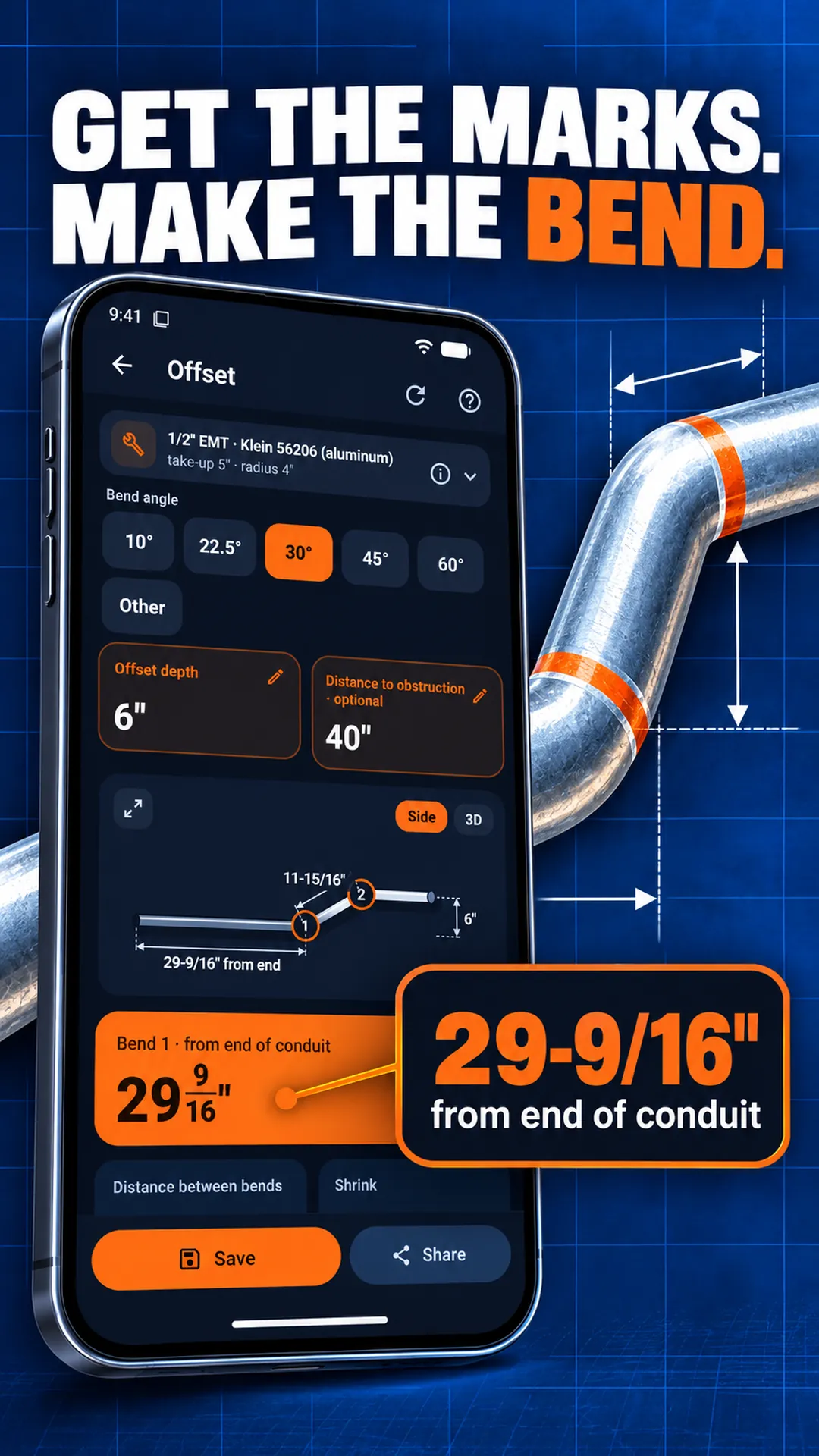
Hit the angle the first time
- Marks from the end, corrected for your shoe
- Drawings with the hook direction for every bend
- Guide mode with the next bend spelled out
- Saved jobs, offline
Android only. There is no iPhone version yet; the free calculators on this site work on any phone.
$7.99 one time · no subscription · no ads · works offline