By Blissom · Updated 2026-11-04

Maximum wires in a 4" square and 4-11/16" box
Box volume divided by the allowance for the wire size, rounded down. This is the count with no device, no clamps and no ground wires: a junction box where every conductor is spliced.
| Box (metal, Table 314.16(A)) | in³ | #14 | #12 | #10 | #8 | #6 |
|---|---|---|---|---|---|---|
| 4 × 1-1/4 square | 18.0 | 9 | 8 | 7 | 6 | 3 |
| 4 × 1-1/2 square | 21.0 | 10 | 9 | 8 | 7 | 4 |
| 4 × 2-1/8 square | 30.3 | 15 | 13 | 12 | 10 | 6 |
| 4-11/16 × 1-1/4 square | 25.5 | 12 | 11 | 10 | 8 | 5 |
| 4-11/16 × 1-1/2 square | 29.5 | 14 | 13 | 11 | 9 | 5 |
| 4-11/16 × 2-1/8 square | 42.0 | 21 | 18 | 16 | 14 | 8 |
Allowances per conductor: #14 = 2.00, #12 = 2.25, #10 = 2.50, #8 = 3.00, #6 = 5.00 in³ (Table 314.16(B)(1)). Verify which NEC edition your inspector enforces.
With a device and grounds
A receptacle or switch on a ring takes two allowances at the largest wire connected to it, and the ground wires take one more. What is left for current-carrying and neutral conductors of the same size:
| Box | #14 with 1 device + grounds | #12 with 1 device + grounds | #10 with 1 device + grounds |
|---|---|---|---|
| 4 × 1-1/4 square | 6 | 5 | 4 |
| 4 × 1-1/2 square | 7 | 6 | 5 |
| 4 × 2-1/8 square | 12 | 10 | 9 |
| 4-11/16 × 1-1/4 square | 9 | 8 | 7 |
| 4-11/16 × 1-1/2 square | 11 | 10 | 8 |
| 4-11/16 × 2-1/8 square | 18 | 15 | 13 |
Assumes one single-gang device, up to four ground wires, no internal clamps and no marked ring volume. A two-gang ring with two devices takes two more allowances.
Mud rings and extension rings
314.16(A) lets you add the volume of a plaster ring, extension ring or domed cover, but only where it is marked with its volume. The calculation is:
Usable volume = box volume (Table 314.16(A)) + marked ring volume
A 4" × 1-1/2" box with a ring marked X in³ has 21 + X in³ to work with. Read the number stamped on the ring you actually install, not one from a catalog; an unmarked ring counts as zero. A marked extension ring on a 4x4 adds volume the same way, which makes it a common fix for a box that comes up a conductor short.
Clamps, grounds and mixed sizes
- Clamps: metal 4" square boxes fed with conduit usually have no internal clamps; the connectors are outside the box and do not count. If the box has internal cable clamps (for MC or NM), all of them together count as one allowance of the largest conductor.
- Grounds: one allowance for up to four equipment grounding conductors, at the largest one, plus a quarter allowance for each additional one. Isolated-ground conductors are counted separately from the regular ones.
- Mixed #12 and #14: each conductor counts at its own size. Only the device, clamp and ground allowances use the largest conductor (for a device, the largest conductor connected to that device).
- Pass-throughs: a conductor running through the box unbroken counts once. A loop long enough to be cut for two terminations, at least 12 in, counts twice.
- What does not count: pigtails and jumpers that never leave the box, and the wire connectors themselves.
Worked examples
1. Junction box on an EMT run: 4 × 1-1/2 square
Eight #12 conductors spliced in the box and one wire-type equipment grounding conductor:
- 8 × 12 AWG conductors = 18.00 in³
- Equipment grounding conductors (1 × 12 AWG total) = 2.25 in³
- Total 20.25 in³ against 21.0 in³: fits, 0.75 in³ to spare.
Add a ninth #12 and the total is 22.50 in³: too full. In the 2-1/8" deep box the same nine come to 22.50 of 30.3 in³.
2. Receptacle on a single-gang ring: 4 × 2-1/8 square
Two 20 A circuits in, one continuing out: six #12 conductors, one receptacle connected with #12, and three #12 ground wires. The ring is not marked with a volume.
- 6 × 12 AWG conductors = 13.50 in³
- 1 device yoke (2 × 12 AWG each) = 4.50 in³
- Equipment grounding conductors (1 × 12 AWG total) = 2.25 in³
- Total 20.25 in³ against 30.3 in³: fits, 10.05 in³ to spare.
3. Mixed sizes, two devices: 4-11/16 × 2-1/8 square
Six #12 and eight #14 conductors, a #12 receptacle and a #14 switch on a two-gang ring, and seven grounds (largest #12):
- 6 × 12 AWG conductors = 13.50 in³
- 8 × 14 AWG conductors = 16.00 in³
- 1 device yoke (2 × 12 AWG each) = 4.50 in³
- 1 device yoke (2 × 14 AWG each) = 4.00 in³
- Equipment grounding conductors (1 × 12 AWG total) = 2.25 in³
- 3 grounding conductors over four (¼ × 12 AWG each) = 1.69 in³
- Total 41.94 in³ against 42.0 in³: fits, 0.06 in³ to spare.
The same load in a 4" × 2-1/8" box needs 41.94 in³ against 30.3: too full, unless a marked ring or extension makes up the difference. Run your own box in the box fill calculator.
Mistakes inspectors catch
- Using the 4-11/16 volume for a 4" box. They look alike in a wall. Check the stamp or measure.
- Adding an unmarked ring. No marking, no volume.
- Forgetting the device. A receptacle on the ring takes two allowances, 4.50 in³ with #12.
- Counting all grounds at a quarter. The first four share one full allowance; the quarters start at the fifth.
- Counting every conductor at #14. In a mixed box each #12 is 2.25 in³, not 2.00.
- Counting pigtails. They do not count; but the conductor they splice to does.
Sources: NEC 2023: 314.16(A), Table 314.16(A), 314.16(B)(1)–(5) and Table 314.16(B)(1); Volume marked on nonmetallic boxes, plaster rings and extension rings. Method.
Questions electricians ask
How many wires can go in a 4x4 junction box?
It depends on depth and wire size. A 4" × 1-1/2" box (21 in³) holds 9 #12 or 10 #14 allowances; a 4" × 2-1/8" (30.3 in³) holds 13 #12 or 15 #14. Grounds, devices and clamps count as allowances too.
What is the box fill for a 4 square deep box?
A 4" square × 2-1/8" deep metal box is 30.3 in³ in Table 314.16(A). Add the marked volume of the ring or extension ring on it.
What is 1900 box fill?
"1900 box" is the trade name for a 4" square box. The 1-1/4" deep one is 18 in³, the 1-1/2" deep one 21 in³ and the 2-1/8" deep one 30.3 in³.
What is the box fill for a 4-11/16 box?
4-11/16" square: 25.5 in³ at 1-1/4" deep, 29.5 in³ at 1-1/2", 42 in³ at 2-1/8". The deep one holds 18 #12 or 16 #10 allowances.
Does a mud ring add to box fill?
Only if it is marked with a volume (314.16(A)). Add the marked number to the box volume. An unmarked ring adds nothing.
Do ground wires count in a 4x4 box?
Up to four equipment grounding conductors count as one allowance of the largest one; each ground beyond four adds a quarter allowance (314.16(B)(5), NEC 2020 and later). If the conduit is the grounding path and no ground wire is pulled, there is nothing to count.
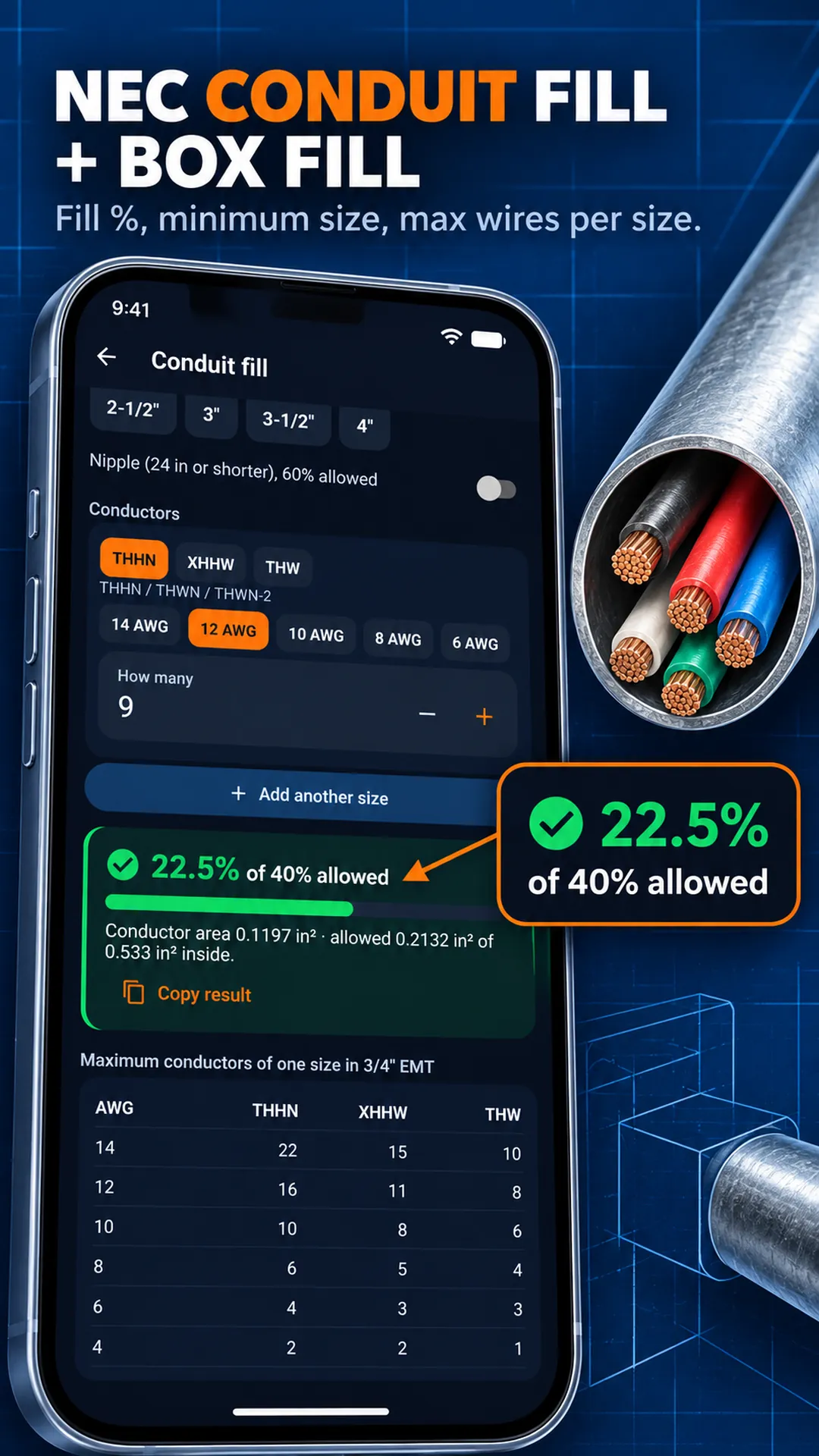
Box fill for every box on the job
- NEC box fill and conduit fill, smallest box that works
- All bends: offsets, saddles, kicks, 90s
- Marks measured from the end of the conduit
- Works offline
Android only. There is no iPhone version yet; the free calculators on this site work on any phone.
$7.99 one time · no subscription · no ads · works offline