 Conduit Bending
By Blissom · Updated 2026-11-04
Layout values: check them against your own bender, on scrap first.
Short answer: 90 mark = stub − take-up (5" on 1/2" EMT). Kick mark = depth × multiplier + half the OD, taped from the back of the 90. Bend the kick with the stub lying flat, so the two bends are square to each other. Sticker values; test on scrap.
What a kick 90 looks like
Picture a conduit running along the floor tight to a wall, then turning up. A plain 90 would put the stub against the wall. A kick 90 bends the run away from the wall a short distance before the stub, so the stub comes up off the wall by the kick depth.
Seen from above, the run is straight along the wall, angles out at the kick, and reaches the stub. Seen from the side, the stub is plumb. The kick sits in the floor plane; the 90 sits in a vertical plane. The two planes are square to each other.
- Kick depth: how far off the wall line the stub stands, measured square to the wall.
- Kick travel: length of the angled piece between the kick and the stub centerline.
- Shrink: how much shorter the run along the wall gets because of the kick.
The same shape, turned on its side, brings a stub out of a slab past a footing, or lifts a run off strut to line up with a box. The math does not change.
Bending order, step by step
- Mark the 90. Stub height minus take-up, from the end. Draw a straight line along the top of the pipe through the mark; you will use it to check the roll.
- Bend the 90 with the arrow on the mark and the hook toward the end, the same as any stub-up. Check it plumb with a level.
- Measure for the kick. Hook the tape on the back of the stub and run it along the leg. Mark travel + half the OD (the calculator gives this number).
- Turn the pipe. Lay the leg in the bender with the stub lying flat on the floor, pointing the way the wall will be. Rotate exactly 90° from the plane of the first bend; the line you drew should now be on the side.
- Bend the kick to the angle you chose, with the arrow on the kick mark. Use the degree sight lines on the shoe, then confirm with a torpedo level or angle finder.
- Stand it up and check. The stub must still read plumb in both directions. Measure from the wall line to the back of the stub: that is your kick depth.
Which reference on your shoe goes on the kick mark can differ by brand. The sticker method puts the arrow on it. If your first piece comes out deep or shallow, move the mark, not the angle.
Worked example: 1/2" EMT, 14" stub, 2" off the wall
- 90 mark: 14" − 5" take-up = 9" from the end.
- Kick travel at 30°: 2" × 2 = 4".
- Kick mark: 4" + 0.706" ÷ 2 = 4-3/8" from the back of the 90.
- Shrink: 2" × 1/4" = 1/2". Wherever the far end has to land, add this to the cut length.
- The kick adds 30° to the run, so the 90 and kick count 120° toward the 360° limit.
Kick mark chart, from the back of the 90
For 1/2" EMT (half the OD = 3/8"), with sticker multipliers. For other sizes, add half their OD instead.
| Kick depth | 10° | 15° | 22.5° | 30° | 45° |
|---|---|---|---|---|---|
| 1" | 6-3/8" | 4-3/16" | 2-15/16" | 2-3/8" | 1-3/4" |
| 1-1/2" | 9-3/8" | 6-1/8" | 4-1/4" | 3-3/8" | 2-7/16" |
| 2" | 12-3/8" | 8-1/16" | 5-9/16" | 4-3/8" | 3-1/8" |
| 3" | 18-3/8" | 11-15/16" | 8-1/8" | 6-3/8" | 4-9/16" |
| 4" | 24-3/8" | 15-13/16" | 10-3/4" | 8-3/8" | 5-15/16" |
| 6" | 36-3/8" | 23-9/16" | 15-15/16" | 12-3/8" | 8-3/4" |
Kick mark = depth × multiplier + 0.706" ÷ 2. The 15° column uses the calculated multiplier (3.86); the rest use the values printed on most benders. Marks closer to the 90 than about take-up + 2" crowd the curve of the 90: choose a shallower angle there.
Parallel kick 90s
Run three or four conduits side by side and kick them together, and the kicks will not line up if every pipe gets the same mark. The outer pipes need their kick moved. It is the same adjustment used for parallel offsets:
Bend the first conduit to the normal mark. Each next conduit in the row moves its kick mark by one more shift. Done right, the stubs stay in a straight row and the kicked legs stay parallel.
| Center spacing | 10° | 15° | 22.5° | 30° | 45° |
|---|---|---|---|---|---|
| 1-1/2" | 1/8" | 3/16" | 5/16" | 3/8" | 5/8" |
| 2" | 3/16" | 1/4" | 3/8" | 9/16" | 13/16" |
| 3" | 1/4" | 3/8" | 5/8" | 13/16" | 1-1/4" |
| 4" | 3/8" | 1/2" | 13/16" | 1-1/16" | 1-11/16" |
Shift added per conduit. Four 3/4" EMT on 2" centers at 30°: marks move 9/16" each, so the fourth sits 1-5/8" past the first. Which way the shift goes depends on which side of the kick each pipe sits; lay the first two side by side and check before bending the rest.
Troubleshooting
| What you see | Likely cause | Fix |
|---|---|---|
| Stub leans toward or away from the wall | Pipe rolled more or less than 90° before the kick | Twist it back; see dog legs |
| Stub sits too far off the wall | Kick mark too far from the 90, or kick over-bent | Next piece: mark closer, check the angle with a level |
| Stub sits too close to the wall | Kick under-bent, or spring-back after release | Add a degree or two; see spring-back |
| Kick lands on the curve of the 90 | Depth too small for a steep angle | Use 10° or 22.5° so the mark moves out |
| Far end lands short | Shrink not added to the cut length | Add depth × shrink per inch |
Not sure how your bender behaves on a kick this close to a 90? Bend one on a scrap length and write the correction on the handle.
Sources: NEC 2023 358.24 and Chapter 9, Table 2; Klein Tools Conduit Bender Guide (stub take-up, offset multipliers and shrink, saddles); Klein Tools Conduit Bending Basics (90° stub-up take-up table: 5", 6", 8", 11"). Method.
Questions electricians ask
How do you bend a kick 90?
Bend the stub-up first using the take-up (mark = stub height − take-up). Lay the conduit down so the stub lies flat, pointing the way the wall will be. Measure from the back of the 90 to the kick mark (depth × multiplier, plus half the conduit OD), set the bender there and bend the kick angle. Stand it up and check the stub with a level.
What is the kick 90 formula?
Stub mark = stub height − take-up. Kick travel = kick depth × multiplier (6 at 10°, 2.6 at 22.5°, 2 at 30°, 1.4 at 45°). Kick mark from the back of the 90 = travel + half the OD. Shrink of the run = depth × shrink per inch (1/4" per inch at 30°).
How much does a kick 90 shrink?
The run shortens by depth × shrink per inch: 1/16" per inch at 10°, 3/16" at 22.5°, 1/4" at 30°, 3/8" at 45°. A 2" kick at 30° shrinks the run 1/2". The stub height does not change if the kick is square to the 90.
What is a parallel kick 90?
Several kick 90s side by side in a rack. Each next conduit moves its kick mark by center spacing × tan(half the kick angle), the same adjustment as parallel offsets, so the kicks stay evenly spaced.
Does it matter if I bend the kick or the 90 first?
This page bends the 90 first: the stub height is easiest to hit on straight pipe, and the kick is then measured from a finished reference. Some electricians bend the kick first; either way, the two bends must sit at right angles to each other.
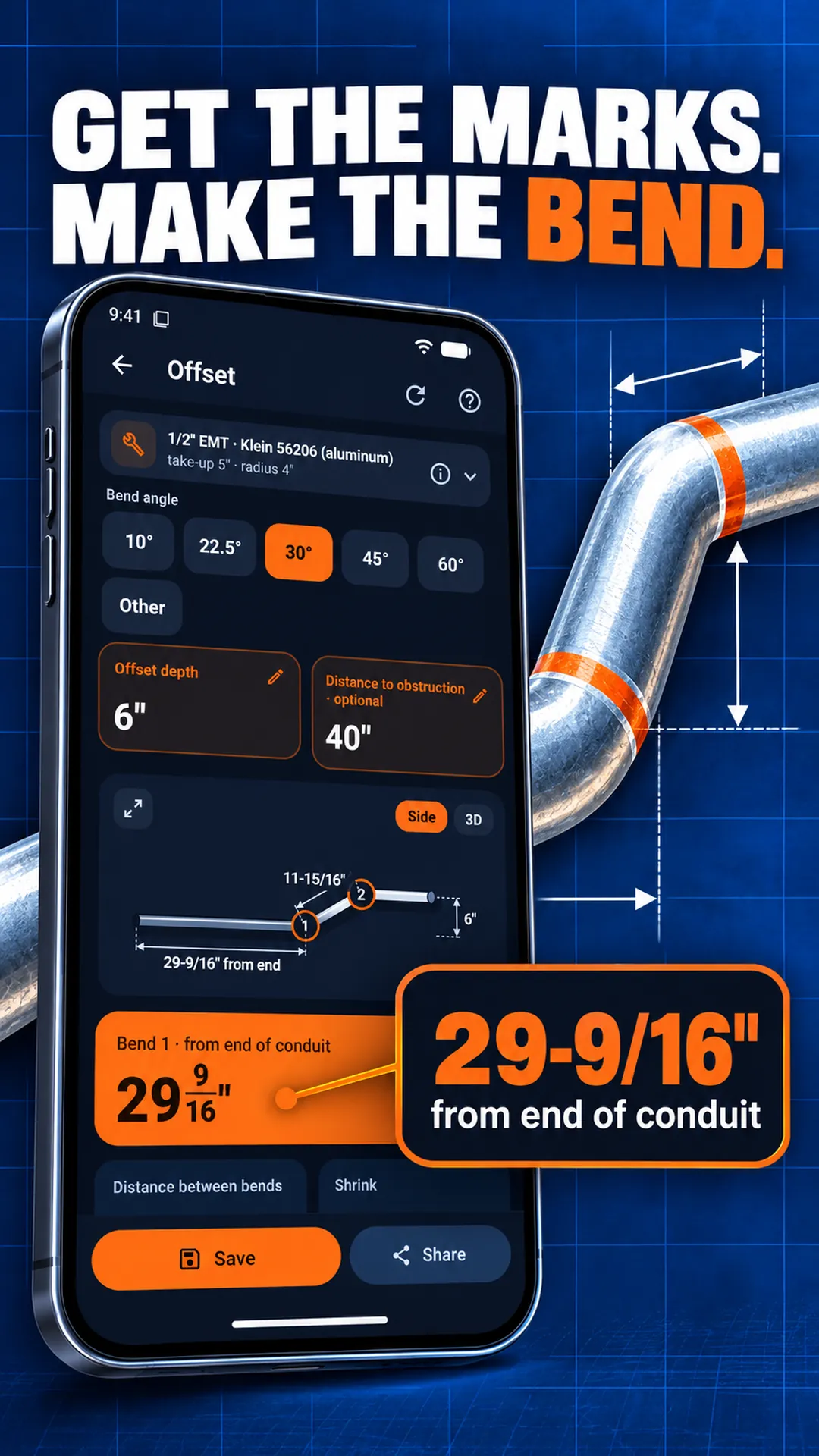
Kick 90s without the guesswork
- Marks from the end of the pipe, corrected for your shoe
- Drawings that show which way the hook faces
- Guide mode that walks you through each bend
- Saved jobs that work offline
Android only. There is no iPhone version yet; the free calculators on this site work on any phone.
$7.99 one time · no subscription · no ads · works offline