By Blissom · Updated 2026-11-04
Layout values: check them against your own bender, on scrap first.

At a glance
Spacing = depth × 1.2 · Shrink = depth × 1/2" · Advance = depth × 0.577
Minimum depth ≈ shoe radius · Bend total 120° per offset · Max per run 3
The offset advances less than its own depth: a 10" offset moves only 5-3/4" along the run. That is its only real advantage, and the reason it gets used in very tight spots.
The depth has to beat the shoe radius
Two bends of angle θ on a shoe with centerline radius R need about 2R(1 − cos θ) of depth before their arcs stop overlapping. Cos 60° is one half, so at this angle the formula simplifies to R itself: the offset must be at least as deep as the shoe's radius.
| EMT hand bender | Centerline radius | Shallowest 60° offset |
|---|---|---|
| 1/2" (Klein 51606) | 4-5/8" | 4-5/8" |
| 3/4" (Klein 51607) | 5-1/2" | 5-1/2" |
| 1" (Greenlee 842AH) | 6-1/2" | 6-1/2" |
Estimate for these three shoes; other models differ.
The arithmetic hides this. A 2" offset at 60° gives marks 2-3/8" apart, which looks bendable on paper. In the shoe, the second bend would start inside the first. Under about 1-11/16" of depth the marks themselves are less than 2" apart and practically on top of each other.
60° chart, 1" to 24"
| Depth | Between bends | Shrink | Advance | Fits EMT shoe |
|---|---|---|---|---|
| 1" | 1-3/16" * | 1/2" | 9/16" | none |
| 1-1/2" | 1-13/16" * | 3/4" | 7/8" | none |
| 2" | 2-3/8" | 1" | 1-1/8" | none |
| 3" | 3-5/8" | 1-1/2" | 1-3/4" | none |
| 4" | 4-13/16" | 2" | 2-5/16" | none |
| 4-1/2" | 5-3/8" | 2-1/4" | 2-5/8" | none |
| 5" | 6" | 2-1/2" | 2-7/8" | 1/2" |
| 5-1/2" | 6-5/8" | 2-3/4" | 3-3/16" | 1/2", 3/4" |
| 6" | 7-3/16" | 3" | 3-7/16" | 1/2", 3/4" |
| 6-1/2" | 7-13/16" | 3-1/4" | 3-3/4" | 1/2", 3/4", 1" |
| 7" | 8-3/8" | 3-1/2" | 4-1/16" | 1/2", 3/4", 1" |
| 8" | 9-5/8" | 4" | 4-5/8" | 1/2", 3/4", 1" |
| 9" | 10-13/16" | 4-1/2" | 5-3/16" | 1/2", 3/4", 1" |
| 10" | 12" | 5" | 5-3/4" | 1/2", 3/4", 1" |
| 11" | 13-3/16" | 5-1/2" | 6-3/8" | 1/2", 3/4", 1" |
| 12" | 14-3/8" | 6" | 6-15/16" | 1/2", 3/4", 1" |
| 14" | 16-13/16" | 7" | 8-1/16" | 1/2", 3/4", 1" |
| 16" | 19-3/16" | 8" | 9-1/4" | 1/2", 3/4", 1" |
| 18" | 21-5/8" | 9" | 10-3/8" | 1/2", 3/4", 1" |
| 20" | 24" | 10" | 11-9/16" | 1/2", 3/4", 1" |
| 22" | 26-3/8" | 11" | 12-11/16" | 1/2", 3/4", 1" |
| 24" | 28-13/16" | 12" | 13-7/8" | 1/2", 3/4", 1" |
Sticker values (1.2 and 1/2"/in) to the nearest 1/16". * Marks closer than 2". Faded rows are too shallow for any of the three shoes above.
Marks for 1/2", 3/4" and 1" EMT
Each depth is above that shoe's minimum. Distances are from the cut end to the point where the offset must be complete.
| 1/2" EMT | 3/4" EMT | 1" EMT | |
|---|---|---|---|
| Depth | 6" | 8" | 10" |
| Finished at | 30" | 40" | 50" |
| Between bends (× 1.2) | 7-3/16" | 9-5/8" | 12" |
| Shrink (× 1/2") | 3" | 4" | 5" |
| Mark 1 | 25-13/16" | 34-3/8" | 43" |
| Mark 2 | 33" | 44" | 55" |
| Advance | 3-7/16" | 4-5/8" | 5-3/4" |
Notice how far the second mark lands past the finish point: the shrink is half the depth, so on the 1" job the second mark sits 5" beyond it. Forgetting the shrink on a 60° offset is a short pipe every time.
Sticker 1.2 and 1/2" vs exact
Both trade numbers are off, in different ways. The multiplier 1.2 is larger than the true 1.1547, so the marks land too far apart and the offset bends 3.9% too deep: 1/2" on 12", 15/16" on 24". The shrink rule of 1/2" per inch is under tan 30° = 0.5774, so the pipe also ends up shorter than the rule says: 15/16" at 12" of depth, 1-7/8" at 24".
For a deep 60° offset that has to land in a fitting, use 1.155 and 0.577 or the offset calculator in exact mode.
When to bend something else
Because each 60° offset is 120°, a run with one of them has only 240° left for everything else. Pulling tension builds with every degree of bend, so a steep offset near the far end of a long pull is felt at the tugger. Options worth weighing first:
- A 45° offset if you can find 1-5/8" more pipe between bends (at 8" deep). It saves 30° and is easier to sight.
- A single kick when the pipe does not need to come back parallel, for example heading into a box or up a wall at an angle. One bend instead of two; see the kick calculator.
- Two 90s for very deep changes of level. They add 180°, more than a 60° offset, but the marks come straight off the take-up, the result is square, and the depth is set by measured straight pipe instead of an angle you sight by eye. The back-to-back 90 calculator lays them out.
A degree either way
An 8" offset laid out with 1.2 puts the marks 9-5/8" apart. What comes out:
| Both bends | Depth | vs 8" wanted |
|---|---|---|
| 58° | 8-1/8" | +1/8" |
| 59° | 8-1/4" | +1/4" |
| 60° | 8-5/16" | +5/16" |
| 61° | 8-3/8" | +3/8" |
| 62° | 8-1/2" | +1/2" |
The sticker overshoot is bigger than a degree's worth of bending error here, so a 60° offset bent a degree or two shy of the mark lands closer to the planned depth than a perfect one.
Sources: NEC 2023 358.24 and Chapter 9, Table 2; Klein Tools Conduit Bender Guide (stub take-up, offset multipliers and shrink, saddles). Method.
Questions electricians ask
What is the multiplier for a 60 degree offset?
1.2. The exact figure is 1 ÷ sin 60° = 1.155. Spacing with 1.2 and bending a true 60° makes the offset about 3.9% deeper than planned.
What is the shrink for a 60 degree offset?
1/2" per inch of depth by the trade rule. The exact value is tan 30° = 0.577", so on a 12" offset the rule is short by 15/16".
What is the smallest 60 degree offset you can bend?
On a hand bender it is about equal to the shoe's centerline radius: roughly 4-5/8" on 1/2", 5-1/2" on 3/4", 6-1/2" on 1" EMT for the shoes listed on this page. Shallower than that, the two bends would overlap.
Does a 60 degree offset count as 120 degrees?
Yes. Two 60° bends add 120° toward the 360° allowed between pull points, so 3 such offsets use up the whole allowance.
Should I use 60 or 45 degrees for an offset?
Use 45° when you have the room. At 8" deep, 45° needs 11-3/16" between bends against 9-5/8" at 60°, shrinks 3" instead of 4", and adds 90° to the run instead of 120°.
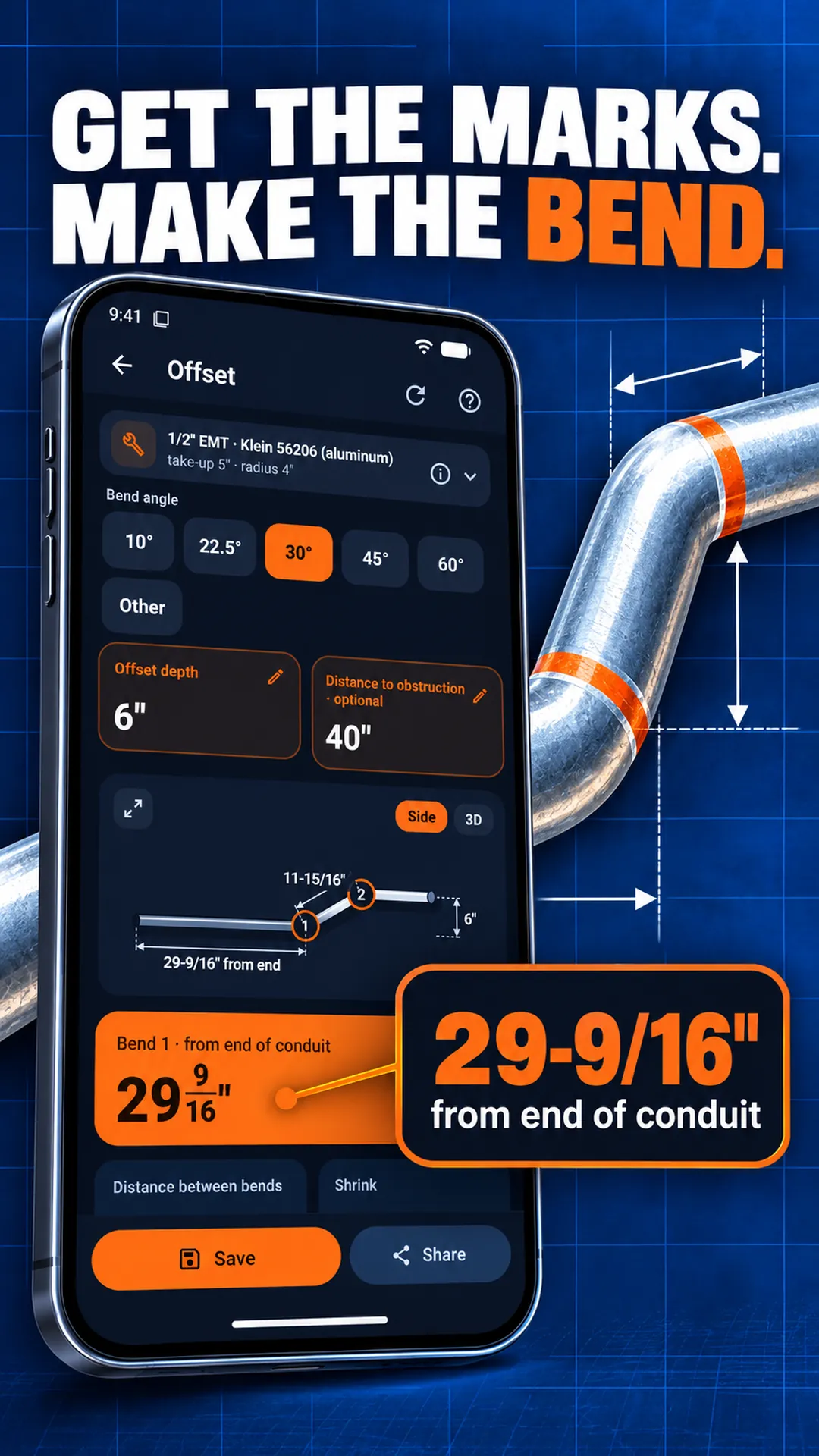
Steep offsets, checked against your shoe
- Marks from the end of the conduit with shrink included
- Stops you when a 60° offset is too shallow for the bender
- Warns when marks land too close together
- Any angle in between, corrected for the shoe, offline
Android only. There is no iPhone version yet; the free calculators on this site work on any phone.
$7.99 one time · no subscription · no ads · works offline