By Blissom · Updated 2026-11-04
Layout values: check them against your own bender, on scrap first.

What a dog leg is
Every pair of bends in a layout belongs to a plane. An offset's two bends share one flat plane; a kick 90's two bends sit on planes square to each other. When the pipe turns in the bender by the wrong amount between bends, the second bend comes out tilted. That tilt is the dog leg.
Signs you have one:
- An offset rocks on the floor instead of lying flat on both legs.
- A back-to-back 90's two stubs are not parallel; one leans in or out.
- A stub that was plumb before the kick now leans after it.
- The pipe enters a box connector at an angle and binds.
How far a twist throws the end
The leg beyond the twisted bend swings like a gate. Its end moves sideways by length × sin(twist). Short legs hide a twist; long ones show it.
| Leg length | 2° twist | 5° twist | 10° twist |
|---|---|---|---|
| 12" | 7/16" | 1-1/16" | 2-1/16" |
| 24" | 13/16" | 2-1/16" | 4-3/16" |
| 36" | 1-1/4" | 3-1/8" | 6-1/4" |
| 60" | 2-1/8" | 5-1/4" | 10-7/16" |
Sideways movement = L × sin φ, measured at the end of the leg. Reversed: a 1/4" miss at the end of a 36" leg means about 0.4° of twist; at the end of 12", about 1.2°.
This is why a dog leg you can barely see at the bender becomes obvious ten feet down the wall: the error grows with the length of pipe beyond it.
Every cause
- Rolling by eye between bends. An offset needs exactly 180°. Turning the pipe by feel lands anywhere from 170° to 190°.
- Handle not vertical. Leaning the handle sideways while you pull bends the pipe slightly out of plane.
- Uneven foot pressure. A foot on the edge of the heel lets the shoe tip, and the pipe follows it.
- Pipe rolling in the shoe. Loose grip at the hook lets the conduit turn as it starts to bend, especially on slick EMT.
- Marking on the side. A mark on the side of the pipe looks right from one angle and wrong from another. You end up rotating to see it.
- Measuring from the wrong side. Taping off the wrong side of a finished bend puts the next mark off, and to make it look right you twist.
- Uneven floor. A sloped or bumpy floor tilts the bender, so the first bend is already out of plumb.
Prevention
- Draw a reference line the full length of the stick, straight along the top, before bending. A chalk line, a marker against a straight edge, or a strip of tape works.
- Keep the line where it belongs. Top-center for every bend in one plane. For an offset's second bend, turn until the line is exactly on the bottom.
- Sight along the pipe from the end before each bend. The finished bend and the bender handle should line up.
- Use a torpedo level on both bends. Lay it on the first leg to check it is level side to side, then on the second after bending.
- Use the floor. After each bend, lay the pipe down. Both legs touching the floor means the plane is true.
- Hold the handle plumb and push down on the heel with a full, flat foot.
Clip-on conduit levels are made for this: they clamp to the pipe and show when it is rolled true. A plain torpedo level does the same job if you take the time to use it.
Fixing one: the twist-back
A dog leg is a rotation, so the fix is a counter-rotation about the bend.
- Find which bend is twisted. Lay the pipe down. The leg that lifts or points off line belongs to the bad bend.
- Lock the good leg. Put the bender back on the bend, hook and shoe seated, with your foot on the pipe. Or clamp it in a second bender held by a helper.
- Twist the other leg. Grab it near the bend, or slip the bender handle's open end over a stub, and rotate it toward the plane. Small, steady twists.
- Go a hair past. The steel springs back a little; twist slightly beyond true and let go.
- Check on the floor and with a level. Repeat until it lies flat.
On a two-bend offset, it sometimes works better to twist both legs a little in opposite directions. On a kick 90, hold the stub and swing the kicked leg.
When to cut and start over
- The bend flattened, wrinkled or kinked while twisting. Out-of-round pipe snags wire on the pull.
- A big twist on a large trade size. The force it takes tends to deform the bend before the plane comes true.
- You have already re-twisted it two or three times. Work-hardened steel gets springy and unpredictable.
- Rigid or IMC. These are hard to twist by hand without crushing; recutting is usually faster.
Before recutting, check the cause in the list above, or the next stick will come out the same. For the rest of the hand-bender basics, see how to bend conduit.
Sources: NEC 2023 358.24 and Chapter 9, Table 2; Klein Tools Conduit Bender Guide (stub take-up, offset multipliers and shrink, saddles). Method.
Questions electricians ask
What is a dog leg in conduit?
Two or more bends that should share one plane but do not. Lay the pipe on the floor and it rocks, or one leg points off to the side instead of straight. It is the most common hand-bending defect on offsets, saddles, back-to-back 90s and kick 90s.
How do you avoid a dog leg when bending conduit?
Draw a straight line along the conduit before the first bend and keep it centered on top for every bend (or exactly 180° away for an offset). Keep the handle vertical, put steady foot pressure on the heel, and sight down the pipe before each new bend.
How do you fix a dog leg?
Hold one leg still (bender on the bend, foot on the pipe, or a second bender) and twist the other leg back into plane by hand or with the bender handle slipped over the end. Twist a little past flat, since it springs back, and check on the floor. Kinked or ovaled pipe gets recut.
Is a small dog leg acceptable?
A degree or two on a short offset may disappear when the conduit is strapped, but it puts load on the couplings and connectors and looks poor on exposed work. Anything that will not lie flat or enter a fitting straight should be fixed.
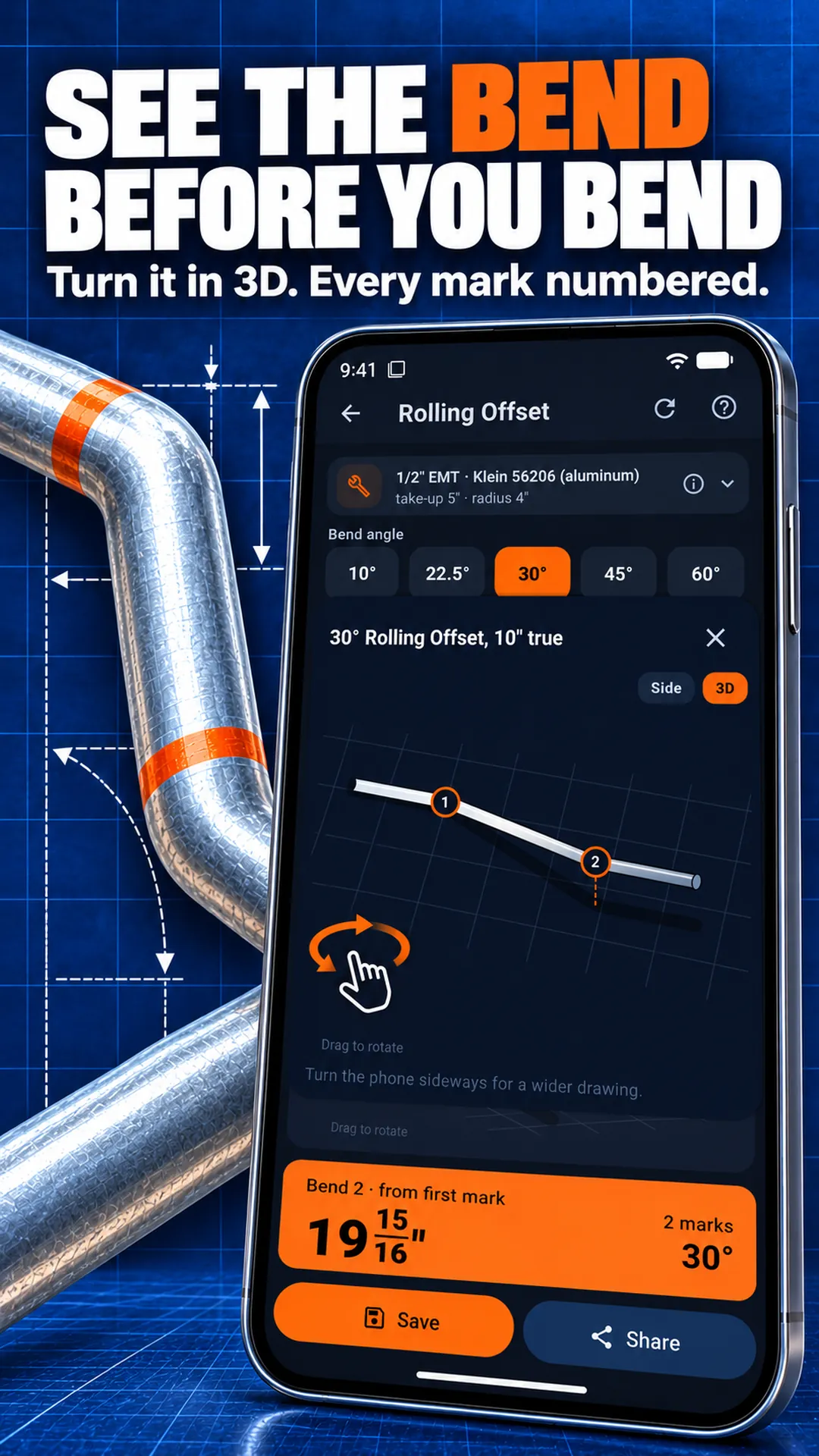
Every bend drawn in the plane it belongs in
- Marks from the end, corrected for your shoe
- Drawings that show hook direction and the roll
- Guide mode for each bend in order
- Saved jobs, offline
Android only. There is no iPhone version yet; the free calculators on this site work on any phone.
$7.99 one time · no subscription · no ads · works offline