By Blissom · Updated 2026-11-04
Layout values: check them against your own bender, on scrap first.

Which bend for which obstruction
| In the way | Bend | Use |
|---|---|---|
| Outside corner of a wall | 90 with standoff, or two 45s; LB if neither fits | Tables below |
| Beam, run stays on the far side level | One offset | Offset |
| Beam, run comes back to its line | 4-point saddle | 4-point saddle |
| Round pipe or small conduit | 3-point saddle | 3-point saddle |
| Column or pilaster on a wall | Two offsets (a saddle on its side) | 4-point saddle |
| Tank or large curved surface | Segmented sweep | Segmented 90 |
| Several conduits round one curve | Concentric bends | Concentric chart |
| Obstruction that moves the run over and up | Rolling offset | Rolling offset |
Outside corners
A hand-bender 90 cannot hug an outside corner. The shoe's radius swings the middle of the bend inward, toward the corner, and a pipe strapped tight to both walls would run its bend straight into the edge.
Option 1: a 90 with standoff
The middle of a 90's arc sits about 0.29 × radius inside the point where the two straight legs would cross. To clear the edge, the conduit centerline must stand that far off each face, plus half its OD, plus a little air (1/4" here).
| EMT | Shoe radius | Centerline off each face | Offset out if strapped tight | 22.5° mark spacing |
|---|---|---|---|---|
| 1/2" | 4-5/8" | 1-15/16" | 1-5/8" | 4-3/16" |
| 3/4" | 5-1/2" | 2-5/16" | 1-7/8" | 4-13/16" |
| 1" | 6-1/2" | 2-3/4" | 2-1/8" | 5-5/8" |
Radii of the named shoes in our take-up chart; your shoe may differ. Spacing = offset depth × 2.6. Strut or standoff straps often give this distance without any offsets.
- Measure the standoff the pipe has now. If it is less than the table, bend a small offset out before the corner.
- Bend the 90 so its back lands where the second wall's run needs to be. Use the stub-up method, measuring from the end on the second wall.
- Bend a matching offset back onto the second wall, square to the 90's plane. Sight it for a dog leg before strapping.
Option 2: two 45s across the corner
The two 45s form a short diagonal that cuts the corner. Each 45 sits a cut-back distance a before the point where the two conduit lines would cross. Treated as a 45° offset of depth a, the marks are a × 1.4 apart.
How much cut-back fits depends on the standoff s: the diagonal clears the edge by (2s − a) ÷ √2. For 1/2" EMT with 1/4" of air:
| Standoff s | Largest cut-back | Mark spacing (× 1.4) | Pipe saved vs a square corner |
|---|---|---|---|
| 2" | 3-1/8" | 4-3/8" | 1-13/16" |
| 3" | 5-1/8" | 7-3/16" | 3" |
| 4" | 7-1/8" | 10" | 4-3/16" |
| 6" | 11-1/8" | 15-5/8" | 6-1/2" |
Sharp-corner geometry. Two 45s on a 1/2" shoe need roughly 3-13/16" between marks to bend separately, so small standoffs do not leave room; that is when an LB or pulling elbow is the answer.
Around a beam
Example: conduit runs along a wall at ceiling height and meets a beam that hangs 7" down and is 10" wide. The near face is 48" from the end of the pipe. With 1" of clearance, the drop is 8".
- Run stays low after the beam: one 30° offset, 8" deep. Marks 34" and 50" from the end (16" apart, shrink 2" added).
- Run returns to the ceiling line: a 30° 4-point saddle. Marks at 33", 49", 61", 77". Flat top 12", total shrink 4".
Each 30° bend adds to the run's 360° budget: the offset costs 60°, the saddle 120°. A deep beam with several more bends to come can push you to a pull point.
Around a column
A pilaster or column face on a wall is a saddle turned on its side: the pipe kicks out, runs past the face, and comes back. Example: a 12" column stands 3" proud of the wall, its near edge 40" from the end. Going 4" out (1" clearance) at 30°:
- Marks at 32", 40", 54", 62" from the end.
- Bend 1 and 2 form the offset out; 3 and 4 bring it back. All four bends lie in the plane of the wall.
- Total shrink 2", which is already in the mark positions above.
A free-standing round column in the middle of a run is the same idea with the bends in the horizontal plane; on a round face, a 3-point saddle on its side can be shorter.
Pipes, ducts and tanks
- Round pipe crossing the run: a 3-point saddle, center bend over the pipe. Measure to the center of the pipe, not its near edge.
- Rectangular duct: a 4-point saddle, because a 3-point hump is too narrow at the top.
- Tank or vessel: follow the curve with a segmented sweep of small shots at the tank radius plus clearance.
- Several conduits round a tank: concentric bends, each conduit on its own radius so the spacing stays even.
Compound 90s
Some corners need the pipe to turn and climb in one move, for example around a column corner while rising onto a beam. That is a compound 90: two bends in different planes whose angles and roll combine into one direction change. The math is a 3D problem and is not on this site; the app has a compound 90 calculator for corner obstructions. For a run that moves over and up at once, the rolling offset covers the simpler case.
Mistakes
- Wrapping a 90 tight round a corner and crushing the bend into the edge.
- Taking the drop as the beam depth alone, with no clearance for the flange, hangers or fireproofing.
- Forgetting that a saddle on a column face still adds its degrees to the 360° count.
- Bending the return offset in the wrong plane after a corner, which leaves the run twisted off the second wall.
Sources: NEC 2023 358.24 and Chapter 9, Table 2; Klein Tools Conduit Bender Guide (stub take-up, offset multipliers and shrink, saddles). Method.
Questions electricians ask
How do you bend conduit around an outside corner?
Either use a pulling elbow or LB, or bend so the pipe stands off both walls far enough for the bend to clear the edge. A 1/2" EMT 90 on a 4-5/8" radius shoe needs its centerline about 1-15/16" off each face; pipe strapped tight to the wall needs a small offset out before the corner and one back after.
How do you bend conduit around a beam?
If the run can stay below the beam, one offset down is enough. If it has to come back up on the far side, bend a 4-point saddle: two offsets, one down before the beam and one back up after it, with the flat between them as wide as the beam plus clearance.
What bend goes around a round pipe?
A 3-point saddle: a center bend over the pipe and two half-angle bends either side. It is shorter than a 4-point saddle and suits round obstructions up to a few inches.
How do you go around a large tank?
With a large-radius sweep that follows the tank: a segmented bend made of small shots, or for several conduits, concentric bends with a different radius for each one.
Can I use two 45s instead of a 90 around a corner?
Yes, when the pipe stands off the walls: the two 45s cut across the corner and the spacing between their marks is the cut-back × 1.4. The table on this page shows how much cut-back fits for a given standoff.
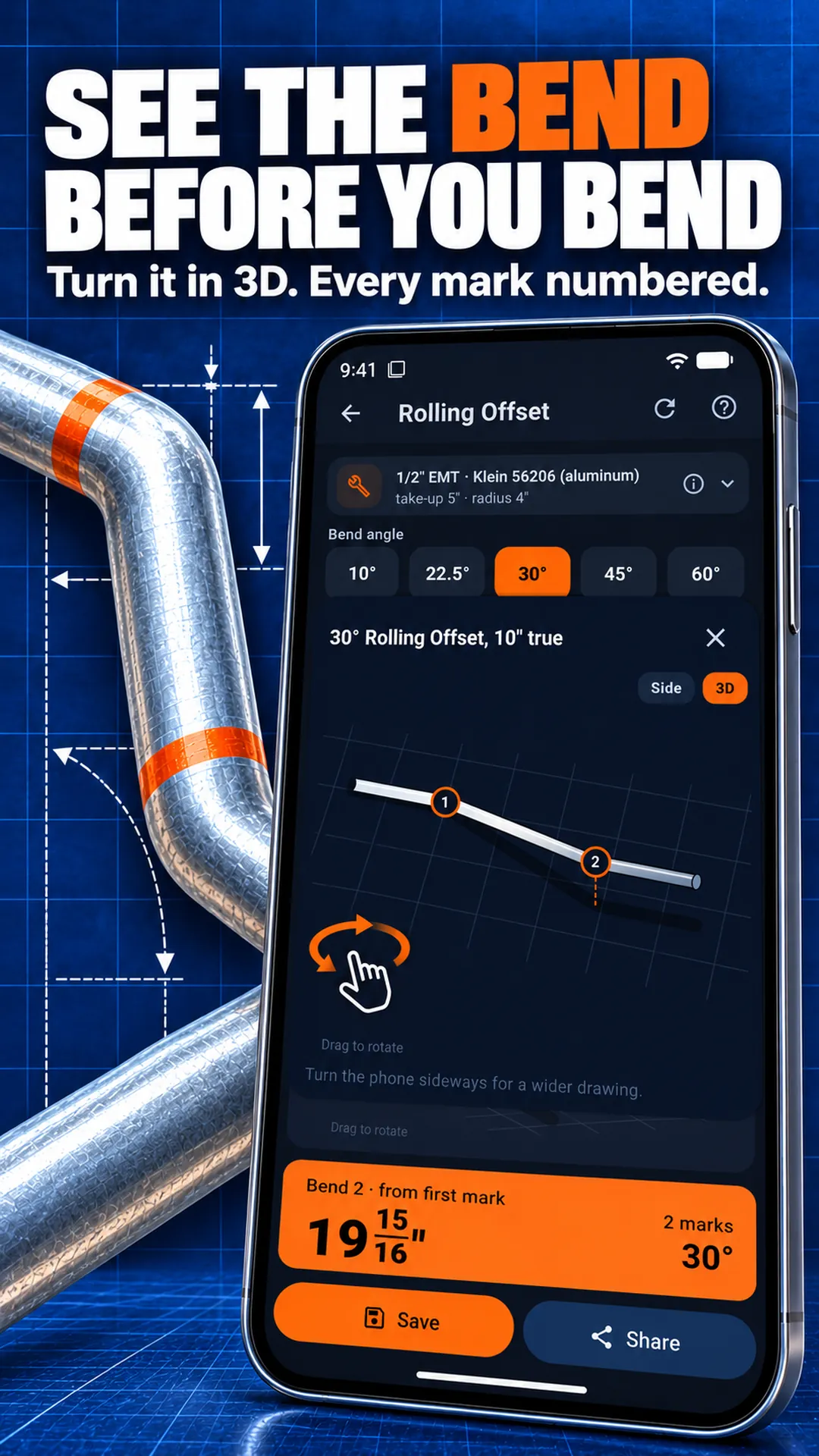
Corners, beams and compound 90s
- Marks from the end, corrected for your shoe
- Drawings that show the hook direction for each bend
- Guide mode, one bend at a time
- Saved jobs, offline
Android only. There is no iPhone version yet; the free calculators on this site work on any phone.
$7.99 one time · no subscription · no ads · works offline