By Blissom · Updated 2026-11-04
Layout values: check them against your own bender, on scrap first.

When a 45° offset is the right call
Depth drives the choice. At 30°, a 12" offset needs 24" of pipe between the bends; at 45° it needs 16-13/16". Reach for 45° when:
- the offset is deep (several inches or more) and the space along the run is short, such as dropping under a beam that sits close to a box;
- you are coming down a wall or out of a ceiling and need to clear a large obstruction in a short distance;
- the run has few other bends, so the extra degrees do not push it over the limit.
A handy property: tan 45° = 1, so the offset's advance along the run equals its depth. A 6" offset moves 6" along the wall, center of bend to center of bend.
What it costs: 360° budget and pulling
Two 45° bends add 90° to the total between pull points, the same as a 90. EMT is limited to 360° (NEC 358.24(B) in 2023; 358.26 in 2020), so 4 of these offsets fill a run on their own. A 30° offset is 60°, a third less. Check the whole run on the bends between pull points page.
Pulling tension also grows with total bend angle, and not linearly: the capstan relation used in pulling calculations multiplies tension by eμθ through each bend. Trading two 30° offsets for two 45° offsets adds 60° of bend to the pull. On long runs with big conductors that shows up at the puller.
Deep offset chart, 1" to 24"
Field values to the nearest 1/16", plus the exact shrink so you can see where the 3/8" rule drifts.
| Depth | Between bends | Shrink (3/8"/in) | Shrink (exact) | Advance |
|---|---|---|---|---|
| 1" * | 1-3/8" | 3/8" | 7/16" | 1" |
| 2" * | 2-13/16" | 3/4" | 13/16" | 2" |
| 3" | 4-3/16" | 1-1/8" | 1-1/4" | 3" |
| 4" | 5-5/8" | 1-1/2" | 1-11/16" | 4" |
| 5" | 7" | 1-7/8" | 2-1/16" | 5" |
| 6" | 8-3/8" | 2-1/4" | 2-1/2" | 6" |
| 7" | 9-13/16" | 2-5/8" | 2-7/8" | 7" |
| 8" | 11-3/16" | 3" | 3-5/16" | 8" |
| 9" | 12-5/8" | 3-3/8" | 3-3/4" | 9" |
| 10" | 14" | 3-3/4" | 4-1/8" | 10" |
| 11" | 15-3/8" | 4-1/8" | 4-9/16" | 11" |
| 12" | 16-13/16" | 4-1/2" | 5" | 12" |
| 13" | 18-3/16" | 4-7/8" | 5-3/8" | 13" |
| 14" | 19-5/8" | 5-1/4" | 5-13/16" | 14" |
| 15" | 21" | 5-5/8" | 6-3/16" | 15" |
| 16" | 22-3/8" | 6" | 6-5/8" | 16" |
| 18" | 25-3/16" | 6-3/4" | 7-7/16" | 18" |
| 20" | 28" | 7-1/2" | 8-5/16" | 20" |
| 22" | 30-13/16" | 8-1/4" | 9-1/8" | 22" |
| 24" | 33-5/8" | 9" | 9-15/16" | 24" |
* Shallower than about 2-11/16", the two 45° arcs overlap even on a 1/2" EMT shoe (4-5/8" radius). Use 30° or less.
Shrink constant: 3/8" vs 0.414"
Shrink per inch is tan(θ ÷ 2). For a 45° offset that is tan 22.5° = 0.4142. The 3/8" on the sticker is a field value, not a rounding: it is short by 0.039" for every inch of depth.
Because 45° offsets tend to be deep, that is where the drift shows. The chart above puts it at 1/2" on a 12" offset and 15/16" at 24". If the offset ends at a fitting or a box, add the exact shrink or run the depth through the shrink calculator.
Multiplier: 1.4 vs 1.414
1 ÷ sin 45° = √2 = 1.4142. With 1.4, the marks are slightly too close, and two true 45° bends deliver 99.0% of the depth: 11-7/8" for a 12" offset, 23-3/4" for 24". On a deep offset that ends at a fitting, space the marks at depth × 1.414 instead.
Shallowest 45° offset per shoe
Estimated from 2 × R × (1 − cos 45°) with the shoe's centerline radius; real shoes vary by maker:
| Shoe | Radius | Min depth at 45° |
|---|---|---|
| 1/2" EMT, Klein 51606 | 4-5/8" | 2-11/16" |
| 3/4" EMT, Klein 51607 | 5-1/2" | 3-1/4" |
| 1" EMT, Greenlee 842AH | 6-1/2" | 3-13/16" |
So a 2" offset at 45° is not a real option on any of these benders, even though the arithmetic gives marks 2-13/16" apart.
Marks for three jobs
1/2" EMT, 4" deep under a 4" flange, finished 30" from the end. Spacing 4" × 1.4 = 5-5/8"; shrink 4" × 3/8" = 1-1/2". First mark 30" + 1-1/2" − 5-5/8" = 25-7/8", second mark 31-1/2". Minimum for this shoe is about 2-11/16", so the depth is fine.
3/4" EMT, 6" deep around a 6" insulated pipe, finished 40" from the end. Spacing 6" × 1.4 = 8-3/8"; shrink 6" × 3/8" = 2-1/4". First mark 40" + 2-1/4" − 8-3/8" = 33-7/8", second mark 42-1/4". Minimum for this shoe is about 3-1/4", so the depth is fine.
1" EMT, 10" deep down past a 10" beam, finished 72" from the end. Spacing 10" × 1.4 = 14"; shrink 10" × 3/8" = 3-3/4". First mark 72" + 3-3/4" − 14" = 61-3/4", second mark 75-3/4". Minimum for this shoe is about 3-13/16", so the depth is fine.
Compared at the same 8" depth with the angles either side:
Over- and under-bending
Spacing for an 8" offset is 11-3/16". The depth that spacing produces is spacing × sin(angle):
| Bent to | Depth | vs a true 45° |
|---|---|---|
| 43° | 7-5/8" | −1/4" |
| 44° | 7-3/4" | −1/8" |
| 45° | 7-15/16" | — |
| 46° | 8-1/16" | +1/8" |
| 47° | 8-3/16" | +1/4" |
Near 45° the sine flattens out, so a degree changes the depth only a little. The bigger risk on a 45° offset is the roll: if the pipe is not turned a true 180° between bends, a deep offset swings visibly off plane. Check it on the floor before you hang it.
Sources: NEC 2023 358.24 and Chapter 9, Table 2; Klein Tools Conduit Bender Guide (stub take-up, offset multipliers and shrink, saddles). Method.
Questions electricians ask
What is the 45 degree offset multiplier?
1.4. The exact value is 1 ÷ sin 45° = 1.414, so with 1.4 the offset comes out about 1% shallow: 1/8" short on a 12" offset.
What is the shrink constant for a 45 degree bend?
3/8" per inch of offset depth on bender charts. The exact figure is tan 22.5° = 0.414", so the chart value leaves out 1/2" on a 12" offset and 15/16" on a 24" one.
What is the formula for a 45 degree offset?
Distance between bends = depth × 1.4. Shrink = depth × 3/8". Because tan 45° = 1, the offset also advances along the run by exactly its own depth.
How many 45 degree offsets can you have in one run?
Each offset is two 45° bends, 90° in all. 4 of them reach the 360° allowed between pull points with nothing else in the run.
What is the 45 degree bend multiplier for a single bend?
A single 45° bend has no offset multiplier; the 1.4 applies to the spacing between the two bends of an offset. For one bend you only need the take-up or the gain of your bender.
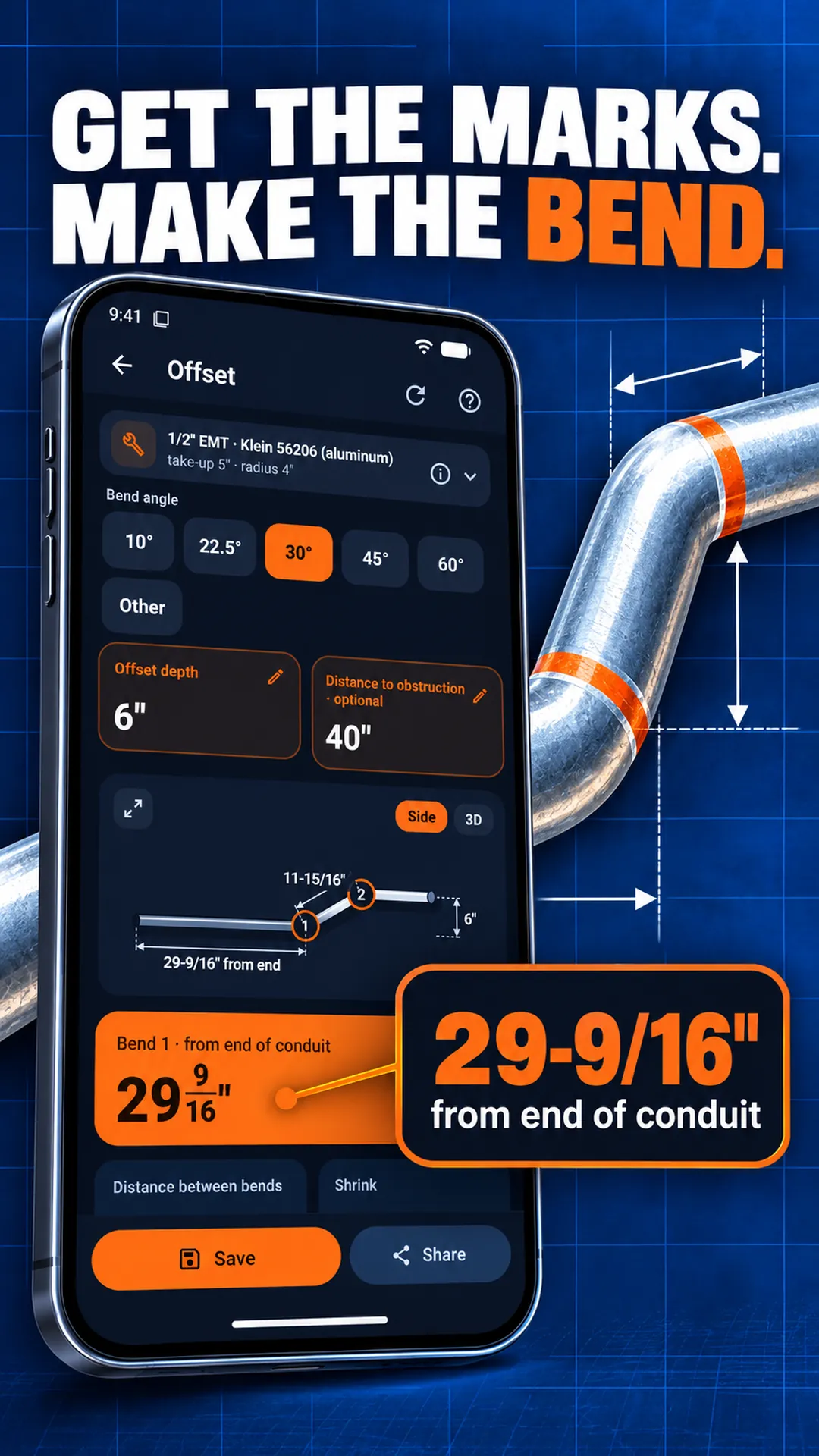
Deep 45° offsets marked from the end
- Both marks from the end of the pipe, shrink worked in
- Warns when a 45° is too shallow for the shoe you are using
- Any angle between the stickers, exact or field math
- Shoe-radius correction, offline
Android only. There is no iPhone version yet; the free calculators on this site work on any phone.
$7.99 one time · no subscription · no ads · works offline